

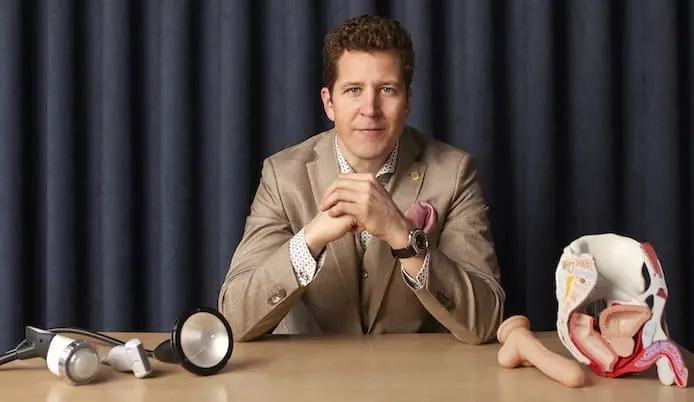
Written and medically reviewed by Michael Strøm
International speaker & expert in shockwave and EMTT treatment for erectile dysfunction, Peyronie’s & CPPS. Read more about me
Life after prostate removal: How to regain control and quality of life
Prostate removal, technically known as radical prostatectomy, is a life-saving surgery, but the price can feel high. When the cancer is gone, you’re often left with a body that reacts differently than you’ve been used to all your life. Suddenly, your erection may fail, or you may find that you can’t hold your water when you stand up or cough. It’s brutal, and it cuts directly into your sense of self and masculinity.
In my clinic in Copenhagen, I meet men every day who have undergone prostate removal. I see the frustration and grief of lost function, but I also see the hope. My main message to you is that even though the surgery is permanent, the effects don’t have to be. I know what it takes to rebuild function and with determined effort, there is a very good chance that you can regain both potency and continence.
In this article
- What happens in the body during prostate removal?
- The typical side effects: Erectile dysfunction and incontinence
- How I work with rehabilitation after surgery
- Pelvic floor training – are you doing it right?
- When to start treatment after prostate removal?
- The psychological aspect: Finding yourself again
- FAQ – Frequently asked questions about life after surgery
- Take the first step towards recovery today
What happens in the body during prostate removal?
When you have a prostate removal, the anatomy of your pelvis changes significantly. The prostate acts as a sleeve around the urethra, just below the bladder, and it has a major impact on both your urination and your ability to get an erection. During surgery, the surgeon removes the gland itself and then sews the bladder back together with the urethra.
Although today’s surgeons are extremely skilled and often use gentle robotic surgery, it is very difficult to completely avoid affecting the delicate tissue around the prostate.
The two main physical challenges after the procedure are:
1. Nerve damage: The nerves that control erection run like a fine spider web along the outside of the prostate. Even with so-called “nerve-sparing” surgeries, these nerves can be stretched or affected by the swelling (inflammation) that occurs after surgery. This often results in “sleeping nerves” (neuropraxia), where the signal from the brain simply does not reach the penis.
2. Weakened sphincter: The prostate normally helps keep the bladder closed. When it is removed, the entire responsibility falls on the external sphincter and your pelvic floor. If these muscles are not strong or coordinated enough, incontinence occurs.
The typical side effects: Erectile dysfunction and incontinence
It can be uncomfortable to talk about, but you should know that you are definitely not alone. The vast majority of men experience these symptoms to a greater or lesser degree after surgery.
Erectile dysfunction (Erectile dysfunction)
After prostate removal, the majority of men experience a loss of potency. The ability to have a spontaneous erection is often completely absent in the first few days after the procedure.
The problem typically occurs as a combination of reduced blood flow and the aforementioned “shocked” nerves. The critical issue here is inactivity. If the penis isn’t getting regular erections – including the nocturnal ones you may not notice – the tissue lacks oxygen. This can lead to the formation of scar tissue (fibrosis) inside the cavernous bodies, which makes the tissue less elastic and can cause the penis to become shorter. That’s why I focus a lot on penile rehabilitation – keeping the tissue in shape while the nerves heal.
Incontinence (Leakage)
Many people experience dribbling or not being able to hold it in during physical activity, sneezing or heavy lifting. This is called stress incontinence. For some, it’s a temporary problem that resolves itself over a few months, but for others it becomes a persistent nuisance that requires diapers or inserts. It can inhibit your social freedom and cause you to withdraw from activities you otherwise enjoy.
Pain and discomfort in the pelvis
In addition to functional losses, I also experience men who suffer from pain in the surgical area, perineum or pain radiating into the penis and scrotum. Often this is due to scar tissue formation or an overstretched pelvic floor that unconsciously “holds back” as a defense mechanism after the trauma of surgery.
How I work with rehabilitation after surgery
At MS Insight, I don’t believe in “wait and see”. My approach is proactive, scientific and structured. I work to awaken the nerves, increase blood flow and retrain the muscles so you can regain function. And the best results are achieved when treatment and rehabilitation starts within 2-4 weeks after surgery.
Every process with me starts with a thorough conversation where we talk through all the elements of the process. This gives us a concrete and factual starting point, so we don’t guess, but treat exactly where we can make the biggest difference after your surgery.
Focused shockwave: Growth factors for the tissue
A cornerstone of my treatment is focused shockwave. It is crucial to understand the difference: I only use focused sound waves that can penetrate deeply and precisely. This is not to be confused with radial pressure waves, which are often used by regular physiotherapists for muscle treatment.
The focused waves are sent precisely into both the tumor bodies and the pelvic floor towards the nerve pathways that are affected. The treatment stimulates the formation of new microscopic blood vessels (angiogenesis) and releases growth factors that promote the healing of nerve tissue. It’s essentially self-help for the body to repair the damage caused by the removal of the prostate faster.
EMTT and Neuromodulation: Awakening the nerves
To maximize the effect, I often combine shockwave with EMTT (Electromagnetic Transduction Therapy). EMTT works on a cellular level by increasing the energy in the cells and reducing inflammation. It is particularly effective if you experience pelvic pain or irritation after the procedure. It also helps calm the nervous system so the body can focus on regeneration.
In addition, I use neuromodulation to stimulate the nerve pathways directly. It’s about re-establishing the ‘connection’ between the brain and the abdomen, which has often been disrupted. Think of it as rebooting and training the signaling pathway so that the message of an erection or closing function gets through again.
Pelvic floor training – are you doing it right?
You’ve probably received a pamphlet from the hospital on how to do pelvic floor exercises. Unfortunately, in my experience, many men either forget them, do them incorrectly or give up because they don’t feel any effect.
A strong pelvic floor is your best insurance against incontinence and an important contributor to a good erection. In my clinic, we don’t guess. I use ultrasound to visualize your muscles on a screen while you squeeze. This means you can immediately see if you’re activating the right muscle fibers or if you’re going to tighten your buttocks and thighs instead. This “mind-muscle connection” makes your home workout much more effective. In addition, shockwave can wake up the “dead” areas so you regain control.
When to start treatment after prostate removal?
Time is an essential factor. The sooner we start rehabilitation, the better the chances of preserving tissue quality.
You can typically start a program with me as soon as the catheter is removed and the surgical wounds have healed satisfactorily – this is usually 4-6 weeks after surgery. However, if it’s been longer, perhaps years, the race is not over. I can still help you make improvements, but the process may require a little more patience.
I see the absolute best results when treatment is started within 2-4 weeks, as we then also have a better opportunity to stimulate the healing processes and reduce stubborn scar tissue.
Most importantly, don’t resign yourself to accepting the condition as permanent until we have fully explored your options.
The psychological aspect: Finding yourself again
Prostate removal isn’t just a physical procedure; it’s an intervention in your identity. Many men feel less “manly” when sexuality is put on hold. This affects relationships, intimacy and overall quality of life.
At MS Insight, I take care of the whole person. I take a sexological approach to my programs, which means we can also talk about how you and your partner maintain intimacy while we work on the physical. I meet you at eye level, without white coats and finger pointing. There are no taboos and I know how difficult it can be to reach out for help.
I am also happy to advise on medical support (such as Viagra or Cialis) in collaboration with your own doctor. Medication alone will not repair the tissue, but it can be a good “crutch” during a transition period to create success experiences.
FAQ – Frequently asked questions about life after surgery
Can I get my full erection back?
That is the goal and for many it is possible. The outcome depends on how gentle the surgery was (nerve sparing), your age and your sexual function before the procedure. With my combination treatment, I see significant improvements in the vast majority of patients.
Does the treatment hurt?
No, not at all. Neither focused shockwave nor EMTT is associated with pain. You will feel small tingles or pulses, but they shouldn’t hurt. I always adjust the intensity precisely to your pain threshold.
Why am I still leaking even though I do squats?
This is often because you’re squeezing incorrectly (e.g. using the large muscles in the buttocks or thighs instead of the pelvic floor) or that your pelvic floor is actually overstretched rather than weak. I’ll quickly clarify this with an ultrasound scan so you don’t waste time on ineffective training.
What if my surgery wasn’t nerve sparing?
Unfortunately, if the nerve bundles are completely severed, spontaneous erection is very difficult to fully restore. However, treatment can still improve tissue health, decrease incontinence and reduce pain. We can also discuss other aids (such as vacuum pumps or injection therapy) that can enable an active sex life despite the nerve damage.
Take the first step towards recovery today
You’ve survived cancer – now it’s about getting your life back. Prostate removal is a big change, but it doesn’t have to define the rest of your life or put an end to your quality of life.
I offer a professional, discreet and safe space in the center of Copenhagen, where we focus on your options. Using the latest technology in focused sound waves and neuromodulation, I work purposefully to rebuild what the surgery has broken down.
If you are interested in hearing more about how I can help you, you are always welcome to contact me by phone 41 40 08 58 or email michael@msinsight.dk. I’ll get back to you quickly with a customized proposal so we can find the best way forward together.
Would you like a specialist assessment of your situation?
You don’t have to figure it out alone. Call directly or write a few lines about your symptoms – I’ll get back to you within 12-24 hours with a concrete suggestion for the next step.