
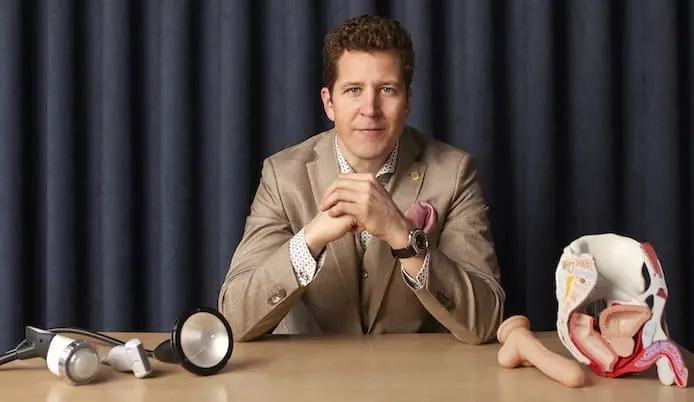
Michael Strøm
Expert in shockwave for men's health & international speaker.
In this article
- What is incontinence?
- Incontinence treatment at MS Insight
- How your first visit works
- Types of incontinence
- Causes of incontinence and risk factors
- What can you do for incontinence yourself?
- When is pelvic floor training not enough?
- Alternative treatment methods for incontinence
- Incontinence in women
- Incontinence in men
What is incontinence?
Mild incontinence can be a few drops when coughing, sneezing, lifting or exercising. Moderate incontinence can be daily leakage, frequent urges or the need for pads. Severe incontinence can cause major leaks, nighttime urination, constant planning around toileting or a significant impact on quality of life. The degree varies:
Mild incontinence: Tear leakage a few times a month
Moderate incontinence: Daily drip leakage
Severe incontinence: Major leaks at least once a week
Incontinence occurs in all age groups and affects both genders. The frequency increases with age, but it’s far from just a problem for older people. Many women in their 30s and 40s experience stress incontinence after childbirth, and men in their 50s and 60s experience incontinence after prostate surgery.
Incontinence treatment at MS Insight
At MS Insight, treating incontinence doesn’t start with a fixed package solution. It starts with a thorough assessment of what’s driving the symptoms in your particular situation.
For some, incontinence is primarily about a weakened pelvic floor and poor muscle control. For others, it’s due to overactive bladder, neurological signaling disorder, scar tissue after surgery, hormonal changes, tension in the pelvic area, reduced tissue quality or a combination of factors.
Therefore, treatment can look different from person to person. Some people primarily need guidance and targeted training. Others need help to activate the pelvic floor correctly. Some need treatment that targets the nervous system signals to the bladder. And for selected clients, shockwave and EMTT may be relevant as part of a more advanced tissue and nerve-oriented strategy.
The goal is not to use the most technology possible. The goal is to choose the right treatment based on your symptoms, your history and the findings we make in the clinic.
Focused shockwave and EMTT - rebuilding muscles, vessels and nerves
Focused shockwave and EMTT may be relevant in selected forms of incontinence where there is evidence of tissue, nerve, blood flow, scar tissue or surgery-related changes. It is particularly common in some men after prostate surgery, but may also be relevant in other cases where pelvic floor function is not just about strength.
Shockwave is used to stimulate biological processes in tissue. EMTT works with electromagnetic pulses that can affect deeper structures and especially deep-seated nerves. The combination can in some cases make sense when the goal is to support tissue quality, nerve function and the local biological response around pelvic floor and bladder control.
In men with incontinence after prostate surgery, the problem can involve sphincter muscle, nerve impingement, scar tissue and altered control around the urethra.
It’s rarely enough to think only in terms of classic knee exercises. It is important to assess whether there are also tissue or nerve components that should be included in the treatment strategy.
MS Insight offers several types of focused shockwave, such as electromagnetic, piezoelectric, electrohydraulic and EMTT. This allows you to choose the technology more precisely based on tissue type, depth, problem and treatment goals.
Treatment is always assessed individually. Shockwave and EMTT are not the right solution for all types of incontinence, but can be a strong complement when symptoms and examination point in that direction.
Incontinence treatment?
Get a free 15-minute specialist assessment.
Pelvic Chair HIFEM - 20,000 knee exercises per session
Pelvic Chair uses HIFEM technology (High-Intensity Focused Electromagnetic Energy) to induce supramaximal contractions in the pelvic floor muscles. One session is equivalent to about 20,000 Kegel exercises - contractions you can’t physically achieve with voluntary exercise. This is exactly what is needed to rebuild missing muscle tissue.
You sit fully clothed on the chair for 30 minutes. The treatment is painless and requires no preparation. Pelvic Chair is combined with shockwave and EMTT for a synergistic treatment that addresses the muscles, vessels and nerve tissue simultaneously. This triple combination is unique in Denmark.
Read more about Pelvic Chair treatment hereNESA X neuromodulation - for overactive bladder and neurological incontinence
Overactive bladder is often caused by imbalances in the autonomic nervous system. It disrupts communication between the brain and the bladder and leads to involuntary contractions, urgency and incontinence. NESA X sends precise electrical signals into the nervous system that normalize the signal patterns and restore bladder control.
Research published at the International Continence Society (ICS) Congress has shown that signaling disturbances in the autonomic nervous system predict overactive bladder - and that stimulation of the nervous system is a crucial part of treatment. A course of NESA X is basically 10 treatments over 4 weeks.
Ultrasound and InBody770 - accurate assessment from day one
The first consultation is about getting an accurate picture of your situation. When appropriate, ultrasound scans are used to assess the bladder, pelvic floor, bladder emptying and relevant structures in the area.
Ultrasound can provide important information about how the pelvic floor is activated, whether the bladder is emptying appropriately and whether there are issues that should be included in the treatment plan. It can also be used to target treatment more precisely if shockwave or other technology is deemed appropriate.
InBody770 can be used to assess body composition, muscle mass, body fat percentage and health-related factors that can affect pelvic floor, bladder control and treatment response. Being overweight, low muscle mass, inflammation, low physical capacity or general metabolic stress may play a role for some.
The aim is not to make the process more complicated, but to create a better basis for choosing the right treatment from the start.
How your first visit works
Your first visit starts with a thorough assessment of your situation so that treatment can be tailored to your symptoms, your body and your goals.
1 Conversation and clarification of symptoms
We review your incontinence, lifestyle, medication and other factors that may affect bladder control. At the same time, we clarify whether it is stress, urge, neurological or overflow incontinence.
2 Ultrasound scan and body analysis
You will receive an ultrasound scan of the pelvic floor and bladder to assess muscle control and bladder emptying ability. The InBody770 is used to measure body composition and identify factors that may affect treatment response.
3 Guidance and realistic treatment plan
You will receive guidance on correct pelvic floor training adapted to your situation. At the same time, expectations are set for what improvement is realistic and what an individual treatment plan might look like.
4 First treatment on the same day
If the treatment is relevant to you, the first treatment with shockwave and EMTT can be performed on the same day. The treatment is personal and discreet, and you always meet Michael in person at the clinic.
Incontinence treatment?
Get a free 15-minute specialist assessment.
Types of incontinence
Stress incontinence
Imagine laughing at a funny joke, sneezing unexpectedly or lifting a shopping bag - and suddenly you experience a small leak. That’s stress incontinence. It happens when the pelvic floor muscles and sphincter muscles in the urethra are weakened. When there is sudden pressure from activities like coughing, laughing or exercise, these weakened muscles cannot hold back urine. Stress incontinence is the most common type in women and the most common type in men after prostate surgery.
Urge incontinence (urge incontinence / overactive bladder)
Have you ever felt a sudden, overwhelming urge to go to the bathroom - and found you couldn’t make it in time? That’s urge incontinence, also known as urge incontinence or overactive bladder. Your bladder sends an urgent message to "go now!" even when it’s not full. It’s caused by involuntary contractions of the bladder muscle, typically disrupted by neurological signals or irritation of the bladder wall. It’s the nervous system - not just the muscles - that needs to be balanced. I’ve tried this myself, so I know exactly how to treat it
Neurological/neurogenic incontinence
The brain, spinal cord and nervous system work together to control the bladder. If a disruption occurs - in spinal cord injury, multiple sclerosis, Parkinson’s disease or other nerve disorders - it can lead to neurogenic incontinence. It can manifest as unexpected leaks or an inability to empty the bladder completely.
Overflow incontinence
The bladder never really empties. The residual builds up and eventually overflows as frequent, small drips. It is most commonly associated with benign prostatic hyperplasia (BPH) in men where the prostate obstructs the urethra.
Causes of incontinence and risk factors
Pregnancy and childbirth
Vaginal birth is the most common cause of stress incontinence in women. The passage of the baby can weaken the pelvic floor muscles and damage the connective tissue that supports the urethra and bladder.
Menopause and estrogen deficiency
The decrease in estrogen production after menopause reduces the elasticity and thickness of the mucous membranes in the vagina and urethra. This significantly increases the risk of both stress and urge incontinence.
Prostate surgery
Up to 40% of men experience incontinence in the first year after prostatectomy. The surgery can damage both the sphincter muscle tissue and the surrounding nerves and blood vessels - two separate injuries that require two separate treatment approaches.
Here it is important to assess whether the problem is primarily about muscle control, sphincter function, scar tissue, nerve impingement or combinations. Treatment can therefore include targeted pelvic floor training, Pelvic Chair, ultrasound feedback and in selected cases shockwave and EMTT.
Age, obesity and lifestyle
Age can affect muscle strength, connective tissue, hormone balance, nerve function and bladder control. Being overweight can increase pressure on the pelvic floor and bladder, which can exacerbate stress incontinence in particular.
Caffeine, alcohol, smoking, low physical activity, constipation and poor sleep can also affect symptoms. This doesn’t mean that incontinence is just a lifestyle issue, but lifestyle can be an important part of the overall picture.
At MS Insight, these factors are assessed without blame or morality. The goal is to find the adjustments that can realistically help treatment progress.
Neurological diseases
Neurological diseases such as multiple sclerosis, Parkinson’s disease, stroke, spinal cord involvement and other nerve disorders can disrupt communication between the brain, spinal cord, bladder and pelvic floor.
This can lead to urgency, leakage, poor emptying, frequent urination or lack of bladder sensation. It’s important to distinguish whether the problem is overactive bladder, reduced bladder power, nerve involvement or coordination.
What can you do for incontinence yourself?
Pelvic floor training and pelvic floor exercises
Find the pelvic floor muscles by imagining you are stopping the flow of urine - but never do the exercise while actually urinating. Contract the muscles, hold for 6-8 seconds, relax and repeat 10-15 times, three to four times a week for at least three to four months. See also our guides to pelvic floor exercises for women and pelvic floor exercises for men, as the exercise requires proper muscle activation to work.
Bladder training
For 2-3 days, write down when you urinate, how much you drink and when leakage occurs. Bladder training involves gradually increasing the interval between toilet visits - from one hour to one and a half to two hours, for example - to re-train the bladder to store more. Aim to go to the toilet 5-7 times a day, not at the slightest sensation of urgency.
Lifestyle changes
Drink 1.5-2 liters of fluid daily - no more, no less. Reduce caffeine and alcohol, which irritate the bladder wall. Weight loss in overweight people significantly reduces the strain on the pelvic floor. Avoid constipation and stop smoking.
When is pelvic floor training not enough?
Kegel exercises are the right first step. But there are situations where self-training isn’t enough - and it’s important to know them:
- You’ve been training correctly for three months without noticeable progress. Lack of progress is most often a sign of incorrect muscle activation, not lack of effort.
- You are unsure if you are activating the right muscles. Many people squeeze their stomach or buttocks without realizing it - and make the symptoms worse.
- You have incontinence after prostate surgery or other abdominal surgery. Here, muscle tissue and vascular/nerve tissue are injured - two separate injuries that exercises cannot address both.
- The pelvic floor muscles are atrophic. In men over 65 or women with long-term pelvic floor dysfunction, muscle fibers may be too weakened to respond to voluntary exercise.
In these cases, treatment is the clinically correct path.
Alternative treatment methods for incontinence
Local estrogen therapy
For post-menopausal women, local estrogen therapy, such as Vagifem or Estring, is often the first choice. Estrogen restores the thickness and elasticity of the mucous membranes in the vagina and urethra and can reduce both stress and urge incontinence. The treatment is local and has minimal systemic effect.
Medical treatment
Anticholinergics, such as Detrusitol, Vesicare and Emselex, and mirabegron suppress an overactive bladder muscle and are primarily used for urge incontinence. Duloxetine, for example Yentreve, improves sphincter contraction and is used for stress incontinence. Alpha-blockers and 5-alpha-reductase inhibitors are used for BPH-related incontinence in men. Medication addresses symptoms - not the underlying muscle and tissue condition.
Surgical treatment
Tension-free vaginal tape (TVT) and sling surgery are well-established procedures for stress incontinence that does not respond to conservative treatment. Botulinum toxin, also known as Botox, injected into the bladder wall is effective for urge incontinence and is typically repeated every six months to a year. Artificial sphincter and sacral nerve modulation are used in selected cases. All surgical solutions require hospitalization and recovery period.
Technology assisted treatment at MS Insight
At MS Insight, technology-assisted treatment is offered when deemed appropriate based on symptoms and findings. This may include Pelvic Chair HIFEM, NESA X neuromodulation, focused shockwave and EMTT.
Pelvic Chair may be relevant for decreased pelvic floor strength and poor muscle activation. NESA X may be relevant for overactive bladder, urgency symptoms or signs of autonomic/nervous imbalance. Shockwave and EMTT may be relevant in selected cases where tissues, nerves, blood flow or scar tissue are considered to play a role.
What matters is not the technology itself, but whether it fits the cause behind your symptoms.
Incontinence in women
Female incontinence can occur after pregnancy and childbirth, menopause, surgery, overactive bladder or as a result of altered pelvic floor function.
Some women experience leakage when coughing, laughing, lifting or exercising. Others experience sudden urges and frequent trips to the toilet. Many have a mixture of both.
MS Insight assesses whether the problem is primarily related to weakness, coordination, tension, tissue quality, bladder regulation or nerve function. Treatment can then be combined with counseling, pelvic floor training, Pelvic Chair, NESA X or other relevant treatment.
Incontinence in men
Male incontinence is often seen after prostate surgery, prostate-related problems, overactive bladder, neurological effects or altered pelvic floor function.
After prostate surgery, the problem may be related to sphincter mechanism, muscle control, scar tissue, nerve impingement or a combination. Therefore, treatment should not just be about standard exercises, but a precise assessment of what is actually limiting control.
At MS Insight, the program can be adapted to men where incontinence is related to prostate history, pelvic floor, nerve function, sexual function or pelvic pain.
Get a no-obligation consultation about incontinence treatment today
Er du interesseret i at høre mere om, hvordan vi kan hjælpe dig, er du altid velkommen til at kontakte os på telefon: 41 40 08 58 eller mail: michael@msinsight.dk. Otherwise, fill out the contact form with your details and a brief description of your problem. I'll get back to you quickly with a customized solution proposal so we can find the best way forward together.