
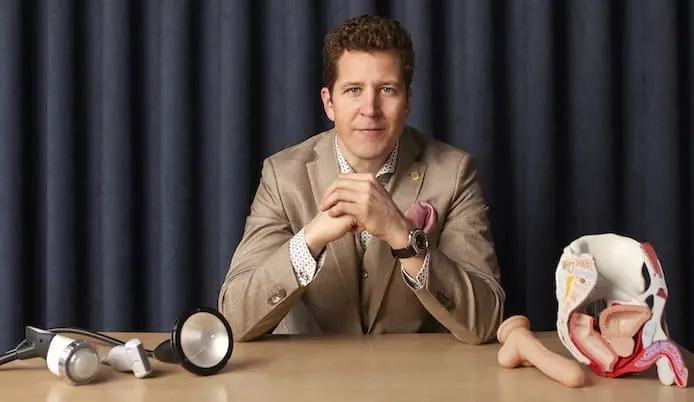
Michael Strøm
International speaker and expert in shockwave and EMTT treatments for men's sexual health.
In this article
- Is it normal to have a crooked penis?
- Why is my penis crooked?
- How do I know if my curved penis is caused by Peyronie’s disease?
- When should a curved penis be examined?
- How is a curved penis examined at MS Insight?
- Can crooked penis be treated without surgery?
- Focused shockwave therapy for penile curvature caused by Peyronie’s disease
- Can EMTT be used to treat a curved penis?
- What about traction and vacuum therapy?
- When should surgery for a curved penis be considered?
- Which treatment is right for your curved penis?
- Why choose MS Insight for the evaluation of a curved penis?
Is it normal to have a crooked penis?
Yes. It’s quite common for the penis not to be perfectly straight during an erection.
Some men have a penis that curves slightly upward, downward, or to one side. Others have a more pronounced curve that has been there since they began having erections during puberty.
A mild, stable curvature usually does not require treatment if it does not cause pain or problems during sex.
The most important thing is not whether your penis is completely straight, but whether the curvature has changed or is affecting your function.
There may be a reason to have the misalignment evaluated if:
- Your penis used to be straighter.
- The curvature becomes more pronounced.
- You experience pain during an erection.
- You feel a hard lump or a firm area.
- The penis has developed a notch or an hourglass shape.
- Your erection has become less stable.
- The misalignment makes sexual intercourse difficult or painful.
If your penis has always been curved and functions normally, treatment is often unnecessary.
If, on the other hand, a change has occurred, the cause should be investigated.
Why is my penis crooked?
There are several causes of a curved penis. The main distinction is between a curvature that has been present since adolescence and one that develops later in life.
1. Naturally or congenitally curved penis
A congenital curvature is caused by differences in the development of the tissue in the penis. When the penis becomes erect, it may therefore curve in a certain direction.
The curvature typically becomes apparent during puberty and generally does not change significantly throughout adulthood.
A congenital penile curvature is often characterized by:
- That the curvature has been there for as long as you can remember.
- That it is relatively stable.
- That there are usually no hard plaques or scar tissue.
- That the erection otherwise functions normally.
- That there isn’t necessarily any pain.
If the curvature doesn’t interfere with your sex life, there’s usually no reason to do anything about it.
In cases of pronounced congenital curvature, a urologist can determine whether surgical correction is appropriate.
Learn more about Krummerik and treatment options.
2. A curved penis that developed later in life
If your penis used to be straight or only slightly curved but has gradually changed shape, this may be due to an acquired tissue change.
One major cause is Peyronie’s disease.
In Peyronie’s disease, an area of thickened connective tissue—also known as a plaque—develops in the connective tissue membrane surrounding the erectile tissues.
The affected area is less elastic than the surrounding tissue. During an erection, the penis may therefore bend toward the less elastic area.
The curvature may be accompanied by pain, shortening, indentations, or erectile dysfunction.
Peyronie’s disease can develop over time and typically has both an active phase, during which symptoms may change, and a later stable phase.
Learn more about Peyronie’s disease and its treatment.
3. A Curved Penis After an Injury
In some cases, an injury to the penis can lead to tissue changes and subsequent curvature.
If you have noticed a gradual change following a previous injury, you should have it evaluated by a doctor.
If your penis suddenly bends sharply during an erection and you experience a snapping sensation, severe pain, rapid swelling, or bruising, seek emergency medical attention. These may be signs of a serious injury that requires immediate treatment.
How do I know if my curved penis is caused by Peyronie’s disease?
Peyronie’s disease is a possible explanation for a new or worsening curvature, but you cannot make a diagnosis based solely on the appearance of the penis.
Typical signs can be:
New or increasing curvature
The penis begins to bend more than before. This change may develop over a period of months and may be most noticeable during an erection.
Pain during erection
Some men experience tenderness or pain, especially while the disease is active.
The pain may subside over time, even though the curvature remains.
A hard lump or plaque on the penis
A thickened area can sometimes feel like a hard lump, a cord, or a flatter change under the skin.
However, not everyone with Peyronie’s disease can feel a distinct plaque themselves.
Notch, hourglass shape, or abbreviation
In some men, the penis changes shape in ways other than the usual curvature.
For example, it may become narrower in a certain spot or develop a notch. Some men also find that their penis feels shorter than before.
Erection problem
Peyronie’s disease may occur alongside erectile dysfunction.
This can make it more difficult to achieve or maintain an erection that is sufficient for sexual intercourse.
If you recognize several of these symptoms, the next step is to find out what is causing these changes.
Learn more about the diagnosis and treatment of Peyronie’s disease at MS Insight.
When should a curved penis be examined?
You don’t need to seek treatment just because your penis is slightly crooked.
However, if the misalignment has changed, is causing pain, or is affecting your sexual function, it makes sense to have it evaluated.
This is especially true if you’re unsure whether the curvature is congenital or caused by Peyronie’s disease.
Newly developed curvature, unexplained significant changes, and worsening symptoms should be evaluated by a doctor or urologist.
At MS Insight, you can schedule an initial consultation to discuss your symptoms and options for further testing.
When Asymmetry Affects Your Sex Life
A curved penis can also be distressing, even if the curvature isn’t very pronounced.
Some men feel insecure about their appearance. Others worry about whether intercourse will be painful, whether they’ll be able to maintain an erection, or whether their partner will notice the change.
These are valid concerns worth discussing.
An evaluation should therefore not focus solely on the angle of the curvature, but also on pain, erectile function, sexual well-being, and your own wishes.
How is a curved penis examined at MS Insight?
The first step is to understand why the penis is curved and what tissue-related factors may be involved.
At MS Insight, Michael Strøm works according to the principle of diagnosis and tissue understanding before selecting technology.
This means that the treatment strategy is not automatically based on a single specific machine or a single standard protocol.
1. Discussion about the misalignment and your symptoms
Let’s start by talking about when you first noticed the curvature.
Among other things, it is important to know:
- Has the penis always been crooked?
- Did the misalignment occur later?
- Has the curvature changed?
- Are you experiencing pain?
- Have you noticed a hard spot?
- Has your erection changed?
- Does the misalignment affect your sex life or your quality of life?
This information helps determine whether the condition might be congenital curvature, Peyronie’s disease, or another issue.
2. Assessment of Curvature and Function
A curvature isn’t always noticeable when the penis is flaccid.
Therefore, it may be helpful to document the shape during an erection.
In some cases, photos taken at home can help assess the direction of the curvature, any indentations, and changes in shape.
It is also important to assess erectile function, as a curved penis and erectile dysfunction may well occur simultaneously.
3. Ultrasound examination if relevant symptoms are present
If Peyronie’s disease, plaque, or calcifications are suspected, an ultrasound scan can provide additional information.
Among other things, ultrasound can help identify tissue changes that may not be apparent during a routine examination.
At MS Insight, ultrasound imaging is used in relevant cases to aid in the evaluation of tissue.
Ultrasound is also part of MS Insight’s technological approach, because treatment choices should be based on an understanding of the structures one wishes to target.
However, the scan alone cannot determine which treatment will be effective, and a medical evaluation may still be necessary.
4. An Individualized Treatment Strategy
Once there is a clearer understanding of the cause, symptoms, and any tissue changes, relevant treatment options can be discussed.
It may be that treatment is not necessary.
It may also be that conservative treatment options, targeted symptom relief, or further urological evaluation are appropriate.
At MS Insight, the starting point is not to adapt the patient to a specific machine, but to understand the problem before selecting the technology.
Can crooked penis be treated without surgery?
Yes, there are non-surgical treatment options for certain causes of penile curvature. However, the options depend on whether the curvature is congenital or acquired, what symptoms are present, and what the goal of treatment is.
A congenital curvature that causes no symptoms typically requires no treatment.
If the curvature is caused by Peyronie’s disease, the situation is more complex. In this case, pain, plaque, changes in elasticity, curvature, and erectile function can all play different roles.
Conservative treatment may include, for example, pain relief, traction, vacuum therapy, or other options determined on a case-by-case basis.
At MS Insight, we specialize in focused shockwave therapy, which is an evidence-based technological treatment platform with a growing body of research across several medical fields.
However, it is important to understand that shockwave therapy is not a single, uniform treatment.
The results depend, among other things, on the patient group, technology, energy level, treatment area, and protocol.
For Peyronie’s disease, the strongest controlled evidence relates to pain relief. Recent research has also shown interesting results regarding curvature, although there is still a need for larger and better-controlled studies.
Therefore, expectations should always be adapted to the specific situation.
Focused shockwave therapy for penile curvature caused by Peyronie’s disease
If a curved penis is caused by Peyronie’s disease, the affected tissue may be characterized by plaque, altered elasticity, pain, and impaired function.
Shockwave therapy has been studied for several years as a non-surgical treatment option for Peyronie’s disease.
Research shows that the treatment can be effective in relieving pain. In addition, recent clinical findings call for further research into its potential effects on spinal curvature.
However, it is necessary to distinguish between these different treatment goals.
What does the research show about shockwave therapy and Peyronie’s disease?
Overall, existing controlled studies have shown positive results for pain relief, while the effect on plaque and curvature has been less clear.
The European Association of Urology (EAU) therefore currently recommends shockwave therapy for the treatment of penile pain during the active phase of Peyronie’s disease, but not as an established method for correcting the curvature itself.
Learn more about shockwave technologies and the scientific evidence.
Diagnosis Before Technology
A curved penis can be caused by a wide variety of factors.
In cases of congenital curvature, the tissue is not necessarily affected by plaque or scar tissue.
In the case of Peyronie’s disease, however, there may be tissue changes, pain, and other symptoms that require a different evaluation.
Therefore, it does not make sense to use the same treatment protocol simply because the penis is crooked.
At MS Insight, the following are among the factors evaluated:
- If Peyronie’s disease is suspected.
- Whether the disease appears to be active or stable.
- Whether there is pain or plaque.
- Whether ultrasound can aid in the assessment.
- Whether the erection is affected.
- What treatment goal is realistic?
- Whether Shockwave is relevant at all.
Sometimes the right next step isn’t shockwave therapy, but observation, a urological examination, or another treatment option.
It is an essential part of the individualized approach.
Can EMTT be used to treat a curved penis?
MS Insight also works with EMTT – Magnetolith.
EMTT uses electromagnetic pulses and is part of the clinic’s overall technological capabilities.
For certain tissue-related conditions, EMTT may be considered as a supplement to other treatments.
However, the scientific evidence for EMTT specifically as a treatment to reduce curvature in Peyronie’s disease remains limited.
This method should therefore not be confused with an established treatment for penile straightening.
If EMTT is included in an individual plan, it must be done with a clear understanding of the treatment goal and the available evidence.
What about traction and vacuum therapy?
In cases of Peyronie’s disease, traction and vacuum therapy may, in some cases, be part of a conservative treatment regimen.
Penile traction applies a controlled stretching force over time, while vacuum therapy uses negative pressure around the penis.
There are studies suggesting that these methods may improve curvature or penis length in some men.
However, the results vary, and the evidence has limitations.
It is important to use the equipment correctly and in accordance with the relevant instructions.
You should not try to forcefully press or bend the penis, as this can cause injury.
When should surgery for a curved penis be considered?
Surgery may be appropriate when the curvature is significant, stable, and makes sexual intercourse difficult or impossible.
This applies both to pronounced congenital curvature and to Peyronie’s disease, where the deformity has stabilized.
Among other things, a urologist evaluates:
- How pronounced the curvature is.
- Whether there are any nicks or other changes in shape.
- Whether erectile function is adequate.
- Whether the disease is stable.
- What expectations the patient has.
- Which surgical method may be appropriate.
Depending on the situation, the procedure may involve plication, surgery with a graft, or, in special cases, the insertion of a penile prosthesis.
Surgery can improve the curvature, but there are also risks, including changes in length, sensation, or erectile function, among others.
That is why it is important to be familiar with both conservative and surgical options before making a decision.
Learn more about treatment and surgery for crumb-like lesions.
Which treatment is right for your curved penis?
It depends first and foremost on what is causing the misalignment and what kind of help you need.
If you are experiencing pain associated with active Peyronie’s disease, your treatment needs are different from those of a man who has had a stable, congenital curvature for many years.
If you want to correct a significant curvature, it is important to distinguish between treatments with proven effectiveness in correcting the curvature and treatments for which research is still ongoing.
At MS Insight, we base our work on five key questions:
- The reason: Is the asymmetry congenital, or could it be due to an acquired tissue change?
- Symptoms: Is it pain, curvature, erectile dysfunction, or other issues that are the most bothersome?
- Tissue: Is there any suspicion of plaque, calcification, or altered elasticity?
- Technology: Which treatment options have a scientific basis in this specific situation?
- Expectations: What can we realistically aim to achieve, and what remains uncertain?
It’s about finding the most appropriate strategy—not about choosing a specific treatment in advance.
Why choose MS Insight for the evaluation of a curved penis?
MS Insight is a specialized private clinic in Copenhagen that focuses on, among other things, men’s sexual health, erectile dysfunction, and Peyronie’s disease-related symptoms.
The clinic’s approach is based on a combination of clinical experience, technological expertise, and a research-based understanding of shockwave therapy.
More technologies—more opportunities for personalization
Michael Strøm works with various types of focused shockwave therapy rather than a single standard technology.
This makes it possible to select the generator type, applicator, and treatment parameters based on the specific problem at hand.
Experience and International Teaching
Michael has been working extensively with shockwave therapy since 2016 and has been training practitioners internationally since 2020.
His work encompasses both the clinical application of the technology and teaching its various principles.
Ultrasound as Part of the Clinical Evaluation
When appropriate, ultrasound can help in understanding tissue conditions and any changes.
This is particularly relevant if plaque or calcifications are suspected.
Realistic Expectations
Shockwave is a scientifically validated treatment platform used in several medical fields.
However, the effect is not the same across diagnoses and treatment protocols.
At MS Insight, we therefore place an emphasis on distinguishing between established evidence, recent research findings, and areas where the evidence is still limited.
Discreet and Personal Contact
A curved penis and sexual problems can be difficult to talk about.
At MS Insight, you’ll meet with Michael directly and have the opportunity to discuss your symptoms in a confidential setting.
You don’t need to know the diagnosis or the medical explanation in advance.
The most important thing is to figure out what might be causing the problem and what you can do about it, if anything.
Get a confidential evaluation of a curved penis at MS Insight
Has your penis become more curved, are you experiencing pain, or have you noticed a change in the tissue?
You don’t need to be able to determine on your own whether it’s Peyronie’s disease, a congenital curvature, or something else.
At MS Insight, you can take the first step with a confidential consultation about your symptoms and treatment options.
You’ll meet Michael Strøm, who has many years of experience with advanced shockwave therapy and men’s sexual health.
With access to several targeted shockwave technologies, relevant ultrasound, and a personalized approach, MS Insight works to select a treatment based on the specific issue rather than fitting the patient into a single standard protocol.