
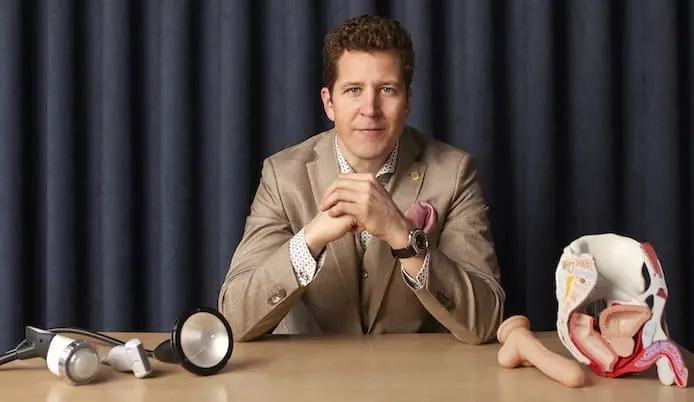
Michael Strøm
Expert in shockwave for men's health & international speaker.
Focused shockwave therapy at MS Insight
There are several types of shockwave and they don’t work the same way.
Focused shockwave can penetrate deep into the tissue and precisely target specific structures. This makes it particularly relevant when working on areas such as tumor bodies, nerves or deeper tissue.
Radial pressure waves work more superficially and cover a wider area. They are often used as a supplement when working with tissues around the pelvis or support functions.
In addition, there are three different types of shockwave devices—or methods of generating focused shockwaves—: electromagnetic (Storz Medical), electrohydraulic (MTS Medical), and piezoelectric (Elvation Piezowave). They differ in how the energy is generated and distributed, which affects depth, precision, and the biological effect on tissue. I have all three in my clinic.
In practice, this means that the choice of technology and the way it is used is not random; it is a central part of the treatment.
Why This Approach to Shockwave Therapy Makes a Real Difference
Most clinics use a single type of shockwave therapy and apply it to all conditions. This naturally limits how precisely the treatment can be tailored. At MS Insight, the approach is different.
With access to the full range of shockwave devices, it is possible to select the method best suited to the specific tissue and the particular condition. The treatment can be adjusted as it progresses, and different biological mechanisms can be activated at various stages of the process.
When shockwave therapy is combined with EMTT, the possibilities are further expanded. This approach not only targets the tissue locally but also influences cellular activity and the overall biological response. This is also where the treatment differs from simpler approaches.
Focused shockwave may also be relevant for Peyronie’s disease and erectile dysfunction, where treatment targets blood flow, pain, tissue response, plaque-related discomfort and function. Read more about shockwave in Peyronie’s disease.
What you as a client actually get out of it
In practice, this approach means that treatment can:
- Adapts precisely to the cause - not just the symptom
- Work in both deep and shallow structures
- Adjusts continuously based on your response
- Combine multiple technologies for increased power
This is where the difference is typically seen in the results.
A typical shockwave course - how it develops
Many people who start a program have already tried other solutions without the desired effect.
The first step is to understand what’s behind the problem. In some cases it is primarily related to blood flow, in others to nerves, the spine or muscle tension. Then the treatment is customized.
Initially, it’s about activating tissues and cells to create a response. For some it is felt quickly, for others it takes a little longer. Along the way, the treatment is adjusted so that the effect not only occurs, but also stabilizes.
What matters is not just improvement, but that the body starts to function differently over time.
Diagnostics - why we don’t just start treatment
One of the most common mistakes is starting treatment without understanding the cause.
At MS Insight, the first consultation is all about clarity. It assesses what is causing the problem and whether shockwave is even the right solution. Ultrasound scanning is an important part of this
This makes the process more precise - and often more efficient.
Documented shockwave treatment - also recognized in EAU Guidelines
Shockwave therapy is a well-documented method used to improve blood flow, stimulate tissue and support the body’s own healing processes. The treatment is now also included in the EAU Guidelines for sexual health as a relevant treatment option for, among other things, erectile dysfunction.
There are thousands of studies supporting its efficacy and the technology is increasingly being used internationally as an alternative to more invasive solutions.
However, the effect depends on how the technology is used. There are several types of shockwave with different properties, and it is the choice of the right technology that determines the outcome. The clinic works with all types of focused shockwave as well as radiating shockwaves, so the treatment can be customized to your exact situation.
The different types of shockwave - and why it makes a difference to the outcome
When talking about shockwave therapy, it is often presented as a single method. In practice, it covers several different technologies that work fundamentally differently in the body, both in terms of precision, energy and biological effect.
It’s these differences that largely determine whether the treatment just feels active or actually creates a measurable improvement.
Electrohydraulic focused shockwave
It is the most powerful and biologically stimulating technology. It is generated via an electrical discharge in fluid, creating a highly energized shockwave. This type of shockwave can penetrate deep into the tissue and affect larger areas simultaneously, making it particularly relevant for more complex or long-term issues. It is often used when there is a need to stimulate blood vessels, tissue regeneration and the overall biological response in an area where function is significantly affected. This is also where we see the best effect on erectile dysfunction of the 3 technologies.
Piezoelectric focused shockwave
Piezo technology represents the opposite end of the spectrum - with extreme precision and control. Here, the energy is generated via crystals, which makes it possible to focus the pressure waves very precisely in a specific point. This makes the technology particularly suitable for treatment in sensitive and complex areas such as the penis, pelvic floor and abdomen, where precision is crucial. The combination of high precision and controlled energy delivery makes it possible to target structures where even small adjustments can have a big impact on function.
Electromagnetically focused shockwave
The technology acts as a stable and flexible complement between the two. The technology is known for its consistent energy delivery and ability to adjust both depth and intensity. It is often used where there is a need for a more controlled and reproducible impact on the tissue, for example in blood flow treatment and general tissue stimulation.
Radial shockwave (radial shockwave)
It differs from the focused technologies by primarily working more superficially. It is mechanically generated and delivers the energy widely in the tissue closer to the skin surface. It is often used as a supplement, especially when working on musculature and connective tissue around the pelvis, but does not have the same depth or biological effect as focused shockwave and therefore cannot be directly compared.
Conclusion on shockwave
What matters is not each technology in isolation - but how they are used and combined. By having access to all types, it becomes possible to work both broad and precise, deep and controlled, depending on what the problem requires.
It is precisely this approach that makes it possible to customize the treatment to the individual - and create an effect that cannot be achieved with one standardized method.
Get a no-obligation conversation today
If you are interested in hearing more about how we can help you, you are always welcome to contact us by phone: 41 40 08 58 or email: michael@msinsight.dk. Otherwise, you can fill out the contact form with your details and a brief description of your problem. I'll get back to you quickly with a customized proposal for a solution so we can find the best way forward together.