

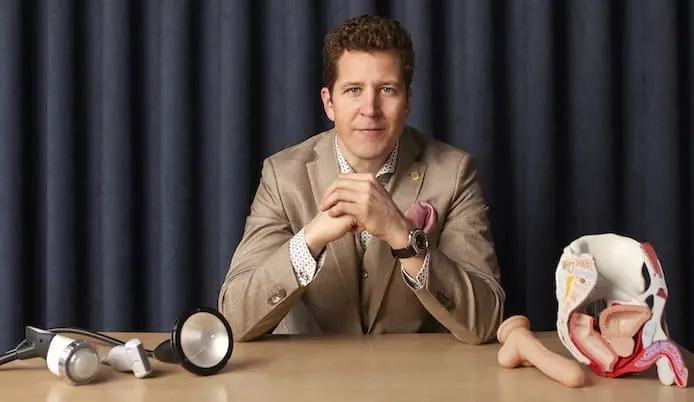
Written and medically reviewed by Michael Strøm
International speaker & expert in shockwave and EMTT treatment for erectile dysfunction, Peyronie’s & CPPS. Read more about me
Pelvic floor exercises for incontinence: get control over your pelvic floor – without taboos
Urine leakage, dribbling or urgency can affect ordinary men – even if you’re struggling with erectile dysfunction, pelvic painor concerns about your intimate health. I see it every week in the clinic. The good news is that targeted knee exercises for incontinence (pelvic floor exercises) often make a significant difference. The key is to do it right, at the right time and at the right pace – and to get help when in doubt. Here’s a comprehensive guide that explains why the exercises work, exactly how to do them and when it makes sense to supplement with other treatments. You’re not alone, and you can learn how to take back control.
In this article
- What is male incontinence – and why does it occur?
- Why squats work – the anatomy in a nutshell
- Do it right: how to do knee exercises for incontinence
- Typical mistakes I help men avoid
- When squats aren’t enough – evidence-based solutions I offer
- How soon can you expect results from pelvic floor exercises for incontinence?
- Mini-program: three levels of pelvic floor exercises for incontinence
- Frequently asked questions about knee exercises for incontinence
- How I help you – safe, discreet and targeted
- Ready to take the first step with knee exercises for incontinence?
What is male incontinence – and why does it occur?
Incontinence is involuntary urine leakage. In men, I typically see it:
- Stress incontinence: small leaks when coughing, sneezing, lifting, running. Often after prostate surgery or weak pelvic floor.
- Urge/overactive bladder: sudden, strong urge to urinate with or without leakage. May be related to bladder irritation, stress, caffeine etc.
- Mixed incontinence: a combination of both of the above.
- After-drip: drops in underpants after urination because urine remains in the urethra.
- Climacturia: urine leakage during orgasm, typically after prostate surgery.
- Incontinence after cancer or prostate surgery that has caused damage to the nervous system or structural changes to the pelvic floor.
Whatever the type, the pelvic floor plays a key role. The pelvic floor is a network of muscles and connective tissue that supports the bladder and bowels and controls the sphincter around the urethra. When the muscles are weak, recruited incorrectly – or are overactive and tense – you lose control. That’s why pelvic floor exercises for incontinence are both strength training and coordination training. For some men, it’s also about learning to let go. Symptoms can fluctuate from day to day; this is normal and doesn’t say anything about your willpower, but about how your muscles and nervous system work together.
Why squats work – the anatomy in a nutshell
In men, the pelvic floor lies like a “hammock” from the pubic bone to the tailbone. It surrounds the prostate and bladder neck and works together with the body’s core muscles and breathing. The pudendal nerve delivers signals to the sphincter and large parts of the pelvic floor.
When you do the correct knee exercises for incontinence:
- Activate the sphincter muscle around the urethra to reduce leakage under stress.
- Improve your timing so that the muscle tenses the moment you cough, lift or start running.
- Strengthen your endurance so you can keep it together through a workday or a run.
- Become more aware of how to tense – and relax – to relieve overactivity and pain.
I often use ultrasound scanning in the clinic to show you the muscles in real time. This makes it easier to learn the right technique and avoid compensating with glutes, thighs or abs. Over time, the nervous system also adapts – so you don’t just get stronger, but smarter in your muscle control. If you have difficulty activating the muscles, we use shockwave and EMTT to reactivate the tissue. You’ll see a difference in muscle control in less than 15 minutes after treatment.
Do it right: how to do knee exercises for incontinence
1) Find the right muscle
The right sensation is an inward-upward lift around the urethra and scrotum – not a hard squeeze with buttocks or thighs. Good cues:
- Imagine stopping an airflow at the opening of your penis – without holding your breath.
- Gently pull the “bottom of the scrotum” upwards into the body.
- Try stopping the urine stream just once to feel the muscle – but don’t train like this on the toilet in everyday life.
It can take some time to find the right sensation. If in doubt, I’ll correct you with simple tests and possibly ultrasound so you can feel the difference right away.
2) Basic technique: breathing and neutral position
Technique before intensity. Calm breathing and a relaxed body give the pelvic floor optimal working conditions.
- Start lying or semi-recumbent with relaxed buttocks and thighs.
- Breathe in slowly through your nose. On the exhalation, make a gentle lift (pinch) for 3-5 seconds. Release completely and rest for 5-10 seconds.
- Avoid holding your breath, pushing out your stomach or tensing your jaw and shoulders.
3) Strength, endurance and timing – a simple program
Start slowly and build up. A suggestion for the first 6-8 weeks:
- Endurance: 8-12 slow squeezes. Hold each for 5-10 seconds, release completely 10 seconds between each. 1-2 sets, 1-2 times daily.
- Strength: 6-8 short, firm squeezes (1-2 seconds). 2-3 sets daily. Focus on quality lifting without compensating.
- Timing (“The Knack”): Learn to make a short, firm squeeze just before coughing, sneezing, getting up from a chair or lifting something. Practice it consciously 10-15 times a day in natural situations.
Once the technique is in place, I move on with you to seated and standing exercises and eventually into functional movements (walking, stairs, running, squats). The goal is automation – not just strong muscles on a mat. Few, precise repetitions are better than many random ones; a slight feeling of fatigue is ok, but pain or worsening of sudden urgency is a sign that you need to slow down.
4) Relaxation: the neglected half
If you have pelvic pain, burning sensation in the penis/perineum, “ball in the rectum” sensation, problems with erection or premature ejaculation, your pelvic floor may be overactive. Then you don’t just need to squeeze more – you need to learn to release and regulate the tension level. I often guide with:
- Slow, deep breathing where the abdomen and sides expand while the pelvic floor softly follows down.
- “Reverse Kegels: conscious release on exhalation, 10-20 repetitions in calm series.
- Gentle mobility for the hips, lower back and ribs, leaving room for the pelvic floor.
- Neuromodulation in the clinic to reduce overactivity and pain sensitivity.
5) Everyday strategies to make exercises more effective
- Empty your bladder slowly: take your time, sit down, lean forward slightly, relax your abdomen and pelvic floor. A gentle “milking” from the perineum towards the penis after urination can reduce after-drip.
- Cut down on irritants: coffee, energy drinks, strong tea, alcohol and artificial sweeteners can trigger urgency.
- Fluid habits: spread 1.5-2 liters throughout the day. Avoid large amounts just before bedtime.
- Cough/constipation: get a handle on coughing and hard stomach – it stresses the pelvic floor. I guide you in simple habits and, if relevant, in talking to your doctor about medical options.
- Planning: before longer meetings/travel, go to the toilet “preemptively” and use “The Knack” just before getting up or lifting.
- Discreet protection: a thin insert can provide initial peace of mind while the training is working. It’s a temporary solution – not a defeat.
Typical mistakes I help men avoid
- Exercising on the toilet and “cutting” the stream repeatedly. It can disrupt the bladder reflex and irritate.
- Holding your breath and pushing. The pelvic floor should lift, not push down.
- Tightening the buttocks, thighs and abdomen instead of activating the sphincter.
- Overtraining. Excessive or too frequent training can increase pain, sudden urgency and erectile dysfunction in some men.
- Giving up too soon. Most people need 8-12 weeks, some longer – especially after prostate surgery.
When squats aren’t enough – evidence-based solutions I offer
For some, incontinence exercises are part of the solution – not the whole solution. At MS Insight, I tailor programs that can include:
- Advanced diagnostics with ultrasound: real-time feedback on pelvic floor, bladder neck and bladder emptying so I target training precisely.
- Neuromodulation: gentle stimulation that can calm overactive bladder and normalize muscle activity for sudden urgency and pain.
- EMTT (electromagnetic transduction therapy): can promote tissue healing and neuromuscular control in chronic conditions.
- Bladder training: structured plan for pee times, urge control and gradual expansion of bladder capacity.
- Sleep, stress and habits: concrete actions to reduce nighttime peeing and nervous system agitation.
- Erectile dysfunction: if ED is part of the picture, focused sound waves and targeted advice can improve blood flow and function.
If there are signs of medication side effects or the need for pharmacological treatment (e.g. overactive bladder), I advise you to talk to your own doctor about relevant options. Some tests – such as urine tests, blood sugar or PSA – are best done by your own doctor; I help you clarify what is relevant to ask about.
How soon can you expect results from pelvic floor exercises for incontinence?
Realistic timeline depends on the cause and starting point:
- General weakness/afterdrip: often noticeable improvement after 4-6 weeks, continued progress over 8-12 weeks.
- After prostate surgery: gradual recovery is typically seen over 2-6 months. Early and proper training makes a difference.
- Overactive pelvic floor/CPPS: focus on relaxation and neuromodulation first; time frame is more individual.
Consistency is key. Short, concise daily sessions beat sporadic marathons. I follow up and adjust the program so you’re always training at the right level. A simple training log – what you did, how it felt, and what the leakage/strain has been – makes it easy to see progress and adjust course.
Mini-program: three levels of pelvic floor exercises for incontinence
Beginner (week 1-2)
- Position: supine, knees slightly bent.
- 10 slow squeezes of 3-5 sec. Release 10 sec. 1-2 sets/day.
- 10 short squats of 1 sec. 2 sets/day.
- 1-2 min. Calm breathing with “release” between sets.
Advanced (weeks 3-6)
- Sitting and standing.
- 12 slow squeezes of 8-10 sec. Release 10 sec. 2 sets/day.
- 10-12 short squats. 2-3 sets/day.
- “The Knack” before cough, sneeze, lift, rise-set-you 15-20 times/day in natural situations.
Functional (week 7+)
- Build squeeze into movement: 3 s squeeze before lifting, climbing stairs or starting a run.
- Endurance exercise: light squat at 30-60% for 30-60 sec. 3 repetitions, with full release in between.
- Relaxation block: 3-5 minutes daily with deep breathing and reverse Kegels.
The program is general. In the clinic, I adapt the intensity, pace and recovery to your specific issue.
Frequently asked questions about knee exercises for incontinence
Do squats always help?
They often help, but not always alone. For postoperative stress incontinence or severe overactive bladder, for example, it often takes more. That’s why I work with a combination of training, neuromodulation, habit change and targeted advice.
How quickly do I see results?
Many notice less leakage and better control within 4-8 weeks if they exercise correctly daily. For long-term discomfort or after prostatectomy, it typically takes longer.
Can kneeling exercises help erectile dysfunction?
A well-functioning pelvic floor can support erection quality in some men because muscle tone and blood flow are linked. However, if your pelvic floor is overactive, hard training can worsen pain and sexual function. I always assess first whether you need to strengthen, coordinate or relax. For ED, focused sound waves and lifestyle interventions can be combined with pelvic floor training.
What if I have chronic pelvic pain (CPPS) or irritation of the pudendal nerve?
Then I start gently, focusing on relaxation, breathing, pain modulation and gradual exposure to movement. Squeezing exercises can still be included – but it needs to be dosed correctly and often later in the process.
Can I exercise too much?
Yes, you can. Signs of overtraining are increased urgency, burning, heaviness in the abdomen or worsening pain. Turn it down, prioritize relaxation, and get an assessment.
Do I need apps or gadgets?
A good app can remind you of training, but technique is key. Biofeedback with ultrasound in the clinic provides the most accurate learning. You rarely need equipment to get the effect.
Can I do squats after prostate surgery?
Yes – and it is recommended. Start gently and correctly, preferably with professional guidance. Progress is often gradual over months.
Do squats help with post-drip?
Yes, combined with good voiding habits and a “milking” technique to get the last drops out of the urethra. I’ll go through the technique with you.
When should I see a doctor?
If you experience blood in your urine, fever, burning pain when urinating, acute urinary retention or unexplained weight loss, you should contact your GP. I can help you clarify which questions and investigations may be relevant to address.
How I help you – safe, discreet and targeted
I know it can be uncomfortable to talk about leaking, dripping or erectile dysfunction. At MS Insight, I meet you without prejudice. You get a thorough conversation, targeted tests and a clear plan. I test the technique with you – often using ultrasound as a mirror – and you leave with a simple, realistic program that fits your everyday life.
If it turns out there’s more to incontinence than knee exercises, I have strong, evidence-based options: neuromodulation, EMTT, focused sound waves for ED and a solid setup for bladder training, sleep and lifestyle. Everything is practical and actionable. I’ll also guide you on how to talk to your own doctor about tests or medication, if appropriate.
You are welcome whether you live in Copenhagen, on Zealand or from far away. My goal is simple: to give you control, peace of mind and the courage to live the life you miss – without constantly thinking about toilets, leaks or pain.
Ready to take the first step with knee exercises for incontinence?
Book an appointment or send me a message with your questions. I’ll work with you to find out if knee exercises for incontinence are enough for you – or if they should be combined with other interventions. You’ll get a manageable program that will help you focus on the things that matter in your everyday life.
If you are interested in hearing more about how I can help you, you are always welcome to contact me by phone 41 40 08 58 or email michael@msinsight.dk. I’ll get back to you quickly with a customized proposal so we can find the best way forward together.
Would you like a specialist assessment of your situation?
You don’t have to figure it out alone. Call directly or write a few lines about your symptoms – I’ll get back to you within 12-24 hours with a concrete suggestion for the next step.