
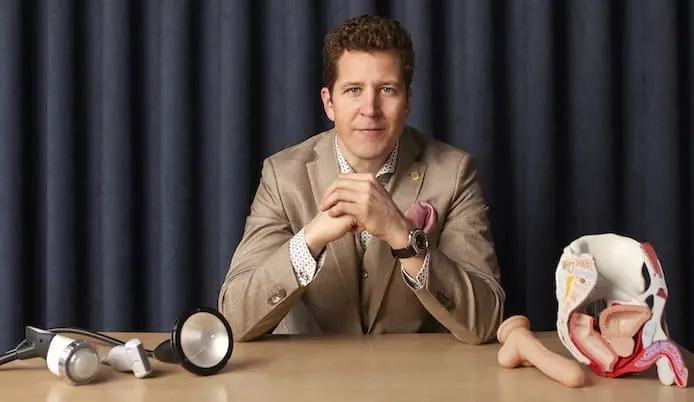
Michael Strøm
International lecturer & expert in shockwave and EMTT treatment for peyronies.
In this article
- What is the pelvic floor in men?
- What can pelvic floor exercises for men help with?
- How to find the right muscles
- Proper technique in pelvic floor exercises for men
- Pelvic floor exercises for men: basic training program
- Maintenance - what do you do when you have achieved control?
- Relaxation and mobility are half of pelvic floor training for men
- Specific training for your symptoms and goals
- Typical mistakes in men’s pelvic floor exercises
- Assistive technology, apps and biofeedback
- Lifestyle that supports pelvic floor training for men
- When pelvic floor exercises are not enough
- Get help with pelvic floor as a man
What is the pelvic floor in men?
The pelvic floor is a strong muscular mesh at the bottom of the pelvis. You can think of it as a flexible hammock or bowl that supports the bladder, bowel and prostate. The muscles help retain urine, intestinal air and feces and play an important role in erection, ejaculation and sexual pleasure.
What can pelvic floor exercises for men help with?
Pelvic floor exercises for men can be relevant for several different problems.
- Erectile dysfunction and erectile dysfunction where better muscle control and vein closure can support erection
- Urine leakage, stress incontinence, urgency and drip after urination
- Urine leakage after prostate or other abdominal surgery
- Premature ejaculation, where better timing, breathing and body control can provide more control
- Chronic pelvic pain, CPPS and irritation around the pudendal nerve, where exercise often needs to be combined with relaxation
- Decreased sexual sensitivity, less pleasure or a "dead" sensation in the genital area
- Stability in pelvis, hips and lower back
Many men go a long time with the symptoms in silence. Seeking help is not weakness. It shows drive, and the more precisely you train, the better chance you have of regaining control.
Pelvic floor exercises for men?
Get a free 15-minute specialist assessment.
How to find the right muscles
Imagine you want to hold in a fart and at the same time stop the stream of urine without straining your buttocks, thighs or stomach. You should feel a subtle inward and upward lift in your perineum.
You can also imagine lifting your scrotum slightly towards your body or rotating the shaft of your penis slightly upwards. The movement should be small and precise. It shouldn’t feel like you’re pushing down.
Stop testing
You can stop the urine stream once to feel which muscles are working. But don’t use it as a daily workout. Repeated exercise during urination can irritate the bladder and interfere with emptying.
Self-test: are you doing it right?
- Place a finger on your perineum between your scrotum and anus. You should feel a slight lift inwards and upwards.
- Look in a mirror. The purse can lift slightly without holding your breath or lifting your shoulders.
- Feel if your buttocks, thighs and abs take over. They shouldn’t.
- After each squeeze, you should be able to let go completely. Relaxation is half of the exercise.
If in doubt, I use ultrasound scanning as biofeedback in the clinic. This allows you to see the muscles working in real time, which often makes it much easier to understand if you’re activating correctly.
Proper technique in pelvic floor exercises for men
1. Start in a relaxed position
Start lying down or sitting. It’s easier to find your pelvic floor when your body doesn’t have to work hard on balance, posture and gravity at the same time.
2. Pinch and lift, don’t push
Breathe in slowly through your nose. On the exhalation, squeeze with about 30-70% of your maximum force. Think "narrow and high" in the pelvis, not "big and hard" in the whole body.
3. Keep your stomach, buttocks and thighs calm
You can feel your body working, but don’t let your buttocks, thighs and abs take over the exercise. The jaw, shoulders and abdomen should be as relaxed as possible.
4. Let go completely again
Let go slowly and feel your perineum lower again. If you can’t let go completely, or if you feel pain, pressure or cramping, the intensity is probably too high.
5. Use your breathing
The pelvic floor works together with the diaphragm. When you breathe in, the pelvic floor lowers slightly. When you breathe out, it can lift more easily. This is why calm breathing is an important part of proper pelvic floor training for men.
Pelvic floor exercises for men: basic training program
Start slowly. Quality is more important than number of repetitions. Stop the exercise when technique slips and always pause for at least as long as you hold the squeeze.
Warm-up: breathing and contact
- Sit or lie still for 1-2 minutes.
- Place a hand on your stomach.
- Breathe in through your nose and out through your mouth.
- On the exhale, make a very light preparatory squeeze for 1-2 seconds and release again.
Exercise 1: Slow Kegel exercises for strength and endurance
- Gently squeeze for 2 seconds.
- Hold the squeeze for 6-10 seconds.
- Release completely for 6-10 seconds.
- Do 8-12 repetitions.
- Do 2-3 sets, 1-2 times daily.
The goal is to gradually be able to hold a controlled squeeze for up to 10 seconds without holding your breath, tensing your buttocks or losing the ability to release.
Exercise 2: Quick pinch for reaction and closure
- Make 10 quick pinches.
- Pinch for about 1 second and release for about 1 second.
- Do 2-3 sets.
- Think "on/off" without tensing your whole body.
Rapid pinches are particularly relevant for post-drip, urgency and the need to react quickly before coughing, sneezing, lifting or moving.
Exercise 3: Functional timing
- Squeeze lightly just before coughing, sneezing, lifting or standing up.
- Use a short squeeze when climbing stairs, lifting shopping bags or during light Kegel exercises.
- Do a few short squeezes after urination if you’re experiencing after-drip.
This technique is often called "the knack". The goal is for the pelvic floor to automatically help you in situations where there is otherwise a risk of leakage or loss of control.
Progression over 6-12 weeks
- Week 1-2: Exercise lying down.
- Week 3-4: Progress to sitting.
- Week 5-6: Train standing.
- Weeks 6-12: Use the clench in movement, such as walking, stairs, lifting and sports.
Many notice the first changes after 4-6 weeks. More significant effects often require 8-12 weeks of regular training. After prostate surgery, it can take months to regain full control and training should be adapted on an ongoing basis.
Maintenance - what do you do when you have achieved control?
Once you’ve achieved your goal - drier pants, better control or improved function - the effect will gradually disappear if you stop training completely. The pelvic floor is like any other muscle: it requires maintenance. Reduce the intensity to 2-3 short sessions per week and continue to actively squeeze in everyday stressful situations: coughing, lifting, erection. Most men manage the maintenance phase well by integrating Kegel exercises into existing routines rather than setting aside separate time for them.
Relaxation and mobility are half of pelvic floor training for men
A strong pelvic floor isn’t necessarily a pelvic floor that’s tense all the time. The best pelvic floor is flexible. It can tighten when it needs to and release when it doesn’t have to work.
Use these exercises especially if you have pain, anxiety, tension or discomfort in your lower abdomen:
- Slow exhalation with a soft belly where you feel the pelvic floor sinking.
- Diaphragmatic breathing for 5-10 minutes daily for pain or overactivity.
- Gentle stretches of hips, buttocks and thighs for 30-45 seconds per stretch.
- Calm mobility for the lower back and pelvis, e.g. cat/cow movements.
- Heating pad for 10-15 minutes on tense middle meat.
- Gentle nerve glides if the pudendal nerve is irritated.
For chronic pelvic pain, I often work with pacing so you build up without triggering flare-ups. The goal is to make the nervous system feel safe again before we push the strength.
Specific training for your symptoms and goals
Pelvic floor exercises for erectile dysfunction and erectile dysfunction
For erectile dysfunction, training especially targets the muscles around the root of the penis, including the bulbospongiosus and ischiocavernosus. They help support erection and help blood stay in the penis during an erection.
The focus is a combination of slow squeezes for endurance and short, precise squeezes for vein closure and control. For many men, it makes the most sense to combine pelvic floor training with circuit training, hip and buttock exercises, sleep, stress reduction and possibly treatment targeting vessels and nerves.
- Do basic training 3-4 days a week.
- Supplement with 20-30 minutes of circuit training twice a week, such as walking, cycling or rowing.
- Exercise the hips and buttocks for better pelvic stability and blood circulation.
- Consider professional assessment if you have diabetes, circulatory problems, nerve damage or long-term ED.
In the clinic, I often combine the training with ultrasound assessment and, when appropriate, focused shockwave therapy, EMTT or neuromodulation. It always depends on the cause of your erectile dysfunction.
Pelvic floor exercises for urine leakage, post-drainage and prostate surgery
For urinary incontinence, training is all about strength, endurance and timing. This is especially important after prostate surgery where the sphincter mechanism may be affected. Training before and after surgery, often called prehab and rehab, can help you rebuild control.
- Start with short, frequent sets and increase gradually.
- Use "pinch before strain" when coughing, sneezing, lifting and playing sports.
- For urgency, you can use calm breathing, shifting focus and a short pinch to calm the urge.
- For post-drip, you can do a few short squeezes after urination and use a gentle "milk technique" behind the scrotum to empty the last drops without squeezing.
The goal is not just dry pants. The goal is peace, predictability and security in everyday life.
Pelvic floor exercises for chronic pelvic pain and pudendal nerve
For chronic pelvic pain, CPPS or irritation of the pudendal nerve, more pinching is rarely the first solution. I typically start by reducing overactivity, pain sensitivity and tension.
- Diaphragmatic breathing with conscious release in the perineum.
- Gentle stretching of hips and buttocks.
- Nerve mobilization and body scanning.
- Neuromodulation or manual relaxation when applicable.
- Later: low-intensity Kegel exercises with full release between each repetition.
The goal is not to push the pelvic floor harder, but to make it more flexible, calm and precise.
Pelvic floor exercises for premature ejaculation
For premature ejaculation, training is about timing, body awareness and the ability to regulate tension. You need to learn to sense arousal earlier, dose pinch and release, and use breathing to keep your body under control.
I often work with stop-start principles, pause/pressure techniques, abdominal and pelvic relaxation and sexological counseling. Small changes in rhythm, pressure, breathing and thought focus can make a big difference.
Typical mistakes in men’s pelvic floor exercises
Most errors can be fixed with small adjustments. Here are the mistakes I see most often in the clinic:
- You hold your breath and push instead of lifting.
- The buttocks, thighs or abdominal muscles work more than the pelvic floor.
- You squeeze too hard and lose precision.
- You don’t completely escape between repetitions.
- You’re exercising too much, especially if you’re in pain.
- You train while urinating instead of just using it as a one-time test.
- You only train lying down and do not transfer the exercises to everyday movements.
- You sit slumped over, so your breathing and pelvic floor have poorer working conditions.
A simple guideline is: the technique should feel precise, not pressured. Turn it down to 30-50% force if you only feel buttocks, stomach or downward pressure.
Assistive technology, apps and biofeedback
Reminder apps can be helpful if you forget to exercise. However, the most important thing is that the exercises are linked to regular routines, for example after brushing your teeth, when the coffee is brewing, after training or at a fixed stop on your walk.
Biofeedback can be useful if the technique is uncertain. Some people use EMG or pressure measurement. In the clinic I use ultrasound because you can see the pelvic floor working in real time. This makes it easier to understand the difference between a correct lift, incorrect pressure and lack of relaxation.
Lifestyle that supports pelvic floor training for men
The pelvic floor does not work in isolation. Circulation, nervous system, stress, sleep, weight, alcohol, smoking and bowel habits also affect the pelvic floor.
- Do circuit training 2-3 times a week for better blood flow.
- Train legs, hips and glutes for better pelvic stability.
- Work on weight, smoking and alcohol if it affects erection or incontinence.
- Prioritize sleep and stress management, especially if your pelvic floor feels constantly tense.
- Avoid straining during bowel movements. Use a footstool on the toilet and take your time.
- Distribute fluids evenly throughout the day and limit caffeine if you have urgency or frequent urination.
- Be aware of medication side effects, especially with erectile dysfunction or altered urination.
When pelvic floor exercises are not enough
Pelvic floor exercises for men are simple on paper, but precision is key. If you don’t feel progress after 6-8 weeks, if you can’t find the muscles, or if the exercises make your symptoms worse, the strategy should be adjusted.
At MS Insight, I take a holistic approach to men’s pelvic floor, erection, incontinence and pain. This can include, among other things:
- Thorough conversation and screening of symptoms, medications, surgeries, pain and goals
- Pelvic floor function tests and ultrasound scans as biofeedback
- Individual program for strength, endurance, quick Kegel exercises, relaxation and progression
- Pelvic Chair or other neuromuscular stimulation as a supplement when self-activation is difficult
- Focused shockwave therapy for relevant vascular and tissue problems such as erectile dysfunction or Peyronie’s disease
- EMTT for selected pain and tissue problems
- Neuromodulation for overactivity, nerve pain and irritation around the pudendal nerve
- Sexological and psychosexual support to make the technique work in real life
- Advice on sleep, stress, exercise, weight, medication, fluids, caffeine and toilet habits
It’s never "one size fits all". A man with post-drainage should not have the same plan as a man with pelvic pain, and a man with mild erectile dysfunction should not necessarily be treated like a man after prostate surgery.
Get help with pelvic floor as a man
If you have difficulty activating the pelvic floor correctly, suffer from incontinence after prostate surgery, or don’t feel progress despite regular training, Pelvic Chair can be a relevant supplement.
Pelvic Chair uses HIFEM technology to stimulate the pelvic floor muscles while you sit fully clothed in the chair. The treatment creates intense muscle contractions that activate muscle fibers you can’t reach with voluntary pinching alone - and can help rebuild strength and control more purposefully than self-training can.
It can be especially relevant for men with urinary incontinence after prostate surgery, post-drainage, or a weakened pelvic floor that is difficult to activate correctly - and for those who have been exercising regularly for 6-8 weeks without noticeable progress.
Read more about Pelvic Chair treatment here
Have a no-obligation conversation about pelvic floor exercises and treatment as a man
Are you unsure if your pelvic floor exercises are working - or would you like to know if Pelvic Chair is relevant for you? You are always welcome to contact me by phone: 41 40 08 58 or email: michael@msinsight.dk. Otherwise, you can fill out the contact form with your details and a brief description of your problem. I'll get back to you quickly with a customized solution proposal so we can find the best way forward together.