

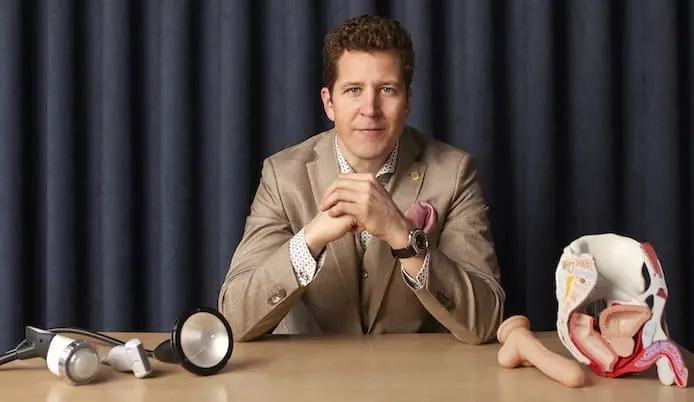
Written and medically reviewed by Michael Strøm
International speaker & expert in shockwave and EMTT treatment for erectile dysfunction, Peyronie’s & CPPS. Read more about me
Ulnar neuropathy – when the nerve at the elbow or wrist is acting up and why it can also affect your overall well-being as a man
I meet many men who come to me for erectile dysfunction, pelvic pain or other intimate health challenges – and then it turns out there’s something else going on in the nervous system. Ulnar neuropathy (irritation, pinching or damage to the ulnar nerve at the elbow or wrist) is a good example. It can cause tingling in the ring and little fingers, grip weakness and pain along the inside of the elbow – and it can be aggravated by common things like sleep position, office work or cycling. The well-being of the nerve is connected to the rest of the body and your nervous system. That’s why I always take a holistic perspective, so you can both calm your hand/arm and strengthen your overall health – including sleep, stress levels and intimate function. When I help you, it’s about both finding and removing what’s provoking the nerve here and now, and about making you robust in the long run so you can live actively without unnecessary fear of relapse.
In this article
- What is Ulnar neuropathy?
- Typical symptoms of Ulnar neuropathy
- Causes and risk factors of Ulnar Neuropathy
- Ulnar neuropathy and men’s intimate health – what’s the connection?
- How to examine Ulnar Neuropathy in the clinic
- Treatment of Ulnar neuropathy in me
- Ulnar neuropathy prognosis: how long does it take?
- Frequently asked questions about Ulnar Neuropathy
- My course: structured, empathetic and targeted to your everyday life
- Take the next step – get help in Copenhagen with MS Insight
What is Ulnar neuropathy?
The ulnar nerve is one of the major nerves in the arm. It runs from the neck down the inside of the upper arm, passes behind the elbow bone in a tunnel (the cubital tunnel) and continues to the wrist where it can get pinched again in Guyon’s canal (called “handlebar palsy” in cyclists). When the nerve becomes irritated, pinched or subjected to repeated mechanical stress, it is called Ulnar Neuropathy. It can manifest as sensory disturbances (tingling, tingling, numbness), pain, reduced strength and problems with fine motor skills. The ulnar nerve provides sensation to the ring and little finger in particular and several of the small hand muscles (interossei and hypothenar), which provide precision grip – so everyday tasks like writing, buttoning a shirt or opening glasses can become more strenuous.
Ulnar neuropathy is often referred to as cubital tunnel syndrome when the problem is at the elbow, and as Guyon’s canal compression when it is at the wrist. Both are variations of the same basic problem: The nerve runs out of space or becomes irritated and reacts with symptoms. At the elbow, symptoms are typically exacerbated by prolonged bending, while pressure at the wrist is often triggered by cycling or hard pressure on the wrist. I can help you differentiate between the two by assessing where on the hand the sensory disturbances are located and which movements provoke the most.
Typical symptoms of Ulnar neuropathy
You don’t have to have all symptoms to have Ulnar Neuropathy. The most typical ones are:
- Tingling, numbness or tingling in the ring and little finger
- Pain or tenderness on the inside of the elbow (often worse with prolonged bending)
- Nighttime symptoms, especially if you sleep with your elbow bent
- Weakened grip strength, tendency to drop things, impaired fine motor skills (e.g. buttons, key in lock)
- Worsening with prolonged phone use, keyboarding, driving, cycling or elbow support
- In cyclists: sensory disturbances in the ulnar side of the hand after longer rides (pressure in Guyon’s canal)
When is it serious?
Seek emergency help if you experience sudden and obvious loss of strength in the hand, rapidly increasing muscle wasting and weakened thumb-pointing grip (positive Froment’s sign), if your hand starts to itch (claw hand), or if you also have severe neck pain with pronounced radiation, difficulty walking or problems with fine motor skills in both hands. If you have had a trauma to the elbow or wrist with subsequent severe pain, deformity or fever, it should be assessed urgently. If you have persistent numbness that does not change over the course of 24 hours, or wounds/burns because you cannot feel heat/cold, you should also be assessed quickly to prevent further nerve damage.
Causes and risk factors of Ulnar Neuropathy
Ulnar neuropathy is often caused by a combination of mechanical and biological factors:
- Prolonged elbow flexion (sleeping, phone, driving) that increases pressure in the cubital tunnel – the more time above 90 degrees flexion, the more provocation.
- Elbow support at the desk or armrest – especially on hard edges without padding.
- Cycling (pressure at the ulnar side of the carpus in Guyon’s canal) – narrow handlebars, hard grips and hunched over position increase risk.
- Repetitive work, vibrating tools, repetitive throws or pulls – especially if breaks and variation are lacking.
- Swelling after impact, scar tissue, bone changes or ganglion cysts – anything that narrows the space in the tunnels.
- “Double crush: simultaneous irritation higher up (neck/shoulder/chest) makes the nerve more vulnerable distally – typically manifesting as wider symptom distribution and slower recovery.
- Metabolic conditions: type 2 diabetes, pre-diabetes, B12 deficiency, metabolic issues, smoking – all factors that can make nerves more sensitive and delay healing.
- Sleep deprivation and stress, which can increase pain sensitivity and delay healing – the body simply finds it harder to “turn down” the alarm.
Ulnar neuropathy and men’s intimate health – what’s the connection?
Ulnar neuropathy does not in itself cause erectile dysfunction. But it does tell us something important about the nervous system, stress over time and the body’s ability to recover. Many men who suffer from erectile dysfunction, performance pressure or chronic pelvic pain also have busy lives, anxiety, lack of sleep and pain elsewhere. It’s the same brain, the same stress hormones and the same nerve regulation that affects pain perception, recovery and sexual function. When I help you calm the ulnar nerve, I also work with the habits that affect the whole system – for less anxiety, more energy and better connection to the body.
Cycling is a good example: Hard, long rides can irritate the ulnar nerve in the hand – and at the same time cause pressure in the perineum, affecting the pudendal nerve, which can cause sensory disturbances, pelvic pain and in some cases affect erections. The solution is rarely to stop completely, but to adjust equipment, technique, load and recovery to allow the nerve to rest. I help you do just that, without taboo and without moralizing. Small things like varying hand positions, using gloves with ulnar relief and adjusting the saddle/handlebars can make a big difference – for both hands and pelvis.
How to examine Ulnar Neuropathy in the clinic
My goal is to find the specific cause and understand the whole picture – both locally at the nerve and in the rest of the body. I prioritize tests that give clear answers and explain what I see along the way so you feel comfortable and informed.
- Thorough conversation: onset, patterns, positions/activities that aggravate or relieve, sleep, work, sports, cycling, previous injuries and medications. I also ask about your overall well-being, including stress levels and any intimate symptoms. I also clarify differential diagnoses such as neck sprain (C8/T1), shoulder problems and vascular problems.
- Clinical tests: sensation, muscle strength and fine motor skills, provocation tests (e.g. elbow flexion test, Tinel’s cubital tunnel/Guyon’s canal), neurodynamic tests for the ulnar nerve and assessment of the scapula, neck and thoracic spine. I also look for signs such as Wartenberg’s sign (little finger “poking out”), two-point discrimination and grip strength in the interossei.
- Advanced ultrasound: I use ultrasound to assess the soft tissues around the ulnar nerve – for example, signs of thickening, swelling, scar tissue, tightness in the cubital tunnel or impingement at the wrist. The scan can also reveal structures that mechanically affect the nerve and it can be performed dynamically (during movement) to see how the nerve slides. I always correlate the findings with your symptoms – the images should make sense in your everyday life.
Additional tests you can talk to your doctor about
Sometimes further investigation is relevant. I advise you to talk to your own doctor about e.g:
- Nerve conduction studies/EMG – can confirm or deny the degree and location of nerve involvement.
- Blood tests (e.g. HbA1c for diabetes, B12, metabolism) – to identify conditions that make nerves more vulnerable.
- Imaging in special cases (X-ray/MRI for suspected bone changes or concurrent neck conditions) – used purposefully when it changes the treatment strategy.
Treatment of Ulnar neuropathy in me
I work in an evidence-based and holistic way. The treatment is tailored to your symptoms, your work life and your goals – and with an eye for how your nervous system wellbeing also affects your intimate health. The focus is to reduce what provokes the nerve, restore function and create a framework that lasts – even when life gets busy again.
Relief and ergonomics
- Adaptations at work and at home: avoid prolonged elbow bending, vary positions, use armrests correctly, avoid leaning directly on the tip of the elbow. Place a soft cushion/cloth on the edge of the desk, use a headset for longer calls and take frequent, short micro-breaks.
- A night splint or soft padding can help you sleep with a more extended elbow for a period of time. A simple solution is a rolled towel around the elbow with elastic bandage – it prevents deep bending without locking completely.
- Cycling: handlebar height, grip, gloves, pressure distribution and breaks; for pelvic discomfort also adjust saddle (cutout/pressure relief), saddle height and position. I guide you on specific goals for ride length, intensity and recovery so that symptoms don’t flare up again.
Exercises and neuromotor training
- Gentle nerve flossing exercises for the ulnar nerve to improve nerve glide and tolerance without provoking. I indicate dosage (typically 1-2 sets of 10-15 gentle repetitions, 1-2 times daily) and adjust if symptoms increase.
- Chest and shoulder mobility and scapula control – reducing pressure on the nerve from above. Focus on easy thoracic mobility, scapula control and neck-down posture that you can use at your desk.
- Progressive strength training of the forearm and hand to restore function and resilience as irritation subsides. We start with a pain-free, low-load, multi-repetition path – and build towards your sport/work.
Neuromodulation
I use targeted neuromodulation to reduce pain, influence nerve sensitivity and support healing processes. It’s non-invasive, safe and customized to your tolerance threshold. The goal is to give the nervous system “more bandwidth” and less alarm. I combine it with breathing techniques and graduated exposure to anchor the effect in your everyday life.
Focused sound waves and EMTT
For persistent irritated tissue around the elbow or wrist, focused sound waves and EMTT (electromagnetic transduction therapy) can be part of a combined approach. They are used judiciously and always in conjunction with offloading, exercises and lifestyle interventions. The evidence is evolving for nerve-related disorders, and I carefully assess whether it makes sense in your particular situation – especially when there is scar tissue, tendon tenderness or long-term local irritability that does not respond adequately to basic interventions.
Sleep, stress and habits
Sleep optimizes nerve healing and pain tolerance. I’ll work with you on routines, caffeine/alcohol in the evening hours and simple strategies that work in practice – e.g. fixed bedtime, screen-free windows before bed and calm breathing. Stress management is not a “nice to have”; it’s a biological shortcut to better nerve function – and often an important piece if you also struggle with erectile dysfunction or performance pressure. Small daily micro-breaks, walks and clear boundaries in the calendar make a measurable difference.
When I recommend surgical assessment
If you have persistent functional impairment with obvious loss of strength, increasing muscle atrophy or lack of improvement despite targeted conservative efforts, surgery may be relevant. In this case, I advise you to talk to your GP about referral and the examinations that typically precede it. For the elbow, a simple decompression or transposition of the nerve may be possible solutions; for the wrist, decompression of Guyon’s canal may be considered. The decision is always based on your symptoms, findings and goals.
Ulnar neuropathy prognosis: how long does it take?
- Mild cases: often recovery within 6-12 weeks with relief and exercises.
- Moderate impact: 3-6 months, depending on duration before starting and daily loads.
- For muscle atrophy or prolonged symptoms: 6-12 months, and not always full normalization. Early intervention improves chances.
The key is consistent relief of triggers, progressive loading, good sleep and a calm nervous system. I’ll help you with a realistic plan that can work in a busy life. The goal is steady progress without unnecessary setbacks, so you can return to work, sport and socializing with peace of mind.
Frequently asked questions about Ulnar Neuropathy
Can Ulnaris neuropathy cause erectile dysfunction?
Not directly. However, pain and poor sleep increase the body’s alertness and can affect libido and erection. Cycling can both irritate the ulnar nerve in the hand and press on the perineum, which can affect the pudendal nerve. I adjust your setup together with you and look at sleep, stress and recovery to improve both hand and intimate function.
Do I need a rail?
A soft night support can help if you sleep with a very bent elbow. During the day, I use more behavioral modification and ergonomics than rigid immobilization. I assess it individually and choose as simple a solution as possible that still works.
Can I do upper body training?
Yes – but wisely. I reduce exercises that put direct pressure on the ulnar nerve (deep elbow bends, heavy dips, long planks with a hard elbow angle) for a while and then build up again with good technique and progression. You’ll get concrete alternatives so you can stay in shape without triggering symptoms.
Is it the same as carpal tunnel syndrome?
What it is. Carpal tunnel syndrome affects the median nerve and causes sensory disturbances in the thumb, index and middle finger. Ulnar neuropathy typically affects the ring and little finger and grip strength in specific hand muscles. I help you distinguish – and treat based on the right cause.
Which sleeping position is best?
Try to avoid prolonged periods of elbow flexion above 90 degrees. A small pillow in front of your stomach can help if you sleep on your side so your arm rests more straight. If you sleep on your back, a soft support under your forearm can reduce the need to bend your elbow.
Why does it get worse when I talk on the phone or type on my laptop?
Phone use and laptop use can keep the elbow at a bent angle and cause localized compression at the elbow. Short breaks, headsets and better forearm support often help quickly. An external monitor and separate keyboard can provide significant relief for longer working days.
Will it come again?
It can if the triggering factors return. With the right habits, strength training, ergonomics and good sleep, the risk drops significantly. I’ll give you a simple checklist to help you spot early signs and prevent relapses.
Does massage help?
Gentle massage of tense muscles around the shoulder/forearm can provide relief, but the nerve itself should not be pressed hard. I use massage as a supplement to relief, exercises and neuromodulation when it makes sense for you.
When should I consider surgery?
If you have persistent or increasing loss of strength, obvious muscle atrophy or lack of progress despite targeted efforts, surgery may be relevant. I will help you with a clear plan for next steps and guide you through the assessment process with your own doctor.
My course: structured, empathetic and targeted to your everyday life
- Clarification: thorough interview, functional screening and ultrasound scan if needed.
- Plan: concrete measures for relief, individual exercise program and clear guidelines for work, sports and sleep.
- Combination therapy: neuromodulation, focused sound waves and EMTT can be included when appropriate – always as part of an overall plan.
- Follow-up: I continuously adjust so that you experience progress without overloading, and you get clear next steps from time to time.
- Holistic: if you’re also struggling with erectile dysfunction, pelvic pain or performance pressure, I integrate evidence-based strategies that support both nerve healing and your intimate well-being.
Take the next step – get help in Copenhagen with MS Insight
It may feel small to “just” have tingling in a few fingers. But Ulnar Neuropathy is not something you have to live with – especially if it starts to affect grip, training, sleep or your mood. I offer a safe and discreet setting in Copenhagen with a high level of professionalism, advanced ultrasound scanning and tailored programs that fit men’s everyday lives. The goal is simple: fewer symptoms, more control and a body and nervous system that work better together – also when it comes to your intimate health.
Contact me today for a non-binding clarification and let’s make a plan that makes sense for you. I meet you without prejudice, without taboo – and with a focus on solutions that work in reality.
If you are interested in hearing more about how I can help you, you are always welcome to contact me by phone 41 40 08 58 or email michael@msinsight.dk. I’ll get back to you quickly with a customized proposal so we can find the best way forward together.
Would you like a specialist assessment of your situation?
You don’t have to figure it out alone. Call directly or write a few lines about your symptoms – I’ll get back to you within 12-24 hours with a concrete suggestion for the next step.