

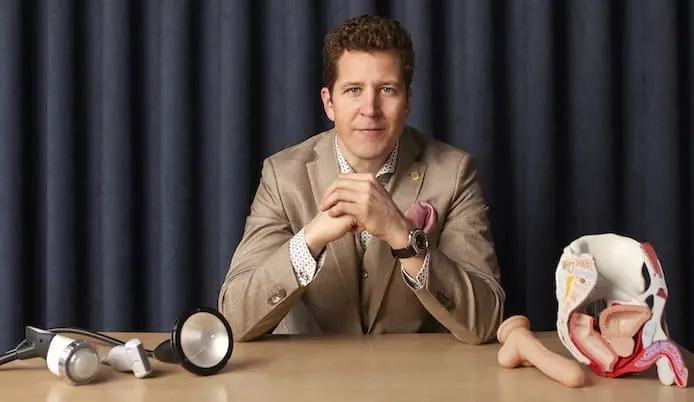
Written and medically reviewed by Michael Strøm
International speaker & expert in shockwave and EMTT treatment for erectile dysfunction, Peyronie’s & CPPS. Read more about me
The link between Peyronie’s and Dupuytren’s contracture: When connective tissue teases
Have you noticed that one or both of your little fingers have started to curl in towards the palm of your hand, while at the same time you notice changes on your penis – maybe a crookedness, pain or hard lumps under the skin? This is far from a coincidence. There is a well-documented and strong link between Peyronie’s disease (crooked penis) and Dupuytren’s contracture (cushion fingers). In my clinic, MS Insight, I see men every day who are surprised to learn that these two conditions are often two sides of the same coin. It’s all about your connective tissue.
It can be scary to discover nodules or stringy formations under the skin, whether it’s in the hand or intimately on the penis. Many fear the worst, but I can reassure you that in the vast majority of cases these are benign connective tissue changes, not cancer. While these conditions are not life-threatening, I know from experience how much they can affect quality of life, self-image and sex life. Here I explain the link between Peyronie’s and Dupuytren’s contracture and how I can help you with effective, non-invasive treatment. Research also shows that only 1 in 10 cases of Peyronies resolve without treatment, so it’s all about taking action as soon as you notice something is wrong.
In this article
- What is the common denominator for Peyronie’s and Dupuytren’s contracture?
- Symptoms of Peyronie’s and Dupuytren’s contracture you should respond to
- Diagnosing Peyronie’s and Dupuytren’s contracture: Why I use ultrasound
- My treatment of Peyronie’s and Dupuytren’s contracture: A combined effort
- The mental pressure of Peyronie’s and Dupuytren’s contracture
- The role of lifestyle in Peyronie’s and Dupuytren’s contracture
- Frequently asked questions about Peyronie’s and Dupuytren’s
- Get help with Peyronie’s and Dupuytren’s contracture today
What is the common denominator for Peyronie’s and Dupuytren’s contracture?
To understand why you experience symptoms in both the hands and penis, we need to look at the body’s “glue”: the connective tissue. Both Peyronie’s and Dupuytren’s contracture are classified as fibrotic disorders. This means that the body forms too much scar tissue or stiff connective tissue in areas that should be elastic and supple.
Dupuytren’s contracture, commonly known as “Viking disease” or “cows’ fingers”, involves the thickening of the membrane in the palm of the hand (palmar aponeurosis). This pulls the fingers – typically the ring and little finger – in towards the palm of the hand so that they eventually cannot be stretched out. In Peyronie’s disease, exactly the same process occurs in the penis. Plaques (hard areas of scar tissue) form in the sheath that surrounds the swelling. When the penis fills with blood, the tissue cannot give where the plaque is, resulting in curvature, hourglass shape or pain.
The statistics are clear: Men with Peyronie’s have a significantly increased risk of also developing Dupuytren’s, and vice versa. This indicates that some men are genetically predisposed for their connective tissue to react inappropriately with scarring and fibrosis when exposed to even small stresses.
Symptoms of Peyronie’s and Dupuytren’s contracture you should respond to
It’s crucial to listen to the body’s signals before the condition develops into chronic pain or severe disability. Unfortunately, I often find that men have been living with the symptoms for years before seeking help. The sooner we intervene, the better results I see.
Signs of Dupuytren’s contracture
- Knots in the palm of the hand: Small, hard nodules or strings that can be felt under the skin.
- Skin changes: The skin in the palm of your hand may appear drawn, wrinkled or “pitted”.
- Curvature: A gradual bending of the fingers, especially the ring and little finger, which cannot be actively straightened.
- Table test: Difficulty placing your hand flat on a tabletop (if you can’t, the test is positive).
Signs of Peyronie’s disease
- Plaques: Palpable, hard areas under the skin of the penis, typically on the top or underside. It feels a bit like hard plastic or cartilage.
- Pain: Pain in the penis, either in a flaccid state or especially during erection in the early phase.
- Deformity: New curvature, bending or narrowing (hourglass shape) of the penis during erection.
- Erectile dysfunction: Problems achieving or maintaining an erection, often because the plaque inhibits blood flow or creates venous leakage.
Diagnosing Peyronie’s and Dupuytren’s contracture: Why I use ultrasound
When you enter my clinic, we always start with a thorough conversation. I need to know how the symptoms affect your everyday life and whether you have made the connection between your hands and your intimate health. But words can’t stand alone.
I use advanced high-end ultrasound scanning as an integral part of the examination. This is crucial to make the correct diagnosis and pinpoint the extent. With ultrasound, I can see exactly where plaque is forming in the penis, how deep and calcified it is, and how the blood vessels are responding. It takes the guesswork out and gives me a precise ‘map’ to navigate during the shockwave treatment, which is one of the only effective methods.
Many of my clients are surprised at how clear the problem appears on the screen. It’s often very reassuring to put pictures on the condition so that it’s no longer just an abstract concern, but a concrete physical change that we can do something about.
My treatment of Peyronie’s and Dupuytren’s contracture: A combined effort
My approach to treating both Peyronie’s and Dupuytren’s contracture is based on the latest shcokwave and EMTT technology and research. I don’t believe in standard solutions. Instead, I tailor a program for you that typically combines multiple technologies to achieve the strongest synergistic effect. The goal is to slow disease progression, reduce pain, soften tissue and restore function.
Focused shockwave (Focused sound waves)
This is the cornerstone of my treatment. Using focused sound waves, I can treat precisely in depth, directly on the damaged tissue in the hand or penis. The sound waves create microscopic effects in the cells that initiate potent biological processes:
- Degradation of fibrosis: The sound waves mechanically and biologically help to “soften” the hard scar tissue and plaques that cause the curvature.
- Restoring elasticity: Shockwave stimulates the collagen in the tissue to become softer, restoring elasticity.
- New blood vessel formation (Angiogenesis): The treatment stimulates the formation of new microscopic blood vessels, increasing blood flow, oxygenation and healing in the area.
- Pain relief: Most people experience a significant reduction in pain after just a few treatments.
It’s important to emphasize that I use focused sound waves. This is the most precise and evidence-based form of shockwave for these conditions – not to be confused with the radiating pressure waves you often see with regular physiotherapists for muscle tension. This will not give you the desired effect.
EMTT (Electromagnetic Transduction Therapy)
As a strong complement, I often use EMTT. Where shockwave works very locally and intensely on the injury itself, EMTT works broader and deeper with high-frequency magnetic pulses. This technology dampens inflammation and “recharges” the cells, increasing their activity level. It also increases elasticity and amplifies the effect of shockwave by releasing more growth factors into the tissue. By combining focused sound waves and EMTT, I’m attacking the problem from two angles: breaking down the hard tissue while optimizing the cells’ ability to regenerate healthy, elastic tissue.
The mental pressure of Peyronie’s and Dupuytren’s contracture
For many men, experiencing potency problems or seeing their penis change shape is extremely taboo and anxiety-provoking. It touches directly on our masculinity and self-image. If you also struggle with your hands due to Dupuytren’s, the feeling of your body “decaying” prematurely can be overwhelming.
In my clinic there are no taboos. I meet you at eye level and I’ve heard it all before. It’s important to me to create a space where you can safely talk about both the physical pain and the psychological concerns that come with the diagnosis. Many men withdraw from intimacy for fear that the penis looks “wrong” or that it hurts. But stress and anxiety only exacerbate erection problems. That’s why I see counseling on well-being and mental health as a natural part of the process.
The role of lifestyle in Peyronie’s and Dupuytren’s contracture
While genetics play a major role in both Peyronie’s and Dupuytren’s contracture, your overall health has a big impact on how aggressive the disease is and how well you respond to treatment. Connective tissue health is closely linked to your metabolism and the level of inflammation in your body.
When you are in my program, we also look at your lifestyle factors. For example, smoking is a known risk factor that drastically worsens microcirculation and can accelerate fibrosis. Diabetes and high blood sugar levels also have a negative impact on connective tissue quality. I guide you on how to optimize the body’s healing potential through diet, sleep and possible supplements. If I think you need to have your numbers checked – such as testosterone, blood sugar or cholesterol – I’ll guide you on exactly what to ask your doctor to test so we can get the full picture.
Frequently asked questions about Peyronie’s and Dupuytren’s
Can Peyronie’s and Dupuytren’s contracture disappear on its own?
Unfortunately, it is extremely rare. In the very early, acute phase of Peyronie’s, the condition can fluctuate, but once the scar tissue has formed and calcified, it will not go away without treatment. The same goes for Dupuytren’s; it’s a progressive condition that typically worsens over time without intervention. Waiting time is rarely your friend in this context. Only 3-8% of Peyronie’s cases will resolve on their own if left untreated. So simply waiting is a big gamble.
Does the focused sound wave treatment hurt?
The treatment can be felt, but it should never be unbearable. As we are working with an area that may already be sore or inflamed, I always adjust the intensity to your pain threshold. Most people describe it as a tingling sensation or small pops deep in the tissue. It’s over quickly and there’s no ‘downtime’ – you can continue your day or go to work immediately after.
Is surgery the only solution?
No, and that’s exactly what I work to avoid. Surgery for Peyronie’s or Dupuytren’s is often associated with risks, long recovery, erectile dysfunction, shorter penis and, paradoxically, the formation of new scar tissue after the procedure. By using focused sound waves and EMTT, we treat the tissue biologically and non-invasively. In my opinion, surgery should always be the absolute last resort when conservative treatment has been tried.
What is the cost of peyronies treatment?
I’ll be honest, treatment is not cheap. But the alternative of doing nothing can have an even greater cost. Prices range from 1,450 to 2,000 kroner per treatment, and a normal course of treatment is usually 10-15 treatments over 3 months. At the same time, a small cost for equipment for home training should be expected.
Get help with Peyronie’s and Dupuytren’s contracture today
Worried about a curvature of the penis, pain during erection or knots in the palm of your hand? The worst thing you can do is ignore it and hope it goes away. Peyronie’s and Dupuytren’s contracture requires professional insight and determined efforts to slow down and improve.
At MS Insight, I guarantee you professional, discreet and competent treatment in a safe environment. I have the equipment to make the right diagnosis and the experience to help you regain your quality of life.
If you are interested in hearing more about how I can help you, you are always welcome to contact me by phone 41 40 08 58 or email michael@msinsight.dk. I’ll get back to you quickly with a customized proposal so we can find the best way forward together.
Would you like a specialist assessment of your situation?
You don’t have to figure it out alone. Call directly or write a few lines about your symptoms – I’ll get back to you within 12-24 hours with a concrete suggestion for the next step.