
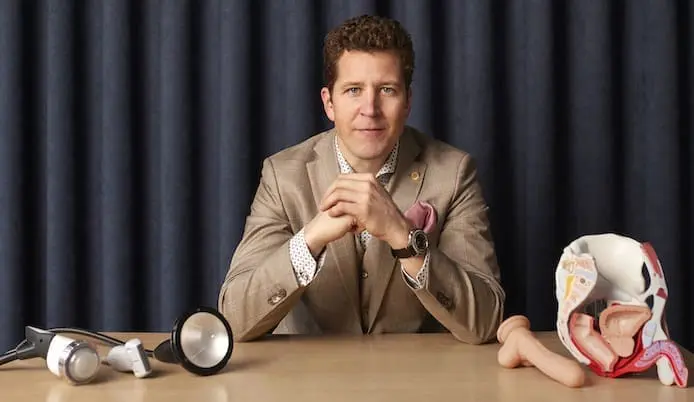
Michael Strøm
International speaker and expert in shockwave and EMTT treatments for men's sexual health.
In this article
- What does it mean when the connective tissue feels tight?
- When the treatment helps—but the problem returns
- You don’t need to know yourself whether it’s fascia, muscles, or nerves
- Why choose MS Insight?
- Different problems require different treatments
- When the problem is centered around the pelvis
- Scar tissue can also be part of the problem
- Why do I combine these treatments?
- The first consultation is about understanding why you’re still experiencing the problem
What does it mean when the connective tissue feels tight?
Connective tissue is found throughout the body. It surrounds and lies between muscles, nerves, blood vessels, and organs, and helps provide both support and mobility between the body’s various structures. Fascia is part of this connective tissue system and functions as a continuous network throughout the body.
When the tissue is functioning properly, the different layers should be able to move relative to one another. After prolonged irritation, overuse, surgery, scar tissue, or pain, an area may feel less pliable. It can feel like stiffness, tension, tenderness, or as if something is “stuck.”
This does not necessarily mean that the tissue needs to be massaged loose with force. An area may also remain tense because the body is trying to protect it, because a nerve is irritated, because the muscles are functioning improperly, or because the tissue no longer moves as it did before following surgery. That’s why it’s more important to understand why the area feels tight than simply to treat the tension over and over again.
When the treatment helps—but the problem returns
This is a situation I see often. You get a massage and become more flexible. You do exercises and see some results. You stretch and notice that the area feels more free. But shortly afterward, you’re back where you started.
That doesn’t necessarily mean the treatment you received was wrong. Instead, it may mean that only one part of the problem was addressed. If the mechanism that keeps the problem going isn’t identified, the body can quickly revert to the same pattern of tension.
The goal, therefore, is not just to make the area more flexible right now, but to understand what is perpetuating the problem and what needs to be changed to achieve a more lasting improvement.
You don’t need to know yourself whether it’s fascia, muscles, or nerves
Many people come to me and say, “I don’t know what it is. It just feels tight.” That’s perfectly fine. It’s my job to figure it out.
During the initial consultation, I’ll review your medical history, how the problem arose, what you’ve already tried, and how the area responds to movement and stress. I’ll examine the relevant structures and assess whether the connective tissue actually appears to be a significant part of the problem. For some conditions, an ultrasound scan may also be part of the evaluation.
Why choose MS Insight?
Because I don’t rely on a single method. If a clinic only offers massage, many problems will naturally be treated with massage. If the clinic only offers shockwave therapy, more problems will be treated with shockwave therapy. At MS Insight, I can first assess the problem and then choose from several treatment approaches.
This is particularly relevant for complex or long-standing problems, where there is rarely just one structure involved. If the connective tissue is stiff, I can work on it. If there is also scar tissue or deeper tissue changes, I can address them in a different way. If the pain has a neural component, the treatment takes on a different approach.
Therefore, the technology itself is not the solution. The strength lies in my ability to combine the relevant treatments based on what I find in your body and to adjust as we go if your response indicates that I need to do something different.
Different problems require different treatments
When connective tissue and fascia play a significant role, I can use HumanTecar, among other things, to address the tissue’s mobility and tension. The treatment can be combined with manual therapy and, in some situations, can be used to prepare the area before I proceed with more targeted work.
If the problem requires a stronger mechanical stimulus, focused shockwave therapy may be appropriate. EMTT can be used to treat larger and deeper areas of tissue without the same mechanical stress, while the Summus P4 laser can be incorporated when pain, irritation, and tissue response are key factors in the presentation. For pelvic-related issues, I can also incorporate NESA neuromodulation or the Pelvic Chair if the nervous system or pelvic floor function appears to be a factor.
This doesn’t mean you have to undergo all of these treatments. On the contrary. The point is that I have several options and can therefore choose the combination that makes the most sense for your specific situation.
When the problem is centered around the pelvis
Connective tissue and fascia are particularly interesting around the pelvis because the area consists of many structures that work closely together. Muscles, connective tissue, blood vessels, nerves, and the pelvic floor influence one another, which is why problems in this area can manifest as much more than just ordinary muscle pain.
Some people experience deep pelvic pain or constant tension. Others describe a burning sensation, pressure, or a feeling of unease. Some have symptoms around the perineum or lower abdomen, while others experience problems with urination, sexual function, or the pelvic floor.
In this context, it’s rarely enough to simply ask whether the pelvic floor is strong or weak. Instead, I assess whether it can contract and relax normally, whether the surrounding tissue moves freely, and whether the nervous system or other structures might be contributing to the problem. This can be relevant, for example, in cases of pelvic pain, CPPS/prostatitis, pudendal nerve-related issues, an overactive pelvic floor, incontinence, and post-surgical discomfort.
Scar tissue can also be part of the problem
After surgery or an injury, scar tissue forms as a natural part of the healing process. For most people, this does not cause any major problems, but for some, the area feels different afterward—tighter, sore, sensitive, or less mobile than before.
In these cases, treatment is not about “removing” the scar. The goal is to assess how the scar tissue and the surrounding tissue move, and whether this affects function, movement, or pain. This may be relevant, for example, after surgery in the abdomen, pelvis, lower abdomen, or prostate area. See how I assess scar tissue after surgery.
Why do I combine these treatments?
Because different treatments address different aspects of the problem. If an area is stiff, tender, and constantly tense, for example, it may make sense to first work on the tissue’s mobility and then apply a more targeted treatment using shockwave, EMTT, or laser. For another patient, following the same sequence might be completely wrong.
That’s why I don’t use a fixed, standard treatment plan. I’d rather take the time to understand what’s driving your problem and then choose the treatment that makes the most clinical sense.
The first consultation is about understanding why you’re still experiencing the problem
If you’ve been dealing with this problem for a long time, you’ve probably already tried something. What interests me, therefore, is not only what you’ve tried, but also why it hasn’t been enough. Perhaps connective tissue is an important part of the explanation. Perhaps it isn’t.
I’ll only find that out by examining you. Then I can develop a plan where I focus specifically on the structures and mechanisms that seem to be keeping the problem going.
Find out what’s keeping the tension going
Do you have an area that keeps feeling tight, stiff, or painful?
You don’t have to figure out on your own whether the problem is caused by fascia, muscles, scar tissue, or nerves. That’s my job.
Start with a no-obligation consultation about your symptoms, and I’ll assess whether an examination at MS Insight is the right next step.