MS Insight · Professional Article
Is shockwave therapy scientifically proven—or just another treatment that’s being marketed more than the research can support? Here’s an honest overview of what the studies actually show.

By Michael Strøm
Clinical shockwave specialist and international instructor
In a nutshell
21 RCTs
and 1,357 men in the 2025 Cochrane review on erectile dysfunction
3 EAU guidelines
mention shockwave therapy: erectile dysfunction, Peyronie’s disease, and chronic pelvic pain
No single treatment
The effect depends on the diagnosis, technology, energy, and protocol
The evidence is real—but it isn’t equally strong across all areas.
The short answer is: Yes. Shockwave is an evidence-based medical technology that has been studied in randomized controlled trials, sham studies, systematic reviews, and meta-analyses.
But there is one important detail that is often overlooked in the discussion: Shockwave is not a single treatment.
Different devices produce different types of acoustic energy. Studies use varying energy levels, numbers of shockwaves, treatment areas, and patient groups. Therefore, two studies can both examine “shockwave” and yet, in practice, be examining quite different treatments.
This also partly explains why some studies show clear results, while others show little or no effect.
For example, a large Cochrane review from 2025 identified 21 randomized studies involving a total of 1,357 men with erectile dysfunction. The researchers found an overall positive signal but rated the certainty of the evidence as low, in part because the treatment protocols and outcomes varied considerably across the studies. Cochrane 2025
The European Association of Urology (EAU) also includes low-intensity shockwave therapy in its guidelines for erectile dysfunction and shockwave therapy in the assessment of both Peyronie’s disease and chronic pelvic pain. The recommendations vary because the evidence differs from one diagnosis to another. EAU guideline
“Which type of shockwave works, at what dose, for which condition—and in which patient?”
Overview
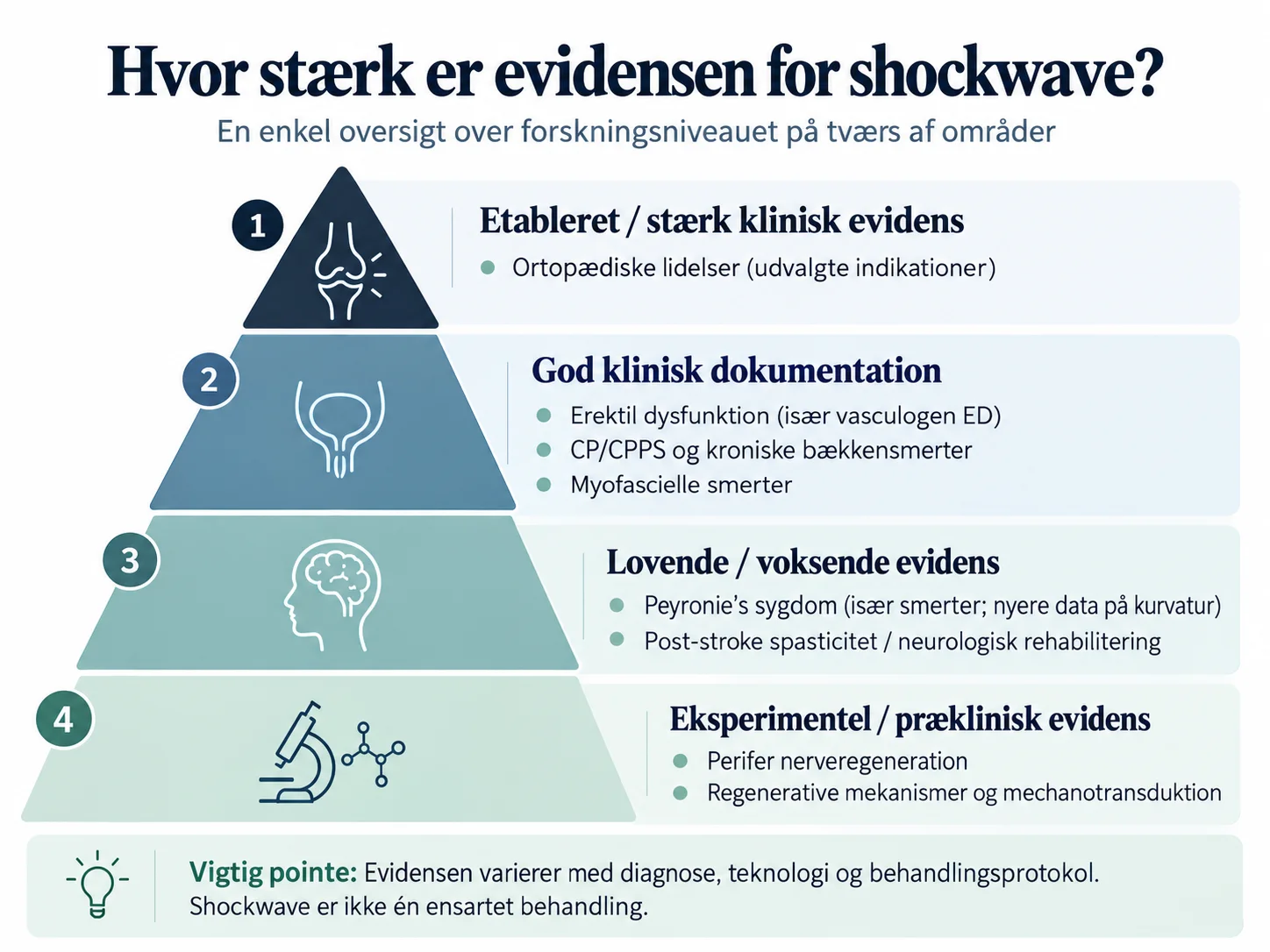
The evidence isn’t equally strong across all areas. This overview is a practical guide—not a substitute for the detailed research further down the page.
Field
What does the research show?
Erectile dysfunction (ED)
Many RCTs. A consistent but moderate clinical signal—especially for vasculogenic ED.
Peyronie’s disease
Best evidence for pain relief. A new study from 2026 shows interesting results regarding curvature.
CP/CPPS and chronic pelvic pain
Several sham-controlled studies show a reduction in pain and symptom burden.
Orthopedics
One of the most extensive areas of research, but results vary by diagnosis.
Myofascial pain
Meta-analyses show an effect on pain and function.
Neurology
Growing body of clinical research, including studies on spasticity.
Nerve Regeneration
Very interesting preclinical research, but not yet at the same level of evidence in humans.
The Technology
Imagine two clinics. Both offer “shockwave therapy.” One clinic has one device and one type of generator. The other can choose from several different ways to generate and focus the acoustic energy.
On paper, both offer shockwave therapy. Technologically, however, the treatments do not have to be the same.
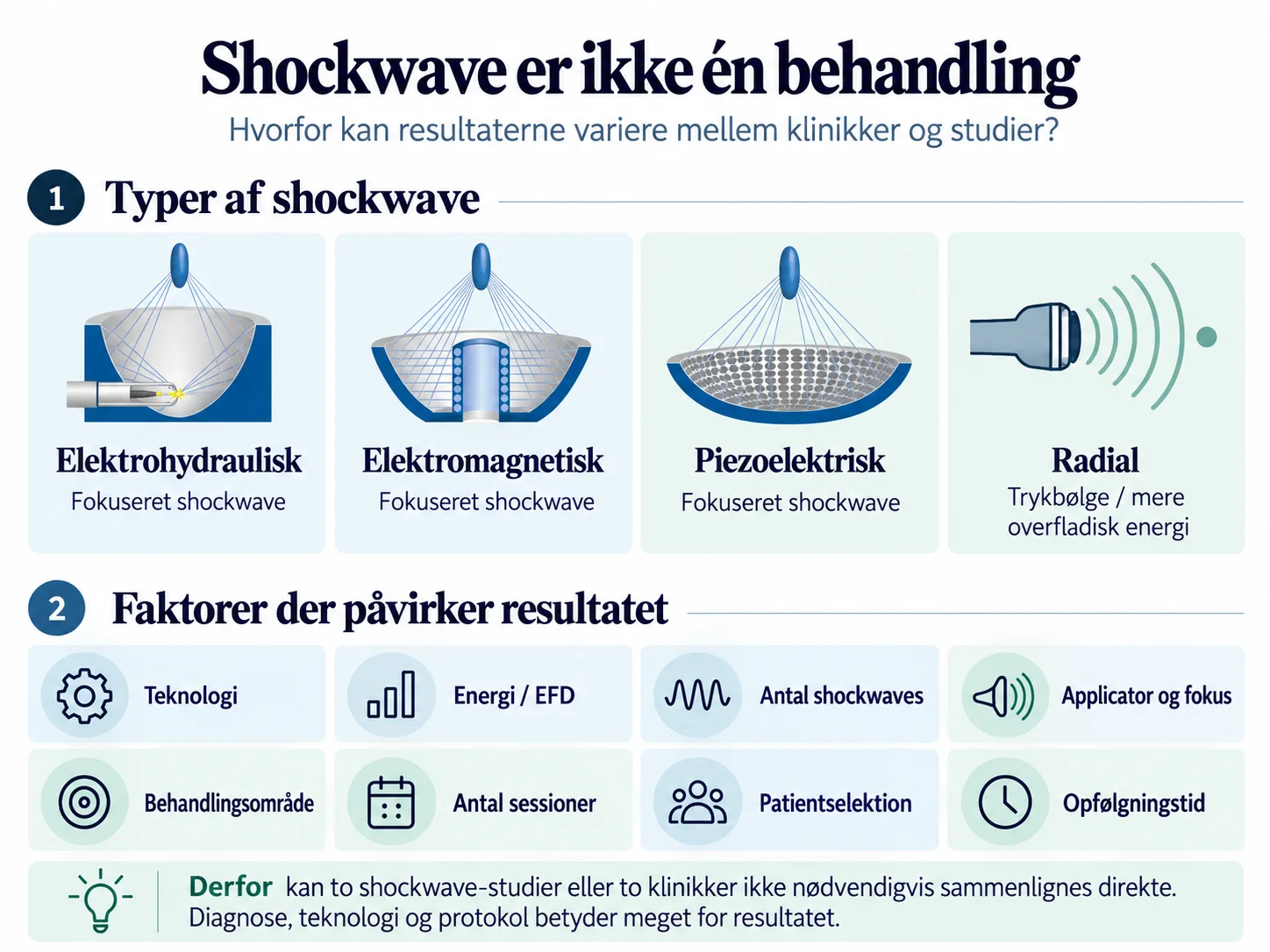
Focused
Generates the shock wave through an electrical discharge in a fluid and then focuses the energy.
Focused
Generates the wave electromagnetically and focuses it on a defined treatment area.
Focused
Uses a series of piezoelectric elements that are activated simultaneously and focus the energy on a specific area.
Radial
Operates with a different physical pressure profile and typically delivers its highest energy more superficially.
This does not mean that one technology is always best. It means that the term “shockwave” alone does not provide enough information about the treatment.
Because tissues and conditions are not the same. A patient with vascular erectile dysfunction does not necessarily have the same treatment goal as a patient with a Peyronie’s plaque. A painful pelvic floor is different from a calcified tendon. And a superficial muscular structure is different from tissue located several centimeters inside the body.
Therefore, it does not necessarily make sense for everyone to be treated with the same machine, the same applicator, the same energy level, and the same protocol.
Cochrane and the EAU specifically point out significant differences in the treatment parameters and technologies used in shockwave studies. EAU
My Approach
It is precisely in this area that my approach at MS Insight differs from that of a traditional clinic that has invested in a single shockwave system.
Technology
System at the clinic
Electrohydraulic
MTS Medical
Electromagnetic
Storz Medical
Piezoelectric
Elvation Medical / Piezowave
Electromagnetic flat coil
Longest Medical
Radial
Used as a supplement when appropriate
This does not provide me with scientific evidence to claim that my results are automatically better than those of a clinic with a single device. But it does give me greater clinical flexibility: treatment does not have to be designed around the specific device the clinic owns.

“I don’t have to try to make the patient fit the machine. Instead, I can choose the technology, applicator, and protocol based on the problem I’m facing.”
Michael Strøm · MS Insight
I have been working intensively with shockwave therapy since 2016. Since 2020, I have trained doctors and other healthcare professionals internationally in more than 25 countries, and I currently work as a clinical consultant and instructor for MTS Medical and Elvation Medical. From 2019 to 2024, I worked as a clinical consultant, instructor, and reference for Storz Medical.
My experience, therefore, does not come solely from operating a single specific machine. I have worked with various generator principles, applicators, energy levels, and manufacturers—and at the same time, I have had to teach others why and when to use the different technologies.
For me, advanced shockwave therapy isn't about using as much energy as possible. It's about understanding the tissue, understanding the technology, and choosing the most rational combination . And sometimes, the most important decision is that shockwave therapy isn't the right treatment.
2016
Intensive shockwave therapy
25+ countries
International training since 2020
MTS & Elvation
Clinical consultant and instructor today
Storz Medical
Consultant, instructor, and reference 2019–2024
Diagnosis Before Technology
If a man has erectile dysfunction, the cause may be vascular, neurological, metabolic, medical, hormonal, psychogenic, or a combination of these.
If a man has Peyronie’s disease, it may be important to understand plaque, calcification, curvature, pain, and erectile function.
In cases of chronic pelvic pain, muscles, fascia, peripheral nerves, and the pain system may be involved to varying degrees.
That’s why I don’t necessarily start with the question , “Where should we apply shockwave therapy?” I start with, “What appears to be causing the problem?”
A relevant clinical examination and ultrasound may therefore be part of the evaluation before we decide whether shockwave therapy makes sense and, if so, how the treatment should be organized.
Not sure if shockwave therapy is right for you?
Book a free, confidential 15-minute consultation with Michael.
Erectile Dysfunction
Low-intensity shockwave therapy is being studied primarily in men with vasculogenic erectile dysfunction—that is, where insufficient blood supply is a major part of the problem.
The fundamental mechanism of action differs from that of Viagra, sildenafil, or tadalafil. PDE5 inhibitors pharmacologically support the erectile mechanism while the medication is active in the body. Shockwave therapy, on the other hand, is being studied for its potential to influence aspects of underlying tissue and vascular function.
The EAU currently assesses that LiSWT may provide a mild improvement in erectile function in men with vasculogenic ED and issues a weak recommendation for selected patients. EAU ED guideline
Shockwave therapy is just one of several possible approaches. If you’re experiencing symptoms and want to understand the diagnosis, causes, and various treatment options, you can read my complete guide to treating erectile dysfunction.
Cochrane review · 21 RCTs · 1,357 men
In the short term, the average improvement in erectile function scores was 3.89 points greater after active treatment than after sham treatment. However, Cochrane rated the evidence as having low certainty due to, among other things, inconsistency, uncertainty, and methodological limitations.
What’s interesting: There is an overall positive signal—but the studies do not necessarily treat patients in the same way.
Double-blind · sham-controlled · 67 men
The patients received 12 sessions of active low-intensity shockwave therapy or sham treatment. The study examined both erectile function and penile hemodynamic measures.
Why is this interesting? The researchers examined not only subjective erectile function but also physiological measures.
Electromagnetic · double-blind · sham
96 patients were included, and 81 completed the study. The median change in IIEF-EF was +5.1 in the shockwave group versus −2.2 in the sham group.
Why is this interesting? The technology and treatment design are relatively clearly defined.
Danish RCT · 126 men · linear low-energy
The researchers were unable to demonstrate the desired clinical benefit at the primary endpoint.
Why is this important? A negative study is crucial for understanding that technology, energy, number of pulses, target, and patient selection may play a role.
Peyronie’s disease
The use of shockwave therapy for the treatment of Peyronie’s disease has been studied for many years, but the results depend on what one is trying to improve. Pain, plaque, curvature, and erectile function are different outcomes and must be assessed separately. See also how shockwave is assessed for a crooked penis and where the evidence is strongest.
The EAU currently concludes that the existing controlled research, taken as a whole, shows an effect on penile pain but no certain effect on plaque or curvature. EAU Peyronie’s disease guideline
Placebo-controlled RCT · 102 men
Patients received six weekly treatments with 2,000 shockwaves per session. Among patients with pain, pain decreased in 85% of the shockwave group compared to 48% in the placebo group. No significant reduction in curvature was documented.
Why is this interesting? It shows that pain and curvature can respond differently to the same treatment.
Prospective study · 112 men · Italy
The patients received three treatments with 3,000 shock waves per session at 0.11–0.17 mJ/mm². 90% of the patients with pain experienced pain relief, while 57.1% showed improvement in curvature. Among the responders, the average improvement was approximately 30 degrees.
Important limitation: The study did not include a sham or control group. Therefore, the entire change cannot be attributed to shockwave therapy with certainty.
Pelvic Pain
CP/CPPS is a complex condition. Men may experience pain around the perineum, penis, testicles, or pelvic floor, problems after ejaculation, and various urinary symptoms. In many cases, the symptoms are not caused by a classic bacterial infection of the prostate.
The EAU guideline describes several randomized, sham-controlled studies showing improvements in pain, quality of life, and the NIH-CPSI following extracorporeal shockwave therapy. EAU Chronic Pelvic Pain
Randomized · double-blind · placebo
Men with chronic pelvic pain syndrome were treated perineally with ESWT. Among other things, the researchers found improvements in pain and quality of life compared to the control group.
Why is this interesting? An early landmark study outside the field of traditional orthopedics.
Systematic review and meta-analysis
Five sham-controlled RCTs and one other randomized study were included. Pain, the total NIH-CPSI score, and quality of life were significantly better after active LiSWT than after sham treatment immediately after treatment, as well as at one and three months. The long-term effect was less certain.
Why is this important? The positive findings are consistent across several randomized studies.
The Big Picture
If you only encounter shockwave therapy in the context of treating erectile dysfunction, you might get the impression that it is a relatively new “potency treatment.” That is a misleading view.
Much of the research literature comes from the fields of orthopedics, rehabilitation, and pain management.
Meta-analysis · 27 RCTs · myofascial pain
The analysis found overall improvements in pain, pressure pain threshold, and function, but also significant variation between protocols and patient groups.
Relevance: The clinical application of shockwaves for pain extends beyond classic tendon disorders.
Recent meta-analyses · 20+ RCTs
Research shows that energy level and protocol may influence outcomes, including pain, function, and calcium resorption.
Principle: Shockwave therapy should be understood as a measured physical intervention—not simply as a machine that is turned on or off.
The Biology Behind It
Mechanotransduction means that a physical or mechanical stimulus is converted into biological signals inside the cell. In very simple terms, the process looks like this:
Shockwave
→
Mechanical stimulus
→
The cell detects the stimulus
→
Biochemical signaling
→
Biological response
Human endothelial cells · laboratory study
Following low-energy shockwave treatment, the researchers observed, among other things, increased expression of VEGF and eNOS, as well as activation of ERK and Akt. They also demonstrated that mechanosensors such as β1-integrin and caveolin-1 played a role in the signaling process.
Why is this important? The study shows that shockwave therapy does not merely affect the tissue mechanically—the cells respond biologically to the stimulus.
Nerve regeneration is a very interesting field, but the clinical evidence in humans is not at the same level as for many musculoskeletal conditions.
Animal model · peripheral nerve regeneration
Animals that received low-energy ESWT after nerve grafting showed faster early functional recovery and more myelinated nerve fibers during parts of the regeneration phase than the control group.
Interpretation: Biologically plausible—no clinical evidence for the treatment of human neuropathy.
Diabetic ED model · animal study
Diabetes reduced erectile function, nNOS-positive nerve fibers, endothelial cells, and smooth muscle. After shockwave therapy, several parameters were partially improved, and the researchers found evidence consistent with the recruitment of the body’s own progenitor cells.
Why is this interesting? The study establishes a biological link between vascular function, nerve tissue, smooth muscle, and erectile function.
The Research
When two studies show different results, one should consider these variables, among others:
Variable
Why might this be important?
Generator principle
Electrohydraulic, electromagnetic, and piezoelectric systems generate energy differently
Focused or radial
Different physical energy profiles
Energy
Low and high energy are not the same biological stimulus
Number of shockwaves
The total mechanical dose varies
Applicator/focus
The energy can be distributed differently
Treatment area
An incorrect target can reduce the relevant stimulus
Number of sessions
Studies use very different protocols
Follow-up
Biological effects may develop over weeks or months
Patient selection
The same symptom can have different underlying causes
Glossary
RCT
Patients are randomly assigned to either the treatment or control group. This reduces the risk that differences between the groups are due to other factors.
Sham
The patient receives a treatment that resembles the active treatment but lacks the actual therapeutic shockwave energy. This is particularly important in cases of pain and sexual function, where expectations can influence the outcome.
Review
Researchers systematically attempt to identify and evaluate all relevant research in a given field.
Meta-analysis
Results from multiple studies are combined statistically. However, if the included studies are very different, the overall conclusion also becomes more uncertain.
Preclinical
Examine biological mechanisms in, for example, cells or animal models. They can explain how shockwave therapy works biologically, but cannot, on their own, prove clinical efficacy in humans.
The Literature
From large-scale reviews and randomized controlled trials to basic research in cell biology and animal models. Click on a study to view it on PubMed.
Study
Field
Why is it interesting?
ED
Electromagnetic focused shockwave with a significant difference compared to sham.
Peyronie’s
Very interesting results regarding pain and curvature, but no control group.
Conclusion
Yes—but that’s a worse question than it initially sounds like.
Shockwave therapy is not an experimental technology without a scientific basis. There is a significant body of research ranging from cell biology and animal models to randomized clinical trials, meta-analyses, and international guidelines.
However, the research also shows very clearly that the effect depends on the diagnosis, patient selection, technology, target, energy, and protocol.
Key Message
Shockwave is a biologically and clinically validated treatment platform, but the evidence and treatment efficacy vary significantly across different indications and protocols.
01
What type of shockwave therapy does the clinic use?
02
Why did the practitioner choose that particular technology?
03
Which structure are they trying to influence?
04
How are the energy source and protocol selected?
05
And have you even tried to understand the root cause of the problem?
Those are exactly the questions I use as a starting point in my work at MS Insight.
MS Insight
The more technological options you have, the more important it becomes to know when to use them—and when not to.
I’ve deliberately designed the clinic so that I’m not tied to a single manufacturer or a single generator principle. I work with electrohydraulic, electromagnetic, and piezoelectric focused shockwave, as well as radial technology.
This allows me to view the technology from multiple angles—not just “how do I use this machine?”, but “which technology makes the most sense for this tissue, this depth, and this clinical issue?”.
I combine this with clinical assessment and relevant ultrasound imaging when it can help me understand, for example, tissue, plaque, calcification, or other structural conditions.
FAQ
Short answers to the questions I’m most frequently asked about the research behind shockwave therapy.
Yes. There are randomized controlled trials, sham-controlled trials, systematic reviews, and meta-analyses for several indications. The strength of the evidence varies significantly across diagnoses and protocols.
There are many RCTs, and the EAU assesses that low-intensity shockwave therapy may provide a mild improvement in erectile function in selected men with vasculogenic ED. However, the recommendation for its use remains weak.
The strongest controlled evidence currently pertains to pain relief. The EAU does not recommend ESWT alone for the primary purpose of reducing curvature. However, a new prospective study from 2026 found interesting improvements that should be verified in controlled studies.
No. Their acoustic and physical properties differ, and results from one technology should therefore not be automatically applied directly to the other.
All three can create focused shockwaves, but they generate and distribute energy differently. That is one of the reasons why I work with all three principles at MS Insight.
No. The dose must be appropriate for the tissue, the target, and the protocol. “More” does not automatically equal “better.”
Preclinical studies have shown an effect on peripheral nerve regeneration, but this is not the same as documented treatment of human neuropathy.
There is no single universal number. Research protocols vary depending on diagnosis, technology, energy level, and treatment goals.
Note: This article provides general information about scientific research on shockwave therapy. Results from studies describe effects at the group level and cannot be used to predict the outcome for an individual patient.
