

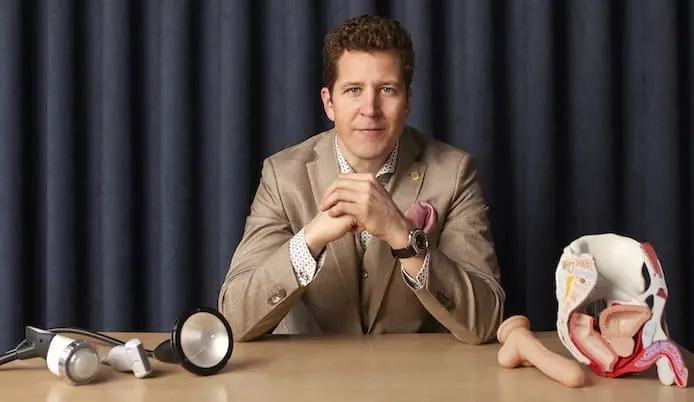
Written and medically reviewed by Michael Strøm
International speaker & expert in shockwave and EMTT treatment for erectile dysfunction, Peyronie’s & CPPS. Read more about me
Prostate surgery: what you need to know – and what I can help you with afterwards
Prostate surgery may be necessary for benign prostatic hyperplasia (BPH) or prostate cancer – but for many men the worries really start afterwards: erectile dysfunction, decreased desire, pelvic pain, altered orgasm or urinary problems. I often meet men who feel alone because “the surgery went well”. Here’s a comprehensive, honest overview of prostate surgery, typical after-effects and your options – and how I can help you with evidence-based diagnostics and treatment.
I’m writing directly because I know how much it can affect everyday life: when your body doesn’t respond as it should, it can affect your identity, relationships and confidence. It’s normal to feel frustrated or insecure, and it’s also normal to need more help than “give it time”.
In this article
- What is prostate surgery?
- Typical types of prostate surgery (short and understandable)
- Genes and side effects after prostate surgery – what men are typically not prepared for
- When should you seek help after prostate surgery?
- How I help you at MS Insight after prostate surgery
- Typical questions about prostate surgery (FAQ)
- Take the next step: get a plan that fits your body and your life
What is prostate surgery?
“Prostate surgery” is a common term for procedures that either remove the entire prostate, parts of it or create a better passage through the urethra. The aim can be to improve urination, remove tissue that causes discomfort – or treat cancer.
It’s important to understand that the prostate is in close proximity to nerves and blood vessels that are crucial for erection, sensation and pelvic floor fine motor control. Therefore, prostate surgery – even when performed well – can affect intimate health for weeks, months or longer.
In particular, I see that many people underestimate the “aftermath” in the body: scar tissue, altered sensation, periods of pain and a stressed pelvic floor can keep symptoms going even when the surgical wound has healed nicely. This doesn’t mean that something has gone wrong – but that the body needs targeted support to get back to stable function.
Typical types of prostate surgery (short and understandable)
Surgery for enlarged prostate (BPH)
For benign enlargement, the goal is often to improve urine flow and reduce discomfort such as frequent urination, nocturnal toileting and weak stream. This can be done with various methods, typically via the urethra. Some men experience subsequent changes in ejaculation and sexual function.
What I often explain is that changing the “passage” through the prostate area can affect the way the body coordinates ejaculation. For some, it’s a small thing. For others, it feels significant because the orgasm experience changes or because there is uncertainty about what is normal.
Radical prostatectomy (removal of the prostate for cancer)
Here the prostate (often also seminal vesicles) is removed. Depending on the disease and surgical method, nerves can be spared (“nerve sparing”), but erectile dysfunction after prostatectomy is still common – especially in the early stages (up to a year and more).
I meet many people who are surprised by how much the “erectile system” can be affected, even if the surgeon has done everything right. Nerves can be temporarily irritated and blood flow can change, which can cause a period of lower response. For some, it also manifests as pelvic discomfort or a feeling of not quite being able to “feel yourself” as before. This is where shockwave and EMTT can be a great part of the rehabilitation process to increase healing and regeneration of both nerves and blood vessels, and reduce the amount of scar tissue after the procedure.
Other interventions and variations
There are several techniques and energies, and you may experience different aftermaths. The point is: Symptoms after prostate surgery are not “imaginary” – they are biologically and mechanically understandable, and they can often be improved with the right efforts.
I always start with your specific situation: what was the reason for the surgery, what are you experiencing now, and how does your body react in everyday life and intimate situations? It’s typically the combination of several factors that determines whether you move on quickly or get stuck in a pattern.
Genes and side effects after prostate surgery – what men are typically not prepared for
The most common concerns I hear are rarely about the surgery itself. They’re about life afterwards.
This is also where many men fall silent. Not because the problem is small, but because it can be hard to put into words: “I should just be grateful.” That thought makes sense, but it rarely helps. You may be relieved about the treatment and at the same time need help to get your body back on track.
Erectile dysfunction (erectile dysfunction)
Reduced ability to get or keep an erection can be due to the effects on nerves, blood vessels and tissue elasticity. Some experience gradual improvement over time, others need active treatment to rebuild function using shockwave and EMTT. As well as effective home exercises to improve mobility and blood flow.
I often see that erectile dysfunction is not just about “strength”, but about stability and confidence in the body: maybe the erection comes, but quickly disappears. Maybe you can get an erection alone, but not with a partner. Or maybe the desire is there, but your body doesn’t “switch on”. By mapping out the pattern, I can better target my efforts towards what’s really limiting you.
Pelvic pain and tension
Pain, heaviness, burning or “electric” sensations may be related to pelvic floor muscle tension, scar tissue, irritation of nerves (e.g. pudendal nerve) or a CPPS-like pattern (chronic pelvic pain).
In practice, CPPS means that pain and discomfort can be maintained by an overactive nervous system and a pelvic floor that is constantly “on guard”. After prostate surgery, the body can get into that state: you unconsciously tense up, you hold back when urinating, or you become extra alert to signals from the area. It’s a completely human reaction – and it’s treatable once I identify the factors that are driving your symptoms.
Incontinence and urinary problems
Leakage, urgency (sudden strong urge to urinate) or uncertain bladder control can occur, especially in the post-surgery period. Pelvic floor function and nervous system regulation play a major role.
I also find that some men start to “plan their life around toilets” or avoid activity because they are afraid of leakage. This affects quality of life and can create more tension in the pelvis. Here, a more precise clarification of the role of the pelvic floor can make training and strategies far more effective than randomly squatting and hoping for the best.
Altered ejaculation and orgasm
Some people experience retrograde ejaculation (semen goes backwards in the bladder) after certain BPH surgeries. After radical prostatectomy, ejaculation may cease, but orgasm may still be possible – though often altered. This can affect identity and confidence, and I take that seriously.
Let me be clear: it’s not “spoiled” to miss the way things were. Sexuality is not only about function, but also about intimacy, security and the experience of being yourself. When orgasm changes, it can cause sadness, shame or concern for the relationship. It’s a natural reaction and there’s often more to do than you think.
Decreased desire and sexual performance issues
When the body changes, the mind follows: anxiety, performance pressure, avoidance and lower desire are normal. I work with both the physical mechanisms and the psycho-sexual part, so you’re not alone with your thoughts.
Many men describe starting to “test” themselves: Is it working today? Can I deliver? This inner control can in itself dampen desire and erection because the nervous system becomes more alert than pleasurable. Here I help you get a calmer and more realistic focus so that your body has better conditions to respond again.
When should you seek help after prostate surgery?
I recommend that you respond if you:
- continue to have erectile dysfunction that limits sex life or intimacy
- Have pelvic pain, pressure, burning or discomfort that won’t go away
- Experiencing incontinence or urinary discomfort that affects everyday life
- Feel unsure about what is “normal” in your process
- have less desire, more anxiety or avoid closeness
You don’t have to wait until it’s “really bad”. Early, targeted action can make a big difference and is often better than waiting and seeing.
I often see men holding out for a long time because they don’t want to be a bother or because they think it will “go away on its own”. Sometimes it does. But if you feel yourself starting to align your whole life with the symptoms, it’s a clear sign that you deserve a plan – not just more time.
How I help you at MS Insight after prostate surgery
I specialize in men’s intimate health and often see the mixed issues that come after prostate surgery: erection + pain + nervous system anxiety + pelvic floor + performance pressure. My approach is evidence-based, practical and respectful.
My goal is for you to leave here with clarity: what is the most likely cause of your symptoms, what can you do from today, and what makes sense to initiate as a targeted program. For many, it’s a relief in itself to put words and direction to something that has felt diffuse and lonely.
Thorough assessment and advanced diagnostics
I start with a structured conversation and a professional assessment of what is likely driving your symptoms. I use ultrasound scanning when relevant to get a better picture of tissue, blood flow and function. The goal is to make it concrete: What is your pattern – and what can we do about it?
I also ask about the situations where the symptoms are worst: Is it during penetration, orgasm, after physical activity, stress, in certain positions or after prolonged sitting? These details allow me to differentiate between, for example, irritation pain, muscle tension and nerve sensitivity so that the treatment is not “one size fits all”.
Treatment of erectile dysfunction (erectile dysfunction)
I design an individualized course that can combine several methods – depending on your surgery, your current function and your goals. I offer focused shockwave therapy (focused sound waves), EMTT (electromagnetic transduction therapy) and neuromodulation when it makes sense. It’s all about supporting the tissues, blood vessels and nervous system towards better response and control.
As soon as the PSA is below 1, we can start treatment and rehabilitation with shockwave. For many people, starting treatment within the first 2 months after surgery gives a good effect.
At the same time, I work with setting expectations and concrete benchmarks so you can track progress. For many, it helps to get a language for progress that is not just about “yes/no erection”, but also about better sensation, more stable response, less anxiety and greater confidence in intimate situations.
Help with pelvic pain and CPPS-like symptoms
If you have pain, tension or symptoms similar to CPPS, I work to reduce overactivity in the pelvic floor and nervous system and normalize signals from the area. Many men find that “everything tightens up” after surgery and anxiety – and this can perpetuate pain.
I make it very practical: I help you understand what provokes the symptoms and how you can break the pattern. This may involve breathing and relaxation, changing the stresses of everyday life, better toilet routines and targeted techniques to calm the nervous system. When the body is calmer, function is often better.
Incontinence and pelvic floor function
I’ll help you understand if your discomfort is about weakness, overactivity, coordination or timing – because pelvic floor training is not a one-size-fits-all exercise. You’ll get a plan that’s realistic in your everyday life.
For some, it’s about building strength and endurance. For others, it’s about the opposite: releasing tension and improving coordination so that the pelvic floor doesn’t “lock up” and interfere with urination or cause anxiety. It’s important to me that you get a plan that you can actually implement and that can be integrated without taking up your whole life.
Psychosexual well-being – without taboos
If you experience performance pressure, insecurity or that you “withdraw” from intimacy, I include it in the program. Not as small talk, but because it affects the nervous system, desire and erection more than most people think. You need to feel comfortable in your body again.
I also meet men who have never spoken up about these things before. I respect that. You set the pace, and I keep the focus on what helps you move forward: concrete steps to reduce pressure, create better communication in the relationship, and get intimate experiences back to a level where you can be present instead of monitoring yourself.
Typical questions about prostate surgery (FAQ)
Is erectile dysfunction after prostate surgery normal?
Yes, it’s common – especially after radical prostatectomy, but also after surgery for enlarged prostate. The extent and duration vary, and many can improve function with targeted treatment.
How long does it take to recover sexually?
It is individual. Some feel improvement over months, others need a longer process. The most important thing is to find out what’s causing the problem for you, so you don’t just keep hoping.
Can pelvic pain after prostate surgery be caused by nerves?
They can. Nerves in the pelvis can become irritated and the body can compensate with muscle tension. I often see a mixture of tissue, muscle and nervous system that can be treated when we get it mapped out.
Can I have an orgasm if my prostate has been removed?
Many people can still orgasm, but the experience can change and there is typically no ejaculation. For some, it takes adjustment and calming the body again – and I help you work towards that.
When does it make sense to contact me?
If you have conditions that affect your quality of life – or if you’re just not sure what’s normal – now makes sense. The sooner I get direction, the better.
Take the next step: get a plan that fits your body and your life
Prostate surgery can save lives and improve urination – but don’t accept a sex life or everyday pain and uncertainty as the “price”. I offer a safe, professional consultation and a treatment program that takes both body and mind seriously.
If you want answers to why you have erectile dysfunction, pelvic pain or urinary problems after prostate surgery – and what you can do about it – contact me at MS Insight in Copenhagen. I meet you at eye level, without taboos, and with a focus on solutions.
If you are interested in hearing more about how I can help you, you are always welcome to contact me by phone 41 40 08 58 or email michael@msinsight.dk. I’ll get back to you quickly with a customized proposal so we can find the best way forward together.
Would you like a specialist assessment of your situation?
You don’t have to figure it out alone. Call directly or write a few lines about your symptoms – I’ll get back to you within 12-24 hours with a concrete suggestion for the next step.