

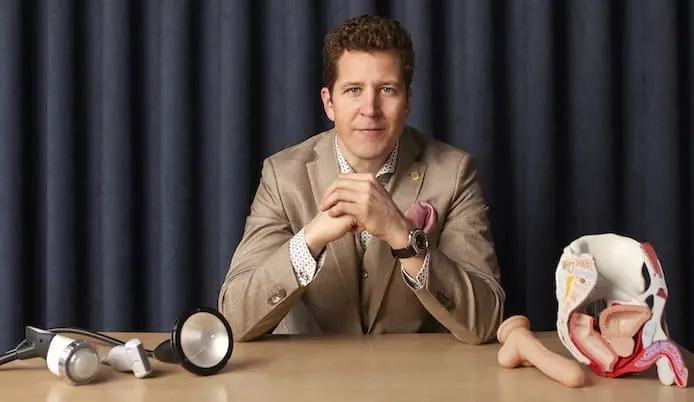
Written and medically reviewed by Michael Strøm
International speaker & expert in shockwave and EMTT treatment for erectile dysfunction, Peyronie’s & CPPS. Read more about me
Midlife crisis in relationships: When your body goes on strike and your emotions go haywire
Being in midlife can feel like being at a crossroads without a road sign. A midlife crisis in a relationship is rarely just about whether you and your partner are still emotionally compatible. For the many men I help in my Copenhagen clinic, the crisis is a complex cocktail of existential considerations, career pressures and – often most frighteningly – physical changes. When potency fails or unexplained abdominal pains appear, the bedroom becomes the stage where the drama unfolds. But there is help, and the solution starts with understanding the close connection between your body, your mind and your life situation.
In this article
What does a midlife crisis in relationships actually cover?
Unfortunately, the term “midlife crisis” is often reduced to a caricature of the man buying a fast sports car or seeking validation from a younger model. The reality as I encounter it is far more nuanced and painful. When men aged 40 to 60 experience a relationship crisis, it often stems from a profound loss of identity and control.
I often see men who have achieved it all – career, wealth, family – but are suddenly struck by an indefinable emptiness. When this inner turmoil takes hold, it inevitably spills over into the relationship. You may withdraw into yourself, become shorter in the head or lose the desire for closeness. This is where the doubt arises: am I tired of my partner or am I really deeply frustrated with my own body and ability to function?
The answer is often a combination. If you experience erectile dysfunction or pelvic pain, intimacy suddenly becomes associated with fear of defeat rather than pleasure. This creates a physical and mental distance from your partner that can be misinterpreted as a lack of love, even if the root of the problem is a health and existential crisis.
When the body reacts to crisis: Erectile dysfunction and pain
A midlife crisis in a relationship is not an isolated mental state. Body and mind are inextricably linked, and the massive stress of a life crisis often manifests itself physically. In my everyday life, I work with men whose intimate health is compromised due to both physical and mental factors.
Erectile Dysfunction (Erectile Dysfunction)
As we age, our testosterone levels naturally decline and the elasticity of our blood vessels decreases. But if you’re in a midlife crisis of stress, worry or grief, your body is flooded with stress hormones like cortisol and adrenaline. These hormones cause blood vessels to contract – the exact opposite of the relaxation needed to achieve an erection.
Many men fear that erectile dysfunction at this stage of life is “the beginning of the end”. It rarely is. I see it more as the body’s warning light going off. It can be a sign of incipient lifestyle diseases such as atherosclerosis, but it can just as easily be a psychological blockage that is directly reinforced by the crisis in the relationship.
Chronic pelvic pain and tension
Another common symptom I treat for men’s midlife crisis is chronic pelvic pain (CPPS) or tension around the pudendal nerve. Men tend to “tighten up” the pelvic floor when we’re under pressure, just like you can tighten up your neck, shoulders or jaw.
If you’re dealing with unresolved frustrations in relationships or life in general, this constant, unconscious tension can lead to painful conditions that make sexual activity unpleasant or even impossible. It becomes a vicious circle: the pain kills the desire, the lack of desire creates distance, and the distance intensifies the crisis.
The vicious circle: Performance anxiety and avoidance behavior
When the midlife crisis in the relationship merges with intimate problems, a behavior I call the “avoidance strategy” often emerges. Maybe you sit in front of the TV longer than your partner to avoid that expectant look in the bedroom. Maybe you excuse yourself more often because you’re tired or busy at work.
This is a classic defense mechanism. No man likes the feeling of not being able to “deliver”. But by consistently avoiding intimacy, you also remove the opportunity for the physical closeness and care that could have helped soften the crisis.
In my experience, many men feel incredibly alone in this situation. It’s rarely something you discuss with friends over a beer, and it can feel impossible to say to your partner, “I’m afraid I can’t perform because I feel pressured about my life.” Instead, silence ensues. My job is to help you break that silence and offer a concrete, actionable way forward.
This is how I help you: A combination of technology and conversation
At MS Insight, I approach your situation from two angles: the physiological and the sexological/psychological. We can’t save the relationship if the body doesn’t work, and we can’t fix the body permanently if the head is filled with chaos.
Advanced diagnostics and treatment
First of all, we need to get the facts on the table. I offer specialized ultrasound scans to examine blood flow in the penis and pelvic floor. Are these physical changes or is it primarily stress-related?
If the problem is physical – such as reduced blood flow or scar tissue (Peyronie’s) – I use the most effective technologies on the market:
- Focused shockwave therapy: I use focused sound waves that stimulate the formation of new blood vessels (neovascularization) and activate the body’s own healing processes. It’s important to emphasize that I use focused shockwave as these waves penetrate deeper and more precisely into the tissue than the radial systems often seen in wellness clinics. The treatment restores natural function without the use of medication.
- EMTT (Electromagnetic Transduction Therapy): This technology works on a cellular level to reduce inflammation and pain in the pelvis. It’s particularly effective if your midlife crisis has settled as chronic tension in the lower abdomen.
- Neuromodulation: If your nerves are overactive or “stressed”, we can calm the nervous system so you can regain your composure and reduce pain signals.
The sexological angle: The conversation that moves mountains
The machines are effective, but they can’t stand alone when it comes to midlife crisis in relationships. As an integral part of the program, I draw on my sexological background. We need to talk about what’s difficult, but in a way that is solution-oriented and free of clichés.
Among other things, we work with:
- How do you communicate your needs and insecurities to your partner without feeling like you’re losing your masculinity?
- How do we remove the pressure to perform so that sex becomes a presence rather than an exam you have to pass?
- Lifestyle factors: Sleep, diet and exercise play a huge role in both testosterone levels and mental energy to deal with the crisis.
I also guide you on which blood tests it might be relevant to talk to your own doctor about. I don’t coordinate directly with the doctor, but I will thoroughly prepare you to have the important dialog yourself to ensure that hormonal imbalances or underlying diseases are not overlooked.
The way out of the crisis starts with action
A midlife crisis in a relationship doesn’t have to end in divorce or resignation. In fact, I often see in my clinic that the crisis becomes a crucial turning point where the man starts to take himself and his health seriously for the first time in many years.
When we treat the physical symptoms – when the erection becomes stable again or the pain subsides – something happens to the mind. You regain faith in yourself and your body. You can take that energy directly into your relationship. Suddenly, you’re no longer the avoidant, irritable man, but a partner with the energy for closeness and intimacy.
It takes courage to book the first appointment; I know that. Many men wait far too long because they feel uncomfortable talking about their genitals and feelings. But with me, you’ll find no prejudices, only professional curiosity and a sincere desire to help you get back to a good life.
I have my clinic in Copenhagen, but I have clients from all over the country who choose to make the trip, precisely because here they get a holistic treatment that takes the man, the body and the problem seriously.
If you are interested in hearing more about how I can help you, you are always welcome to contact me by phone 41 40 08 58 or email michael@msinsight.dk. I’ll get back to you quickly with a customized proposal so we can find the best way forward together.
Would you like a specialist assessment of your situation?
You don’t have to figure it out alone. Call directly or write a few lines about your symptoms – I’ll get back to you within 12-24 hours with a concrete suggestion for the next step.