
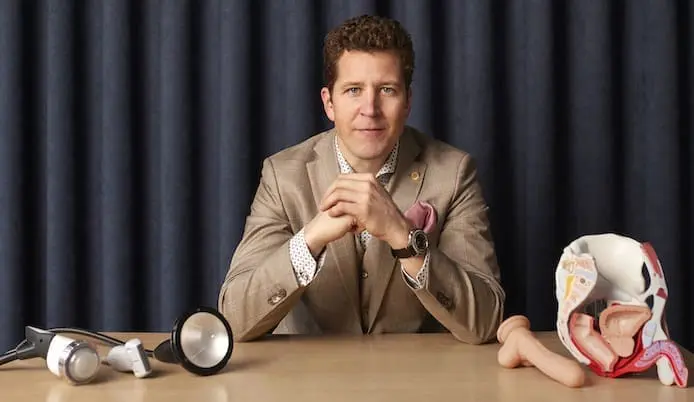
Michael Strøm
International speaker and expert in shockwave and EMTT treatments for men's sexual health.
In this article
- What is TECAR therapy?
- What does a TECAR treatment feel like?
- What can TECAR be used for?
- TECAR and Connective Tissue
- TECAR for pelvic pain, CPPS, and prostatitis-like symptoms
- Tense or Overactive Pelvic Floor
- Incontinence and Problems After Prostate Surgery
- Pudendal-Related Pain and Nerve Irritation
- Erectile Dysfunction
- Peyronie’s disease and scar tissue in the penis
- Scar tissue after surgery
- Why do I combine TECAR with other treatments?
- TECAR can be the first step in treatment
- What is the difference between TECAR and shockwave therapy?
- Do I need to know on my own whether TECAR is the right treatment?
What is TECAR therapy?
TECAR is a radiofrequency-based treatment used to affect the tissue in the area being treated. You don’t need to understand frequencies or technical details to benefit from the treatment.
The most important thing is that the technology allows me to work with the tissue in a different way than with manual therapy alone. Depending on how the treatment is used, the goal may include supporting local blood flow, addressing tissue mobility and tension, and creating better conditions in the area I’m treating.
TECAR is therefore not just a machine you lie under. It’s a treatment that can be actively integrated into the work I already do with muscles, connective tissue, and movement.
What does a TECAR treatment feel like?
Most people find the treatment comfortable. Depending on the purpose, you may feel a mild or distinct warmth in the area while I’m working on the tissue. The intensity is continuously adjusted based on the area, your response, and what I’m aiming to achieve.
At the same time, I can use pressure, movement, and manual therapy. This allows me to assess as I go whether the area is becoming more mobile, less tense, or easier to work with.
What can TECAR be used for?
I don’t use TECAR based on a diagnosis alone. I use it when the examination shows that the tissue is part of the problem, for example in cases of:
- tight or stiff connective tissue and fascia
- muscle tension and areas that feel locked up
- scar tissue and discomfort following surgery
- reduced mobility and chronic pain
- issues related to the pelvis and pelvic floor
This also means that two people with the same diagnosis may well receive different treatments. For one person, TECAR may be an important part of the treatment plan. For the other, focused shockwave therapy, EMTT, pelvic floor therapy, or manual therapy may be more appropriate.
TECAR and Connective Tissue
One of the areas where TECAR is particularly useful is in working with fascia and connective tissue. If an area has been tense or painful for a long time, the tissue may feel less pliable and less mobile.
In such cases, I can use HumanTecar in conjunction with manual therapy to address the tissue’s mobility and tension. However, I don’t use TECAR based on the idea that everything just needs to be “loosened up.” The most important thing is to understand why the area became tight in the first place. Read more about treating connective tissue and fascia.
TECAR for pelvic pain, CPPS, and prostatitis-like symptoms
In cases of prolonged pelvic pain, the body may begin to protect the area by constantly tensing up. This can involve the muscles, fascia, and nervous system. If, during the examination, I find areas around the pelvis, perineum, hip, or pelvic floor that are very tense, tender, or have limited mobility, I can use TECAR to first work on the tissue and make the area easier to treat.
Afterward, I can, for example, continue with focused shockwave therapy, EMTT, or another relevant treatment. This is particularly beneficial for patients for whom massage or exercises alone have provided only short-term relief, but where the problem quickly returns. Read more about pelvic pain, CPPS, and prostatitis.
Tense or Overactive Pelvic Floor
A pelvic floor can be too weak, but it can also be too tight. If the muscles and tissue around the pelvic floor are constantly tense, it can be difficult to simply exercise your way out of the problem.
Here, TECAR can be incorporated into the process of making the area less sensitive and more mobile before I move on to active exercise or other treatments. If, on the other hand, the problem is primarily related to a lack of strength or activation, the Pelvic Chair or targeted pelvic floor exercises may be more appropriate. It is therefore important to first determine whether the pelvic floor needs to be strengthened, relaxed, or both. Read about a tight pelvic floor.
Incontinence and Problems After Prostate Surgery
After prostate surgery, rehabilitation isn’t just about strengthening the pelvic floor. There may also be tension, scar tissue, altered mobility, and an area that the body is still protecting.
If this is part of the problem, TECAR can be used to treat the tissue first. After that, I can continue with, for example, the Pelvic Chair, pelvic floor exercises, EMTT, or other relevant treatments. So TECAR doesn’t replace the exercises, but in some cases it can help create better conditions for them. Read more about incontinence.
Pudendal-Related Pain and Nerve Irritation
In cases of pudendal nerve-related pain, it is rarely sufficient to focus solely on the nerve. The tissue surrounding the nerve’s path may also be tense, sensitive, or less mobile.
If that is the case, TECAR can be used to treat the surrounding structures. The treatment will often be part of a broader strategy, in which I also consider manual therapy, EMTT, and changes in load or movement patterns. Read more about the pudendal nerve.
Erectile Dysfunction
For erectile dysfunction, TECAR is not necessarily the primary treatment. In these cases, I must first determine whether the problem is related to, for example, blood flow, nerve function, hormones, medication, or the pelvic floor.
In some men, however, I also observe significant tension in the pelvic floor, perineum, and the area around the base of the penis. If this component is present, TECAR can be used as a supplement to treat the tissue surrounding the problem, while more targeted treatment of the erectile dysfunction itself may involve focused shockwave therapy, EMTT, or pelvic floor therapy. Read more about erectile dysfunction.
Peyronie’s disease and scar tissue in the penis
Peyronie’s disease involves more specific tissue changes in the penis, and treatment therefore requires a more targeted assessment. TECAR cannot be used as a standalone treatment for Peyronie’s disease, and I do not use the technology with the promise that it can correct a curvature.
However, if there is also stiff, sensitive, or scar-like tissue present, TECAR may be relevant as a supplement in a comprehensive treatment plan. In such cases, ultrasound scanning, plaque assessment, blood flow evaluation, and focused shockwave therapy will typically play a more central role. Read more about Peyronie’s disease and penile curvature.
Scar tissue after surgery
After surgery, the incision itself may have healed well, while the surrounding tissue still feels tight, hard, or tender. This can occur, for example, after surgery in the abdomen, pelvis, lower abdomen, or prostate area.
In these cases, TECAR can be used in combination with manual therapy if the goal is to improve the mobility of the tissue and the surrounding structures. It’s not about “removing the scar tissue,” but about helping the area function better. Read about scar tissue after surgery.
Why do I combine TECAR with other treatments?
Because different treatments affect the problem in different ways. TECAR may be appropriate when I want to address tissue mobility, tension, and local conditions. Focused shockwave therapy may be appropriate when I want a more targeted mechanical effect, while EMTT allows me to work on larger and deeper tissue areas without the same mechanical stress.
The Pelvic Chair can be used when pelvic floor activation and strength are a significant part of the problem, and manual therapy can be used simultaneously to work directly on movement and tension in the tissue.
That doesn’t mean that using more technologies automatically leads to better results. The advantage is that I’m not limited to a single treatment method, but can choose and combine approaches based on what I find when I examine you.
TECAR can be the first step in treatment
Sometimes an area is so tense, sensitive, or restricted in movement that it makes sense to work on the tissue itself first. In these cases, TECAR can be used as a way to prepare the area.
If the tissue becomes more mobile and less sensitive, it may subsequently be easier to proceed with treatments such as shockwave therapy, EMTT, or active exercise. For others, TECAR becomes the primary treatment, and for some, it isn’t necessary at all. That’s why I don’t follow a single, fixed TECAR protocol.
What is the difference between TECAR and shockwave therapy?
The two treatments are very different. TECAR is typically a gentler treatment, where I work with the tissue as I go. Shockwave, on the other hand, provides a more direct mechanical impact on a specific area.
Therefore, it is not necessarily a question of choosing between TECAR and shockwave therapy. In some cases, the two treatments can complement each other. The same applies to EMTT.
Do I need to know on my own whether TECAR is the right treatment?
No. You also don’t need to book TECAR specifically. The most important thing is that I first determine the cause of your problem, which structures are involved, and what is likely keeping the problem going.
During the initial consultation, I’ll review your medical history and examine the relevant structures. For some conditions, an ultrasound scan may also be part of the evaluation. I’ll then develop a treatment plan, which may include TECAR—but could also be something entirely different.
I choose the treatment based on the problem—not the problem based on the treatment.
Find out if TECAR is right for you
Do you have an area that keeps feeling tight, sore, or stiff?
You don’t need to know which treatment you need. That’s my job to figure out.
Start with a no-obligation consultation about your symptoms. Then I’ll assess whether an evaluation at MS Insight is the right next step, and whether TECAR, shockwave therapy, EMTT, or something else entirely makes the most sense for your situation.