

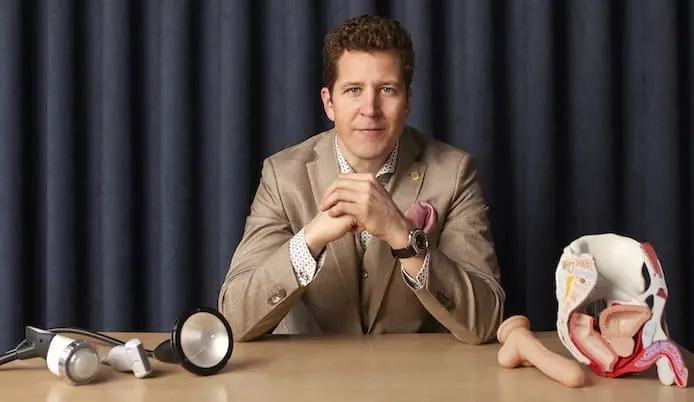
Written and medically reviewed by Michael Strøm
International speaker & expert in shockwave and EMTT treatment for erectile dysfunction, Peyronie’s & CPPS. Read more about me
What is phimosis – and why does it affect so many?
Phimosis – or balanoposthitis, as it’s known professionally when both the foreskin and head of the penis are involved – is one of the conditions I see most often in the clinic. It’s an inflammation of the foreskin and often the glans itself. Although it’s an incredibly common condition that can affect men of all ages, it’s unfortunately still a taboo for many. I often see men who associate the condition with shame and worry, when there is absolutely no reason to do so.
In my view, intimate health is never isolated to the purely physical. An irritated, red or painful foreskin directly affects your desire, your ability to relax and ultimately your quality of life. When the skin on your penis is imbalanced, your nervous system sends constant danger signals to your brain. This can cause you to unconsciously tighten your pelvic floor to protect the area, which paradoxically can cause erectile dysfunction. That’s why I don’t just see phimosis as a skin problem, but as a barrier to your overall male wellbeing.
In this article
Typical symptoms of phimosis
Symptoms range from mild redness to pain that makes it impossible to touch the penis. It’s crucial to act before the condition becomes entrenched and chronic. The classic signs I tell my clients to look out for are:
- Redness and swelling: The skin on the foreskin and glans appears red, irritated and often shiny or tense.
- Intense itching and burning: A bothersome itching or burning sensation that often worsens with urination or touching.
- Coatings and odor nuisance: Accumulation of smegma (neck cheese) under the foreskin, which can develop an unpleasant odor and whitish deposits.
- Pain with activity: Sex and masturbation go from pleasurable to painful due to friction.
- Narrowing of the foreskin: The swelling and inflammation can make the skin less elastic, making it difficult or downright painful to pull the foreskin back over the head. Effectively treated with Novoglan in the clinic.
If you recognize these symptoms, it’s important to seek help. Many men wait in the hope that it will go away on its own, but untreated phimosis can, over time, lead to scar tissue formation and a permanent narrowing (phimosis) that is more difficult to correct.
Causes: It’s rarely about poor hygiene
Let me make one thing clear right away: The myth that phimosis is caused by being “dirty” is just that – a myth. In my clinic, I actually see the exact opposite problem more often. Many men wash too aggressively in an attempt to keep the area clean. But intimate soap, shower gel and frequent scrubbing destroy the natural bacterial flora and dry out the delicate mucous membranes. This creates a breeding ground for fungus and harmful bacteria.
The most common causes I encounter are:
- Fungal infection (Candida): yeast thrives in the warm, moist environment under the foreskin.
- Bacterial imbalance: When the skin’s natural defenses break down, foreign bacteria can take over.
- Contact dermatitis and irritation: An allergic or irritant reaction to detergent, soap, condoms or lubricants.
- Diabetes: This is an important factor. Sugar in the urine feeds fungus, which is why men with diabetes have a significantly increased risk of recurrent phimosis.
- Underlying skin conditions: Diseases such as Lichen Sclerosus can be mistaken for common irritation in the early stages.
Phimosis and sexual function
As a male genital specialist, I have a strong focus on functionality. A healthy foreskin should be elastic and glide effortlessly. When the foreskin is inflamed, it loses this elasticity. This means that the natural movement during erection and intercourse is inhibited, causing pain (dyspareunia). And pain is the biggest killer of a good erection.
I often see a vicious circle in my clients: the pain or fear of pain causes you to tense up your pelvic floor. This chronic tension can lead to perineal pain and erectile dysfunction, even after the inflammation has subsided. The body remembers the pain. That’s why I never just treat the surface; I assess the whole area – from the quality of the tissue to the state of tension in your pelvic floor.
Chronic phimosis and Lichen Sclerosus
If you find that the phimosis keeps returning or that your foreskin is gradually becoming tighter, whitish and forming small cracks, we need to be extra vigilant. This could be a sign of Lichen Sclerosus, a condition where the skin forms scar tissue and loses its elasticity. Ordinary creams are rarely enough.
While your GP typically treats the acute flare-up with adrenal cortex hormone, I focus on rebuilding long-term tissue health. If tissue changes are suspected, I use advanced ultrasound scanning. This allows me to see below the surface of the skin and assess the extent of scar tissue or thickening, so we know exactly what we’re treating.
Treatment: How I help you
When you come for a consultation with me, we always start with a thorough discussion and examination. I emphasize creating a safe space where we can talk openly about both the physical discomfort and the frustrations that come with it.
Ultrasound and precise diagnostics
I use high-frequency ultrasound to map the structures of the penis. Is there thickened tissue? Is there incipient scar tissue formation? What does the blood flow look like? This gives us a concrete and factual basis for planning the right treatment.
Focused sound waves and EMTT
If the inflammation has left the tissue stiff, scarred or painful, medicated creams are rarely enough to restore function. Here I use focused sound waves (shockwave) combined with EMTT (Electromagnetic Transduction Therapy). This technology is extremely effective:
- Break down scar tissue and soften thickened tissue.
- Stimulate the formation of new, healthy blood vessels (angiogenesis).
- Reduce inflammation down to the cellular level.
- Restore the natural elasticity of the foreskin.
The treatment is non-invasive, without side effects, and addresses the root cause of tissue dysfunction rather than just treating symptoms.
Guidance and collaboration with the doctor
If I assess that you have an acute, active infection that requires antibiotics or antifungal medication, I will guide you on exactly what to ask your own doctor for, such as a specific swab. I don’t take over the doctor’s role in acute disease management, but I make sure you are equipped to get the right medical help while we work in the clinic to optimize the tissue and ensure the problem doesn’t recur.
Prevention and self-help tips
During a course of treatment, there are several things you can do to alleviate symptoms and avoid exacerbations. In my experience, a few adjustments in everyday life make a big difference:
- Wash with care: Rinse the penis with lukewarm water once a day. Avoid soap directly on the glans and under the foreskin. If you must use soap, choose a mild intimate soap and use it sparingly.
- Dry yourself thoroughly: Moisture is the enemy. Make sure you’re completely dry under the foreskin after showering before you pull it out again. Dab gently – do not rub.
- Avoid irritation: wear loose-fitting cotton underwear that allows the skin to breathe and avoid synthetic materials that retain heat.
- Sexual hygiene: Rinse the penis with water after intercourse or masturbation to remove any body fluids or lube residue that may irritate the delicate skin.
Frequently asked questions about phimosis
Is phimosis contagious?
Dermatitis is generally not a contagious disease. However, if the cause is a fungal infection, it can theoretically be transmitted to a partner, but it is rare for the partner to develop symptoms. If it is caused by an STI, it is of course contagious. If you are unsure of the cause, I always recommend a test.
Can I have sex when I have phimosis?
I generally recommend taking a break from sex until the acute inflammation and pain are gone. Friction can significantly worsen the condition and if the skin cracks, the risk of further infection increases. Listen to your body – pain is a signal to stop.
Why does my foreskin feel tighter than before?
Repeated inflammation creates microscopic wounds that heal as scar tissue. Scar tissue is far less elastic than healthy skin. Over time, this can lead to phimosis. This is where my focused sound wave treatment can make a crucial difference by softening the tissue again.
Get help for healthier intimate health
Phimosis should not be a condition you just learn to live with or limit your sex life. At MS Insight, I meet you at eye level, without prejudice and with a deep professional understanding of the mechanisms at play.
I offer a professional assessment and a tailored program that not only relieves symptoms now, but strengthens the tissue and prevents future problems. You don’t have to accept pain, odor or irritation as a regular part of your everyday life.
If you are interested in hearing more about how I can help you, you are always welcome to contact me by phone 41 40 08 58 or email michael@msinsight.dk. I’ll get back to you quickly with a customized proposal so we can find the best way forward together.
Would you like a specialist assessment of your situation?
You don’t have to figure it out alone. Call directly or write a few lines about your symptoms – I’ll get back to you within 12-24 hours with a concrete suggestion for the next step.