

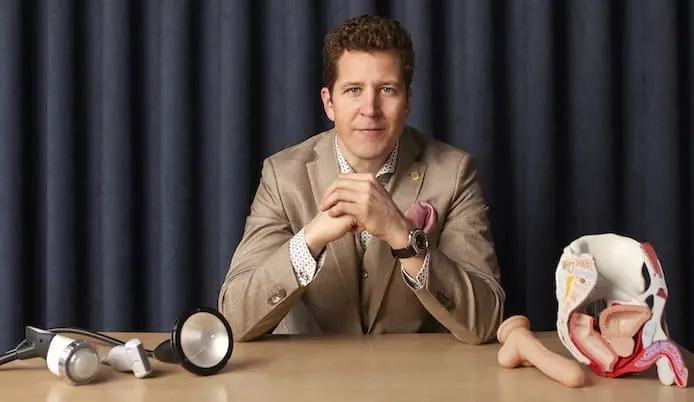
Written and medically reviewed by Michael Strøm
International speaker & expert in shockwave and EMTT treatment for erectile dysfunction, Peyronie’s & CPPS. Read more about me
Prostate score (PSA): What it means for your intimate health – and when to take action
What is Prostate Score (PSA)?
PSA stands for prostate-specific antigen – a protein that is produced in the cells of the prostate gland and is normally secreted into the seminal fluid. A small amount escapes into the bloodstream. Your “Prostate Specific Antigen (PSA)” is just the concentration that can be measured in a blood test (expressed as ng/mL or µg/L – the same unit). PSA is prostate-specific, not cancer-specific. Therefore, PSA is not a diagnosis in itself, but a risk marker that can point to both benign and more serious conditions.
An elevated PSA can be seen in prostate cancer, but also frequently in benign prostatic hyperplasia (BPH), inflammation of the prostate (prostatitis) and after irritation of the prostate. The number should always be interpreted in the context of age, symptoms, medication and other findings. At my clinic, MS Insight in Copenhagen, I help you understand your PSA in relation to your overall intimate health – especially if you also experience erectile dysfunction, pelvic pain or urinary problems.
When does it make sense to have my prostate count measured?
- You have persistent urination symptoms (weak stream, frequent/nighttime urination, sudden urge).
- You have persistent pelvic/perineal pain, possibly with prostate tenderness.
- You have an increased risk of prostate cancer (close family history of prostate cancer, especially early onset or if you belong to a risk group).
- You are considering testosterone replacement therapy (TRT) and need baseline and ongoing monitoring.
- You’re worried and want a starting point to follow developments over time.
In Denmark, no general PSA screening is recommended for all men. Instead, an individual assessment is recommended, typically for men aged around 50-70 years, earlier if you are at increased risk. I can help you decide if a PSA test is relevant for you – and how to prepare yourself so that the result is as reliable as possible. For some people, for example, it makes sense to have a “personal zero point”, which can then be compared with new measurements.
What is a “normal” prostate number (PSA)?
“Normal” depends on age, prostate size and context. Deficiency means it should be zero, but there may be a higher number without it being dangerous. As a rule of thumb, age-adjusted reference ranges are often used, e.g:
- 40-49 years: up to approx. 2.5
- 50-59 years: up to approx. 3.5
- 60-69 years: up to approx. 4.5
- 70-79 years: up to approx. 6.5
Some laboratories work with different thresholds, and some GPs use a screening threshold of 3 for men aged 50-70. The bottom line is this:
- Am I looking at the number in isolation or over time (PSA development/”velocity” – how fast it changes)?
- What is your prostate size (a larger gland often produces more PSA)?
- Are there any symptoms or findings that indicate inflammation?
- Are there any medications that affect the measurement?
There are also additional markers and calculations such as free PSA (the proportion of PSA circulating freely in the blood), PSA density (PSA relative to prostate volume) and composite risk tests. This can provide a more nuanced risk picture than total PSA alone. I will assess with you whether any of this is relevant to your situation so that you are neither under- nor over-screened.
Why can prostate numbers be elevated?
An elevated Prostate Score Index (PSA) does not automatically mean cancer. It is often caused by other, more common conditions:
- Benign prostatic hyperplasia (BPH): Very common with age and can raise PSA.
- Prostatitis/inflammation: Acute or chronic inflammation can significantly increase PSA and it can take weeks to normalize after treatment.
- Ejaculation: May temporarily increase PSA. Avoid ejaculation for 48 hours before the blood test.
- Cycling/Intense perineal pressure: May irritate the prostate. Take a break for 24-48 hours before the test.
- Urinary tract infection or urinary retention: Can cause significant elevation. Test only after the infection is treated and conditions are calm.
- Prostate manipulation: Biopsy can raise PSA for several weeks; a regular rectal exploration (DRE) minimally affects the number, but I still recommend coordinating timing of tests.
- Urinary catheterization and instrumentation: May temporarily affect PSA.
- Medication: 5-alpha reductase inhibitors (finasteride, dutasteride) often halve the PSA after a few months. This must be adjusted for when interpreting the result.
I always review your specific circumstances before coming to a conclusion on a number and may send you back to your GP if something is out of the ordinary. This reduces the risk of false alarms – and of us missing something that requires action.
How do I work in MS Insight with prostate numbers (PSA) and your overall health?
My focus is your function and safety. I offer:
- Thorough examination: Discussion of symptoms, lifestyle, sleep, stress and sexuality – and a review of your numbers (incl. Prostate score (PSA)).
- Advanced ultrasound: Assessment of bladder emptying, residual urine and estimated prostate volume. For erectile dysfunction, I also use ultrasound to understand blood flow and tissue conditions in the penis/pelvis.
- Evidence-based treatments: Tailor-made courses with focused shockwave therapy, EMTT (electromagnetic transduction therapy) and neuromodulation – especially relevant for erectile dysfunction, Peyronie’s disease and chronic pelvic pain (including pudendal pain ).
- Pelvic floor and nerve function: Exercise and neuromodulation to reduce pain, improve bladder control and calm the system.
- Sexology and lifestyle advice: Practical strategies to restore desire, intimacy and performance confidence – without taboos.
I have clients from all over the Nordic region and especially Copenhagen. You can come directly – you don’t need a referral. I set a clear plan and follow up so you feel confident and confident. If you are interested in hearing more about how I can help you, you are always welcome to contact me by phone 41 40 08 58 or email michael@msinsight.dk. I’ll get back to you quickly with a customized proposal so we can find the best way forward together.
PSA, erectile dysfunction and pelvic pain – how are they related?
PSA is not a “potency test”. But several conditions that affect the prostate gland and PSA can also affect erection, orgasm and pelvic wellbeing:
- Chronic pelvic pain and prostatitis can cause tenderness, ejaculation pain, frequent urination and decreased desire. Inflammation can raise the PSA and simultaneously trigger an alarm in the nervous system, exacerbating pain and tension patterns.
- Benign prostate enlargement can cause sleep disturbances and frequent trips to the toilet. Sleep deprivation, stress and anxiety are well-known inhibitors of erection and sex drive.
- Vascular conditions: Erectile dysfunction is often about the health of blood vessels. Risk factors for cardiovascular disease are also seen in many with prostate problems. These are two tracks that can mutually influence each other.
- After prostate cancer treatment (surgery/radiation), erection and bladder control can be affected. If you have concerns, early detection – and targeted rehabilitation – is about preserving as much function as possible.
In MS Insight, I put the pieces together: prostate, pelvic floor, nerves, vessels, sleep and psychosexual well-being. My goal is for you to feel less pain, have peace of mind and feel more confident in your sexuality – not just nice numbers on paper.
How to prepare for a PSA test
To get the most accurate Prostate Score Index (PSA) possible, I recommend:
- No ejaculation 48 hours before the blood test.
- Avoid heavy cycling or other direct pressure on the perineum 24-48 hours before.
- Postpone testing if you have a urinary tract infection, fever or acute prostatitis (typically wait 6-8 weeks after full recovery).
- Plan the test carefully after any instrumentation (catheter, cystoscopy) or biopsy.
- Tell if you are taking finasteride/dutasteride (PSA should be interpreted with correction).
- Take the blood sample at the same time of day with repeated measurements, if possible, for consistency.
It is not necessary to fast for PSA. Drink and eat as normal, unless you are told otherwise in connection with other blood tests. I’m happy to help coordinate the blood test via your GP or private laboratory so that we get the timing right – and avoid unnecessary sources of error.
What happens if your prostate count (PSA) is elevated?
An elevated PSA requires calm, systematic follow-up – not panic. Typical plan:
- Repeat the measurement
Often a control measurement after a short time is enough to clarify whether it was a transient effect. - Additional assessment
Return to GP, consider free PSA, PSA density and ultrasound to assess prostate volume and bladder emptying. Urinalysis may be relevant to rule out infection. - Advanced imaging
If suspicion persists, an MRI of the prostate is recommended. Today, MRI is often the next step before a biopsy and can identify areas that need further investigation. - Targeted urological assessment
If MRI or the overall risk picture suggests it, a urologist will perform a targeted (MRI-fusion) biopsy. Biopsy is only done on reasonable suspicion. Along the way, I will focus on your current symptoms to give you relief and direction during the assessment.
My role is to guide you safely through the process on the sidelines, so you understand every step – and get help for what you feel in your everyday life, right now. And you’ll be met as a human being, not just a number in the public system.
Prostate numbers (PSA) and medications/treatments
- 5-alpha reductase inhibitors (finasteride, dutasteride): Lower PSA approximately 50% after a few months. Your measured number should therefore often be multiplied by two to assess your “true” level.
- Alpha blockers (e.g. tamsulosin): Relieves urinary symptoms, usually does not significantly affect PSA.
- Antibiotics/anti-inflammatory treatment: In prostatitis, PSA may decrease gradually after treatment; please wait 6-8 weeks before checking.
- Testosterone replacement therapy (TRT): May cause a slight increase in PSA in some and requires baseline and regular monitoring. I always assess the benefits/risks together with you and your doctor.
- After prostate cancer surgery (radical prostatectomy): PSA should become unmeasurable. An increase afterwards requires urologic follow-up.
Always tell us about your medication and any supplements. This avoids misunderstandings and unnecessary worry when interpreting prostate numbers (PSA).
Frequently asked questions about Prostate numbers (PSA)
- How often should I measure PSA?
It depends on your age, risk profile and previous numbers. For many, annual or biannual checks make sense if there are concerns or symptoms. After an isolated slightly elevated reading, a repeat after 6-8 weeks may make sense. - Can sex before the test ruin the answer?
Ejaculation can temporarily raise the PSA. Take a 48-hour break before the blood test to avoid unnecessary fluctuations. - Can cycling affect my prostate number (PSA)?
Yes, hard cycling and pressure on the perineum can irritate the prostate and raise PSA briefly. Avoid cycling 24-48 hours before the test. - I take finasteride/dutasteride – what does that mean?
These drugs lower PSA by about 50% over time. Your doctor will need to correct for this. Always let them know if you are on treatment. - Is elevated PSA always linked to cancer?
Answer. BPH and prostatitis are common causes. PSA is a risk marker, not a diagnosis. If I have concerns, I follow a structured process with genetic testing, possibly additional blood tests, MRI and urological assessment. - Can low PSA rule out cancer?
A low prostate-specific antigen (PSA) indicates aggressive prostate cancer, but does not rule out all cases. The overall clinical assessment is important. - Does a rectal examination (DRE) make PSA unreliable?
A DRE can have minimal effect. Still, plan tests wisely and inform the lab about timing. - What if I have chronic pelvic pain and elevated PSA?
I often see PSA normalize as inflammation decreases. I focus on calming the tissue (neuromodulation/EMTT), optimizing the pelvic floor and reducing triggers – while ruling out serious disease in collaboration with the doctor/urologist.
Typical signs you should not ignore
- New blood in semen or urine.
- Persistent pelvic pain that doesn’t go away.
- Increasing difficulty urinating, especially if you feel unwell at the same time.
- Rapidly increasing PSA on repeated measurements.
If you are experiencing any of the above, you need to be examined. I’ll help you set the pace and direction of the investigation so you’re not alone with your anxiety.
My clear recommendation – get in touch and get a plan
If you’re worried about your prostate count (PSA), have erectile dysfunction, pelvic pain or concerns about your intimate health, contact me at MS Insight in Copenhagen. I meet you without prejudice and without taboo. I will work with you to create a plan that makes sense for your everyday life and your goals:
- I review your PSA in context – not as a number in a vacuum.
- I help you manage symptoms here and now with targeted treatment and advice.
- I clarify your risk and make effective referrals to imaging/urology when necessary.
- I work both physically and mentally to help you regain calm, control and function.
You don’t have to wait for it to get worse. Take the first step – I make it clear, concrete and safe.
If you are interested in hearing more about how I can help you, you are always welcome to contact me by phone 41 40 08 58 or email michael@msinsight.dk. I’ll get back to you quickly with a customized proposal so we can find the best way forward together.
Would you like a specialist assessment of your situation?
You don’t have to figure it out alone. Call directly or write a few lines about your symptoms – I’ll get back to you within 12-24 hours with a concrete suggestion for the next step.