

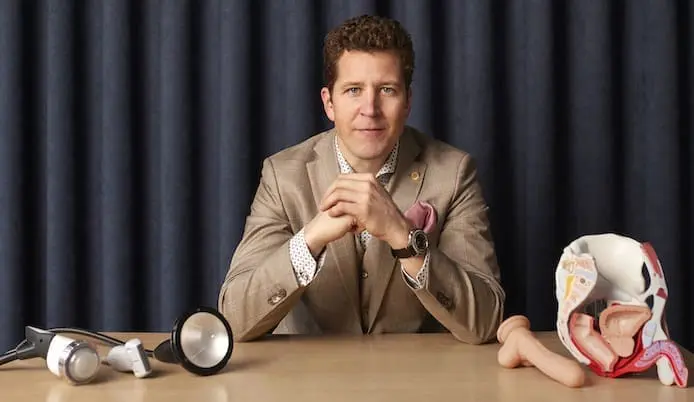
Educator: Michael Strøm
International speaker & expert in shockwave and EMTT therapy for erectile dysfunction, Peyronie’s disease, and CPPS. Learn more about me
The keynote at Venn Healthcare Innovation 2023
”Have you had a morning erection today?” Sometimes you have to start a conference with an unexpected question, and that is exactly how I opened my keynote. It raised smiles, but also reflection – because in men, morning erections are an important indicator of vascular and neurological health.
In the talk, I shared my experience with low-intensity focused shockwave (LI-ESWT) and EMTT for erectile dysfunction and Peyronie’s disease. I also presented my work on non-invasive treatment of male incontinence – an area that rarely gets the attention it deserves.

A conference is not only about talks. The conversations during the breaks and at the dinners were at least as valuable – especially the discussions with Ludger Gerdesmeyer, one of the pioneers of EMTT, about the future applications of the technology. Thank you to all participants and to Jonny, Sarah, Jenny, James, Thomas and the rest of the team behind the event. It was also a pleasure to meet Benoy, Helen and Stuart.
The conversation continued shortly afterwards when I met Gerard Greene and Yves De Vos at the Advanced Men’s Health course in Liverpool.
Focus of the teaching
The teaching focused on focused shockwave in men’s health and developments in incontinence. I emphasised the differences between technologies, energy delivery and practical patient selection rather than presenting a universal protocol. When I teach, the goal is for participants to be able to explain why a treatment is chosen, who it suits and when a different approach is more relevant.
Why it matters in a patient journey
With incontinence, ’a stronger pelvic floor’ is not always a sufficient answer. Timing, coordination, tissue, nerve function and the specific cause of the leakage all matter. The professional point is therefore to link the technology to function and measurement rather than using one standard protocol for everyone. A central point in my teaching is that ’shockwave’ is not one uniform treatment. Electrohydraulic, electromagnetic and piezoelectric systems generate and deliver energy differently. The focus should therefore be on tissue, target, energy, focal zone and patient selection – not just on the name of the technology or a standard protocol.
This is also how I want to work in the clinic: first understand the problem, then choose the examination and finally decide whether treatment makes sense. It reduces the risk of starting a standard course on too thin a basis.
From teaching to clinical quality
International teaching is not in itself evidence of a treatment effect. The value lies in the professional exposure: questions from other clinicians, comparison of devices and protocols, discussion of research and meeting other patient populations. It forces me to keep distinguishing between what is biologically plausible, what is clinically observed and what is actually supported by research.
Another important element is managing expectations. In areas such as sexual function, chronic pain and incontinence, two patients with the same headline can have very different causes and prognoses. One should therefore be precise about which problem is being targeted, how progress is measured, and when a lack of response should lead to a new assessment rather than simply more of the same treatment.
I also place emphasis on distinguishing between mechanism, clinical evidence and marketing. That a technology can affect tissue biologically is not the same as having a documented effect on every indication. Conversely, clinical evidence can be relevant without being directly transferable between different devices, doses or patient groups. That distinction is central both in teaching and in conversations with patients.
This is the professional link between teaching and clinic that I want these teaching activities to document: not a promise of results, but experience in assessing technology critically, following the evidence and translating it into more precise decisions for the individual patient.
Read more: assessment and treatment of erectile dysfunction · treatment of incontinence · the evidence for shockwave therapy
Documentation: This article is based on publicly available event material and/or LinkedIn posts. Sources: LinkedIn post · LinkedIn post
Would you like a specialist evaluation of your situation?
You don’t have to figure this out on your own. Call me directly or send a brief message describing your symptoms—I’ll get back to you within 12–24 hours with a concrete recommendation on the next steps.