

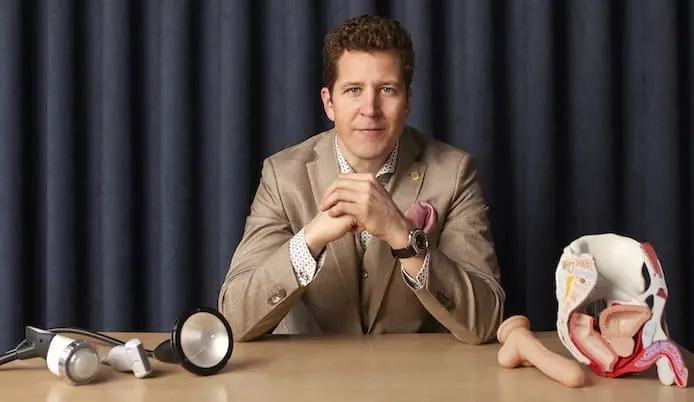
Written and medically reviewed by Michael Strøm
International speaker & expert in shockwave and EMTT treatment for erectile dysfunction, Peyronie’s & CPPS. Read more about me
Are you a pleaser in your relationship? How it affects your body and potency
Do you know the feeling of always being on guard for your partner’s mood? Maybe you catch yourself constantly adapting, swallowing your own needs and doing everything to avoid conflict. If you recognize this, it could be that you’ve taken on the role of a pleaser. At MS Insight, I meet many men who live exactly like this. What they often don’t realize is that this constant mental overwork doesn’t just drain energy – it manifests itself directly in the body as erectile dysfunction, pelvic pain or lack of desire. I’m here to help you understand the connection so you can regain both your strength and your intimacy.
In this article
- What does it mean to live in a pleaser relationship?
- The link between the pleaser role and your nervous system
- Pleaser behavior and sex life: When performance becomes the most important thing
- The body’s emergency brake
- How I help you at MS Insight
- From pleaser to partner – the way back to yourself
- Frequently asked questions about the pleaser role and men’s health
- Take the first step today
What does it mean to live in a pleaser relationship?
Being a “pleaser” is about more than just being a nice and sociable guy. It’s a survival strategy. In a pleaser relationship, you’ve typically learned that your value depends on how happy you can make your partner or how effectively you can eliminate potential problems before they arise. You override your own boundaries to ensure harmony.
For many of the men I see in my clinic, it’s an unconscious behavior that has been going on for years. It can feel like walking on eggshells. You’re constantly scanning the room: “Is she angry?”, “Did I do something wrong?”, “What should I do now to keep the good vibe going?”.
The problem is that when you’re constantly “on” to meet the needs of others, you lose touch with your own. And when you can’t feel your own limits, your body often starts to speak up in ways you can no longer ignore.
The link between the pleaser role and your nervous system
To understand why your behavior in relationships can cause physical problems in the abdomen, I need to explain a bit about the nervous system. When you’re a pleaser, you’re often in a state of chronic stress. Your brain perceives the risk of rejection or conflict as a real danger. This activates your sympathetic nervous system – also known as ‘fight or flight’. But for the pleaser, the response is often “fawn” (to submit or please).
When your nervous system is constantly on alert, your body pumps stress hormones like cortisol and adrenaline into your bloodstream. It’s a physiological state that works against sexual function and relaxation. To get an erection, your parasympathetic nervous system (the resting system) needs to take over. If you’re stressed about performing or pleasing, your body simply shuts down the blood flow to the penis.
When the pelvic floor tenses up
Another physical consequence of this constant vigilance is muscle tension. Just as some people tense their neck or jaw when they’re stressed, many men unconsciously tense their pelvic floor. I often see clients with chronic pelvic pain (CPPS) or symptoms similar to prostatitis, where the cause is not a bacterial infection but a chronically tense pelvic floor muscle.
This tension can squeeze nerves (including the pudendal nerve) and blood vessels, which can lead to:
- Pain in the perineum, testicles or penis itself.
- Problems achieving or maintaining an erection.
- Premature ejaculation because the pelvic floor is hypersensitive.
- Urination problems, such as frequent urges.
Pleaser behavior and sex life: When performance becomes the most important thing
In the bedroom, the pleaser role is often particularly evident – and unfortunately also particularly damaging. If your primary focus during sex is whether your partner enjoys it, whether you’re “good enough” or whether you can last long enough, you’re not present in your own body. You become a spectator to your own sexuality.
This is called “spectatoring”. Instead of feeling touch and desire, you monitor the situation from the outside. Thoughts run: “Can she feel that it’s not quite hard?”, “What if I come too fast?”, “Is she satisfied?”.
This mental approach kills the erection. A good erection requires that you dare to let go of control and sink into pleasure. But as a pleaser, control and monitoring are your primary tools. This creates a vicious circle where the fear of failure (and thus disappointing your partner) actually provokes exactly what you fear: erectile dysfunction.
The body’s emergency brake
I like to tell my clients that erectile dysfunction in this context can be seen as the body’s emergency brake. When you’ve ignored your own boundaries for too long – saying “yes” when you meant “no”, or having sex for the sake of domesticity rather than pleasure – your body takes over. It says “no” for you by refusing to respond.
It can be hugely frustrating and filled with shame. But it’s actually a sign of health that your body is reacting to the mismatch between what you do and what you actually feel.
How I help you at MS Insight
When you come to me at the clinic, I don’t just look at the symptoms. I work with the whole you. It’s rarely helpful to treat only the physical if the cause lies in a dysfunctional pattern in the relationship – and conversely, we can’t just talk our way out of it if the tissue in the penis or pelvic floor has been damaged by years of stress.
My approach is a combination of advanced technology and sexological conversation:
1. The sexological conversation: Break the pattern
I start by helping you map your patterns. Together, we’ll see where the pleaser role is getting in the way of your masculinity and your health. It’s about daring to take space, setting boundaries and understanding that a healthy sex life requires two equal partners who both take responsibility for their own pleasure. I meet you without prejudice and create a space where it is allowed to talk about the difficult things.
2. Diagnostics with ultrasound
To rule out other causes and to see exactly how your tissue is doing, I use high-frequency ultrasound scanning. This gives me a concrete picture of the blood flow and condition of your tumor bodies, so we know exactly what we’re dealing with.
3. Processing the physics: Shockwave and EMTT
If your body has been in a state of stress for a long time, it can have physical consequences that conversation alone cannot solve. Here I use focused sound waves (shockwave) and EMTT (Electromagnetic Transduction Therapy).
- Focused sound waves: This technology stimulates the formation of new blood vessels and breaks down any calcifications or scar tissue in the penis. This increases blood flow and restores the physical ability to erect.
- EMTT and Neuromodulation: These technologies are effective in calming an overactive nervous system and relieving chronic pelvic floor tension. It helps reduce pain and restore natural function to the area.
From pleaser to partner – the way back to yourself
The goal of a program with me is not just to get an erection again. The goal is for you to regain your integrity. When you stop pleasing and start being an authentic partner, something magical often happens: your relationship becomes stronger and your sex life improves.
It takes courage to change old habits. It can feel risky to speak up or express your needs when you’re used to smoothing things over. But the rewards are huge. You’ll find that when the pressure is off and you calm down, your potency often follows naturally.
Frequently asked questions about the pleaser role and men’s health
Can relationship stress really cause physical pain?
Yes, it certainly can. Chronic emotional stress manifests itself as physical tension, especially in the pelvic floor in men. It can feel like a “knot” in the perineum, pain during ejaculation or radiating pain into the groin. It’s the body’s response to a constant state of alarm.
Should I see a psychologist or a physical therapist?
Often it’s an advantage to combine the efforts. With me, you get just that combination. I take care of the physical treatment of tissues and nerves, while my sexological background allows me to advise you on the mental and relational aspects. If I believe there is deeper trauma, I will always advise you to seek relevant help from a psychologist or encourage you to talk to your own doctor.
Is it too late to do something about it if I’ve been like this for many years?
It’s never too late. The body and brain are plastic – they can change throughout life. With the right combination of physical treatment and behavioral change, I see men of all ages regain their quality of life and intimacy.
Take the first step today
Reaching out for help can be overwhelming, especially when it comes to something as personal as your role in the relationship and your sex life. But know that you’re not alone, and that what you’re experiencing is a natural reaction to unnatural stress. With me, you’re in safe, professional hands.
If you are interested in hearing more about how I can help you, you are always welcome to contact me by phone 41 40 08 58 or email michael@msinsight.dk. I’ll get back to you quickly with a customized proposal so we can find the best way forward together.
Would you like a specialist assessment of your situation?
You don’t have to figure it out alone. Call directly or write a few lines about your symptoms – I’ll get back to you within 12-24 hours with a concrete suggestion for the next step.