

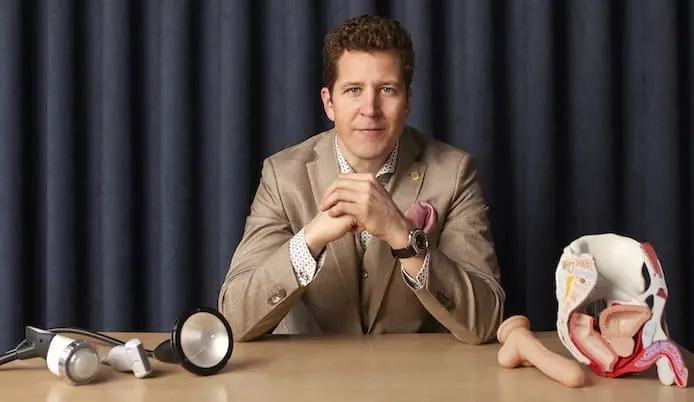
Written and medically reviewed by Michael Strøm
International speaker & expert in shockwave and EMTT treatment for erectile dysfunction, Peyronie’s & CPPS. Read more about me
When Your Body Doesn’t Cooperate with a New Partner—and What You Can Actually Do About It
You’re not alone. Erectile problems with a new partner are one of the most common issues I hear about at the clinic. Many men can get an erection on their own, during masturbation, or wake up with morning erections—but when a new partner is in bed with them, the erection fails completely or becomes unreliable. It feels frustrating and makes you feel vulnerable, and it can start a vicious cycle of worry and avoidance.
The truth is that this is a well-known and almost always manageable phenomenon in which the mind plays the leading role and the body follows suit. If, on the other hand, your problem is constant—even when you’re alone and in the morning—it points to a physical cause, and the next step is an evaluation and treatment of erectile dysfunction, where I’ll identify the cause using ultrasound before beginning treatment. The rest of this article focuses on the situational variant: when the problem only occurs with a new partner.
In this article
- Does it work on its own, but not in combination with others? Here’s how to interpret the pattern
- Performance Anxiety: When the Brain Gets in the Way of an Erection
- Desire requires a calm nervous system
- Porn and Overstimulation: Why the Screen Works, but the Bed Doesn’t
- How to Talk to Your New Partner About It
- Practical advice you can use tonight
- Help for erectile dysfunction with a new partner
- Frequently asked questions about erectile dysfunction with a new partner
- Take the next step—get comfortable with your new partner
Does it work on its own, but not in combination with others? Here’s how to interpret the pattern
This is the most important self-test you can take—and it doesn’t cost a thing:
- Morning erections are intact + occur during masturbation + only fail with a new partner → situation-dependent. The body is functioning; it is the nervous system that is sabotaging the situation. It typically responds quickly to targeted strategies.
- Erectile function is impaired in all situations → a physical cause is likely. So you need to identify the cause before you spend energy on techniques in the bedroom.
That distinction is good news for most people facing relationship problems: A permanent injury alone does not prevent you from functioning fully. Your body has already proven that it can.
Performance Anxiety: When the Brain Gets in the Way of an Erection
With a new partner, the brain goes into overdrive: “Can I do this? Will I be able to keep it up? Am I measuring up?” These kinds of evaluative thoughts trigger the release of adrenaline—the body’s fight-or-flight hormone. Adrenaline is great for running fast, but it shuts down the parasympathetic calm that an erection requires. The result is that the penis “shuts down,” even though the desire is there. It’s not a character flaw—it’s biology.
The first time with a new partner is a perfect storm: a new bedroom, a new body, no shared history to fall back on—and often a single bad experience in your past that lingers in the back of your mind. One failed erection turns into fear of the next one, and that fear is exactly what triggers it. That cycle can be broken, and it often happens faster than men think.
Desire requires a calm nervous system
An erection is primarily controlled by the parasympathetic nervous system (“rest-and-digest”). A new partner, uncertainty, and high expectations tip the balance toward the sympathetic nervous system. Small changes in breathing, tension in the jaw and pelvic floor, and the pace of events can be enough to tip the scales.
I focus specifically on reducing the body’s baseline tension so that the signals between the brain and the penis can travel under optimal conditions. When you feel your body shift gears, it becomes clear why pace and pauses are so important in bed. A tense pelvic floor can be a contributing factor in itself—if you’re also experiencing pain or irritation in your lower abdomen, you can read more about pelvic pain, and if you notice a curvature or tenderness in the shaft, you should have it evaluated—read about Peyronie’s disease.
Porn and Overstimulation: Why the Screen Works, but the Bed Doesn’t
Some men describe being able to get an erection just fine on their own—especially with pornography—but not with a new partner. Repeated intense visual stimulation can “train” the brain to respond to a very specific type of input: endless variety, a fully controlled pace, and zero pressure to perform. A new partner is the exact opposite—unpredictable, real, and with you as a participant rather than a spectator.
That doesn’t mean that porn has “ruined” your erection. But it can create a bias in your expectations, requiring your brain to be retrained to respond to slower, physical stimulation. This can be changed—often quickly—with a step-by-step strategy: gradually reducing the intensity, focusing on touch and sensation rather than visual stimulation, and having realistic expectations about how real sex feels compared to what’s on a screen. I’ll create a plan that’s realistic for your daily life, so you’re not just stopping something, but replacing it with something that works better for your body.
How to Talk to Your New Partner About It
The most effective—and the hardest—thing you can do is to say it out loud. Silence is almost always interpreted worse than the truth: Your partner will think it’s about a lack of attraction, when in reality it’s the opposite—you want it too much.
Three phrases that work because they’re honest and take the pressure off both of you:
- Before: “I’m really turned on by you—and that’s exactly why I’m a little nervous. It might mess with my erection at first. It’ll pass.”
- In this situation: “Let’s slow things down—I’d rather feel you than just go through the motions.”
- After a letdown: “It wasn’t about you. This happens to a lot of men when they have a new partner, and I know what it’s like.”
A partner who understands the mechanism stops taking it personally—and that, in turn, reduces the pressure enough that the body often takes care of the rest on its own.
Practical advice you can use tonight
Change the goal: From “erection on command” to “connection and pleasure”
Agree with your partner that sex is, first and foremost, about touch and pleasure—not penetration. 20–30 minutes of gentle touch, kissing, and deep breathing lower adrenaline levels and increase the likelihood of a spontaneous response. Ironically, an erection is more likely to occur when it isn’t the goal.
Breathing and Grounding
Breathe slowly into your abdomen: 4 seconds in, 6–8 seconds out. Consciously relax your jaw, shoulders, and pelvic floor. Practice for 3–5 minutes daily outside the bedroom so your body knows what to do when the time comes.
Pace and breaks
Take short breaks when you feel tension or your mind racing, and shift your focus to touch and your senses. Use lubricant to reduce friction and take away the pressure to “perform quickly.” Agree in advance that breaks are part of the play—not a failure.
When pain interferes
Pain is a warning sign—not something you should just ignore. Stop, change your position, and try again later. If the pain keeps coming back, come see us—it’s often treatable, and it keeps your nervous system on high alert as long as it’s there.
Help for erectile dysfunction with a new partner
If the problem persists even after you’ve tried the advice here, you don’t have to struggle through it alone. As a sexologist and specialist in men’s sexual health, I deal with exactly this issue every week—and because I can provide both a physical evaluation and psychosexual counseling, you won’t end up being shuffled from one practitioner to another.
You’ll learn specific exercises: sensate focus (touch without performance goals), principles of rhythm and pause, positions that provide control, and working with the inner dialogue that triggers adrenaline. If medical consultation is needed—for example, regarding PDE5 inhibitors as a temporary tool—I’ll coordinate with your doctor so that it serves as a bridge rather than a crutch. Learn more about sex therapy →
Frequently asked questions about erectile dysfunction with a new partner
Is this normal?
Yes. It’s one of the most common sexual challenges men face, and the vast majority are able to resolve it with targeted help.
Why does it work alone but not with a new partner?
Because being with a new partner boosts your adrenaline and makes you focus on performance. It’s a biological reaction—not proof that you’re not attracted to them.
Should I take Viagra right away?
It can be a useful tool during a transitional period, but it’s rarely the entire solution to problems with a new partner. If your nervous system and habits aren’t addressed, the effect will be unstable—and you risk making the pill a prerequisite for functioning. Talk to your doctor, and use it as a bridge, not a crutch.
Could porn be the cause?
Porn can be helpful for some people, especially if their brains are accustomed to very intense and varied stimulation. This can be changed using a step-by-step strategy.
Should I tell my new partner about this?
Yes—in almost all cases. A short, honest sentence relieves the pressure that triggers the problem and prevents your partner from interpreting it as rejection. See the suggested phrasing further up.
How long does it take to get rid of it?
Many people experience improvement within 2–6 weeks through a combination of behavioral changes, exercises, and, if necessary, counseling. Situation-specific problems typically respond the fastest.
Is it confidential?
Yeah, totally. I know it’s vulnerable to talk about. You are met with respect, discretion and professionalism.
Do you also help men who don’t live in Copenhagen?
Yes. I have clients from all over Denmark, and I plan treatment programs with fewer but longer sessions and video-based follow-ups.
Take the next step—get comfortable with your new partner
Erectile problems with a new partner arise when your brain and body aren’t on the same page. With the right approach, they’ll learn to work together again—often quickly, because your body has already proven it can. You shouldn’t feel ashamed, and you don’t have to deal with this alone.
Start with a brief, confidential, and free consultation: Call 41 40 08 58 or email michael@msinsight.dk, and together we’ll assess whether your pattern is situation-specific or requires further investigation—and what your next step should be.
Would you like a specialist assessment of your situation?
You don’t have to figure it out alone. Call directly or write a few lines about your symptoms – I’ll get back to you within 12-24 hours with a concrete suggestion for the next step.