
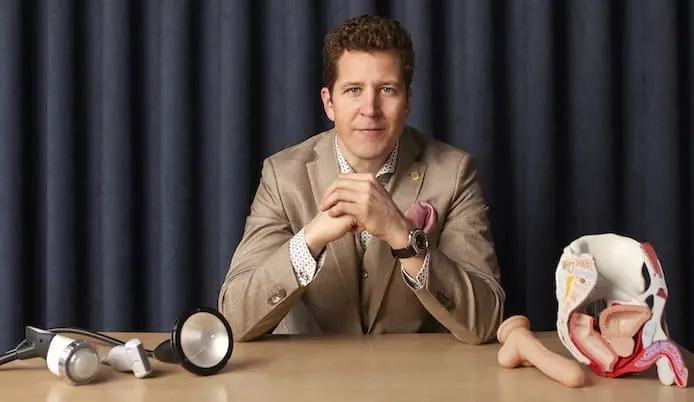
Michael Strøm
International lecturer & expert in shockwave and EMTT treatment for peyronies.
In this article
- Examination for Peyronie’s disease – get clarity on the changes
- Signs of Peyronie’s disease: curvature, plaque, and pain
- Here’s How a Peyronie’s Disease Examination Is Conducted
- Individualized Treatment for Peyronie’s Disease – Not a One-Size-Fits-All Approach
- Shockwave Therapy for Peyronie’s Disease
- Traction and Vacuum Therapy for Peyronie’s Disease
- What can you expect from Peyronie’s disease treatment?
- Specialized Peyronie’s Disease Treatment at MS Insight in Copenhagen
- Alternative treatment methods for Peyronie’s disease
Examination for Peyronie’s disease – get clarity on the changes
A change in the penis is rarely just about its appearance.
Many men worry that the curvature will get worse, that their penis will become shorter, or that their erections and sex life will be permanently affected.
During the initial consultation, I’ll examine the relationship between the shape of the penis, the tissue, the pain, and erectile function. Afterward, you’ll receive my specific assessment of what’s likely going on and what the right next step is.
If I think you should see a urologist, I’ll tell you so clearly.
Personal Assessment Before Peyronie’s Treatment
I don’t use a standard treatment plan that’s prescribed to everyone with a curved penis.
First, I’ll examine what has happened and whether the symptoms are consistent with Peyronie’s disease. Then we’ll assess whether treatment is appropriate and what a realistic goal should be.
Ultrasound, tissue, and erectile function are assessed collectively
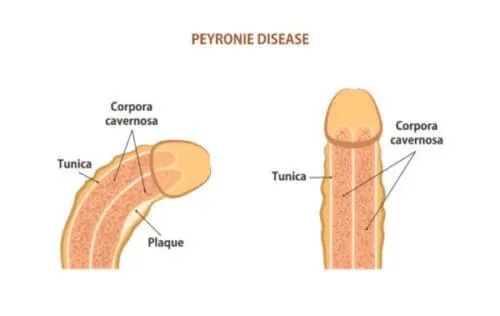
Peyronie’s disease cannot be diagnosed based on curvature alone.
It’s also important to understand how the tissue feels, whether there is pain or calcification, and how erections function. Ultrasound is used as standard practice to see what’s actually happening inside the penis and to tailor treatment as effectively as possible. It is not enough to simply feel with your fingers.
Signs of Peyronie’s disease: curvature, plaque, and pain
A penis may be naturally curved – read when a crooked penis should be examined. It is especially a new or progressive change that may raise suspicion of Peyronie’s disease.
New or progressively curving penis
Some men notice that their penis has gradually become more curved. The curvature may be upward, downward, or to the side, and it can make sexual intercourse more difficult.
Plaque or a hard lump on the penis
A tissue change may feel like a hard lump, a cord, or a flat plaque. However, not all men can feel a distinct plaque themselves.
Pain, shortening, or changes in erection
Peyronie’s disease can also manifest as pain during an erection, a kink, an hourglass shape, a perceived shortening, or an erection that no longer feels firm.
The most important thing is whether anything has changed.
Here’s How a Peyronie’s Disease Examination Is Conducted
We’ll start with a calm and confidential conversation about what you’ve been through.
I’ll ask you when the change began, whether it’s still progressing, and how it’s affecting your erection and your sex life.
Next, I’ll examine your penis and the area where you’ve noticed or seen a change.
Assessment of Curvature and Shape
It may be helpful to bring photos of the penis during an erection. Curvature, notches, and an hourglass shape cannot always be accurately assessed when the penis is flaccid.
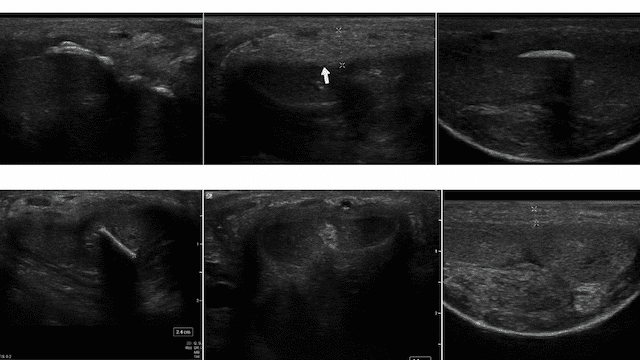
Ultrasound Scan of the Penis for Peyronie’s Disease
Ultrasound imaging of the penis is used to examine plaque, calcifications, tissue changes, or blood flow in more detail.
The scan is not evaluated in isolation, but is assessed in conjunction with the interview and the clinical examination.
You’ll receive a clear recommendation
Afterward, I’ll go over the findings with you in language that’s easy to understand.
I’ll give you my assessment of what’s likely going on, whether treatment makes sense, and what I think you should do from here.
Individualized Treatment for Peyronie’s Disease – Not a One-Size-Fits-All Approach
Peyronie’s disease does not present the same way in all men.
For some people, the pain is the biggest problem. For others, it’s the curvature, shortening, a kink, or an erection that no longer feels stable.
Treatment is therefore chosen based on the stage of the disease, the affected tissue, pain levels, erectile function, and your personal goals.
An individualized treatment plan may include various types of focused shockwave therapy, EMTT, traction, vacuum therapy, or a customized home exercise program.
Shockwave Therapy for Peyronie’s Disease
Focused shockwave therapy uses targeted acoustic pulses in the affected tissue area.
This treatment may be appropriate when pain or local tissue discomfort is a major concern. It can also be part of a broader treatment plan focused on function and rehabilitation.
In a 2026 prospective study of 112 men with Peyronie’s, patients received three ESWT sessions. The study reported:
- Pain relief in 90% of patients.
- Improvement of curvature in 57.1%.
- An average reduction in curvature of 30 degrees among responders.
- Clinically relevant improvement in erectile function was observed in 26.2% of patients who also had erectile dysfunction.
A 2024 systematic review and meta-analysis also found that shockwave was associated with a higher proportion of men with plaque reduction, curvature improvement and pain relief than control treatment.
EMTT as a supplement to Peyronie’s disease treatment
EMTT can be used as a supplement to treatment, especially when there is a lot of pain.
Whether the treatment is appropriate depends on the tissue, the symptoms, and the overall treatment plan.
Traction and Vacuum Therapy for Peyronie’s Disease
Traction or vacuum therapy may be appropriate when treating issues related to length, elasticity, erectile function, or deformity.
The methods must be used correctly and with an appropriate amount of pressure. More force or a longer treatment time is not necessarily better.
Traction for Peyronie’s Disease
In certain cases, traction may be used as part of treatment for penile length, curvature, and tissue elasticity.
Vacuum Pump for Peyronie’s Disease
Vacuum therapy can be used as part of an individualized rehabilitation program, particularly when erection, tissue tolerance, or preservation of function are relevant.
If home care makes sense for you, you’ll receive specific guidance. You won’t be left on your own with a device, trying to figure things out as you go.
What can you expect from Peyronie’s disease treatment?
A good result does not necessarily mean that the penis will be exactly as it was before.
For some men, the most important thing is that the pain subsides. For others, it’s about achieving a more stable erection, easier sexual intercourse, or better preservation of length and function.
Another important benefit may be that you feel less anxious and regain a sense of security in your sex life.
I won’t promise a specific result or course of treatment until I’ve examined you.
In return, you’ll receive an honest assessment of what can realistically be improved and where there is greater uncertainty.
Specialized Peyronie’s Disease Treatment at MS Insight in Copenhagen
I have specialized in men’s sexual health for many years.
At the clinic, I often meet men who have been dealing with their concerns on their own because they didn’t know who to talk to or whether their problem was serious enough to warrant an examination.
My first task is to provide clarity.
We will then work together to determine whether treatment is appropriate and what a realistic goal should be.
You’ll meet Michael in person
I am the one who will talk with you, examine you, review the findings, and guide you through any necessary course of treatment.
Therefore, you do not need to explain your situation to several different healthcare providers.
Pre-treatment examination
I combine clinical examination, ultrasound, and various treatment options when clinically appropriate.
But experience isn’t just about being able to provide treatment. It’s also about being able to recognize when treatment isn’t the right solution.
Everything is handled discreetly, personally, and without unnecessary sales pressure.
Alternative treatment methods for Peyronie’s disease
Peyronie’s treatment with vacuum pump
A vacuum pump creates negative pressure that draws blood into the swelling and stretches the tissue in a controlled manner. This oxygenates the scar tissue, prevents atrophy and maintains penis length. The vacuum pump is most effective as a daily home workout in combination with shockwave – alone it rarely removes the curvature. I will instruct you on the correct use and dosage so that the pump supports your treatment program without the risk of tissue damage.
Xiaflex for Peyronie’s disease
Xiaflex (collagenase clostridium histolyticum) is an injection treatment that chemically breaks down the collagen in scar tissue. It is approved in the US but has been withdrawn from the European market by the manufacturer and is currently not available in Denmark. Xiaflex also requires a real, defined plaque to inject into – which not everyone with Peyronie’s has. At MS Insight, we achieve comparable results with focused shockwave, which softens scar tissue biologically and without needles or side effects.
Collagenase injection for Peyronie’s
Collagenase injections are the same enzyme treatment as Xiaflex – an enzyme is injected directly into the plaque to dissolve the hard scar tissue. The treatment is typically given in series over several months with manual stretching exercises in between. Side effects can include swelling, bleeding and, in rare cases, rupture of the tumor bodies. As the treatment is not available in Europe, I recommend focused shockwave and EMTT as the most effective non-surgical alternative.
Peyronie’s new treatment
There is a lot of hype around what new treatments there are for Peyronie’s. PRP therapy is currently being marketed as a new Peyronie’s treatment, but the results from the initial studies are not positive in terms of a real effect in the tissue.
When it comes to shockwave, the latest knowledge on a new form of treatment is that several types of shockwave are used in combination with EMTT and laser treatment, which are also offered together in the clinic.
Get a no-obligation consultation about peyronie's disease treatment today
If you are interested in hearing more about how we can help you, you are always welcome to contact us by phone: 41 40 08 58 or email: michael@msinsight.dk. Otherwise, you can fill out the contact form with your details and a brief description of your problem. I'll get back to you quickly with a customized proposal for a solution so we can find the best way forward together.