

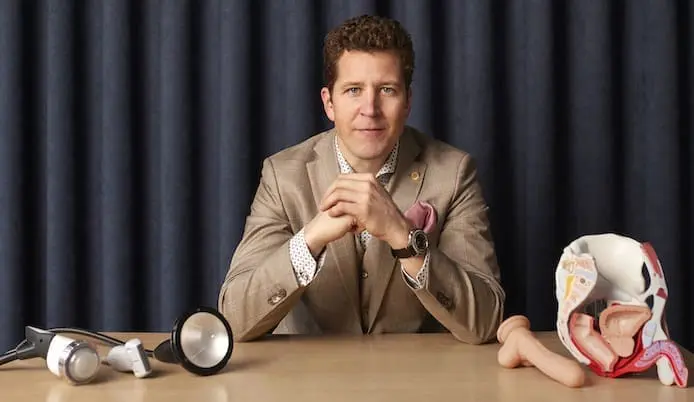
Educator: Michael Strøm
International speaker & expert in shockwave and EMTT therapy for erectile dysfunction, Peyronie’s disease, and CPPS. Learn more about me
Keynote speaker at OCC ISMST in Bogotá
A special thank you to Carlos Leal for his generosity and hospitality. It was an honour to be invited to his home, his clinic and this important congress. Speaking to more than 300 participants about the latest research and practice in ESWT and EMTT for erectile dysfunction and Peyronie’s disease was an experience I will never forget.
Colombia was a great experience – not only professionally but also culturally. Experiencing Bogotá, meeting inspiring people and having long conversations with some of the biggest names in the shockwave world was a huge pleasure.
One of the topics we discussed most at the congress was the combination of ESWT and EMTT. While ESWT mainly works through mechanical stimulation of the tissue, EMTT is being studied as a supplement that may support the biological regeneration processes. I have summarised what the research actually shows on the page about the evidence for shockwave therapy.

I came home from Bogotá with new knowledge, inspiration and an even stronger motivation to raise the standard of care in men’s sexual health – and to bring what I learned back to the clinic.
Focus of the teaching
The teaching focused on shockwave for erectile dysfunction and Peyronie’s disease in the urology section. I emphasised the differences between technologies, energy delivery and practical patient selection rather than presenting a universal protocol. When I teach, the goal is for participants to be able to explain why a treatment is chosen, who it suits and when a different approach is more relevant.
Why it matters in a patient journey
For a man with erectile dysfunction, the key question is not just whether a particular treatment can be used, but why the erection has changed. Blood flow, nerve function, medication, metabolic disease, hormones, the pelvic floor and psychosexual factors can each play a different role. Treatment should therefore only be chosen once the pattern has been clarified through conversation, relevant clinical examination and, where needed, targeted ultrasound. With Peyronie’s disease and newly developed curvature, the clinical assessment is at least as important as the choice of treatment. Plaque, calcification, pain, stability, erection quality and the degree of curvature should be assessed together. It is precisely this kind of differentiation that makes it possible to explain to the patient what shockwave can and cannot realistically be expected to change.
In practice, this means that for patients, technology should come after the assessment – not before. A treatment can be well documented at group level and still be a poor choice for the individual if the cause of the symptoms is different.
From teaching to clinical quality
The professional benefit goes both ways. I contribute experience from the clinic and from teaching across different shockwave systems, while participants bring other workflows, cases and perspectives. This provides a more robust basis for asking the critical questions that should also be asked before a course of treatment.
Another important element is managing expectations. In areas such as sexual function, chronic pain and incontinence, two patients with the same headline can have very different causes and prognoses. One should therefore be precise about which problem is being targeted, how progress is measured, and when a lack of response should lead to a new assessment rather than simply more of the same treatment.
I also place emphasis on distinguishing between mechanism, clinical evidence and marketing. That a technology can affect tissue biologically is not the same as having a documented effect on every indication. Conversely, clinical evidence can be relevant without being directly transferable between different devices, doses or patient groups. That distinction is central both in teaching and in conversations with patients.
This is the professional link between teaching and clinic that I want these teaching activities to document: not a promise of results, but experience in assessing technology critically, following the evidence and translating it into more precise decisions for the individual patient.
Read more: my professional background and MS Insight
Documentation: This article is based on publicly available event material and/or LinkedIn posts. Sources: LinkedIn post
Would you like a specialist evaluation of your situation?
You don’t have to figure this out on your own. Call me directly or send a brief message describing your symptoms—I’ll get back to you within 12–24 hours with a concrete recommendation on the next steps.