

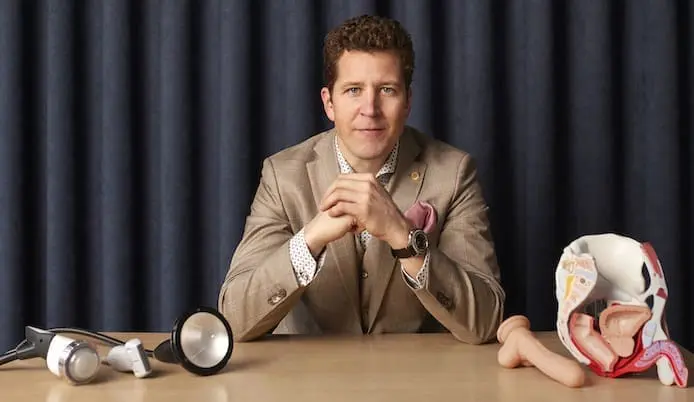
Educator: Michael Strøm
International speaker & expert in shockwave and EMTT therapy for erectile dysfunction, Peyronie’s disease, and CPPS. Learn more about me
Ultrasound at the Advanced Men’s Health course in Liverpool
The course was organised by Yves De Vos and Gerard Greene and gave a thorough introduction to erectile dysfunction, pelvic pain and Peyronie’s disease. For me, it was an opportunity to refine my own skills, exchange knowledge with other experts and share my experience with penile ultrasound scanning.
I presented some of the more advanced ultrasound scans I perform in the clinic – such as assessing blood flow in the penis, mapping plaque in Peyronie’s disease and assessing the pelvic floor muscles. This type of scanning is still not standard in many parts of the world, and it attracted great interest among the participants. You can read more about how I use ultrasound scanning in the clinical assessment.
Thank you to Yves De Vos, Gerard Greene and everyone involved for an inspiring course – and for the chance to see old friends and meet new colleagues who share the passion for improving men’s health.
Focus of the teaching
The teaching focused on penile ultrasound and vascular assessment as part of an advanced men’s health course. The point here was to link measurements and imaging to the clinical decision, so that the technology does not become a goal in itself. When I teach, the goal is for participants to be able to explain why a treatment is chosen, who it suits and when a different approach is more relevant.
Why it matters in a patient journey
Ultrasound is particularly relevant when symptoms and the choice of treatment depend on anatomy or blood flow. It can give a more concrete picture of tissue, vessels, plaque or other structural factors and thereby reduce the risk of treatment being chosen on the basis of the symptom alone.
I therefore use teaching as an ongoing quality test of my own clinical model. When the choice of technology and indication has to be explained to other clinicians, both strengths and limitations become clearer.
From teaching to clinical quality
When teaching takes place internationally, differences in practice become clear: which patients are referred, how they are examined, which devices are available and how results are assessed. That variation is valuable because it is a reminder that good clinical decisions should not rest on one manufacturer, one protocol or one single explanatory model.
Another important element is managing expectations. In areas such as sexual function, chronic pain and incontinence, two patients with the same headline can have very different causes and prognoses. One should therefore be precise about which problem is being targeted, how progress is measured, and when a lack of response should lead to a new assessment rather than simply more of the same treatment.
I also place emphasis on distinguishing between mechanism, clinical evidence and marketing. That a technology can affect tissue biologically is not the same as having a documented effect on every indication. Conversely, clinical evidence can be relevant without being directly transferable between different devices, doses or patient groups. That distinction is central both in teaching and in conversations with patients.
For the individual patient, expertise should be felt as clarity: What do we know? What is likely? What is uncertain? And what is the next rational step? That is the part of the patient journey that is often missing when you come across many different treatment options online. My aim is for examination and explanation to make the choice clearer before a decision on a course of treatment is made.
This is the professional link between teaching and clinic that I want these teaching activities to document: not a promise of results, but experience in assessing technology critically, following the evidence and translating it into more precise decisions for the individual patient.
Read more: assessment and treatment of erectile dysfunction · my professional background and MS Insight
Documentation: This article is based on publicly available event material and/or LinkedIn posts. Sources: LinkedIn post
Would you like a specialist evaluation of your situation?
You don’t have to figure this out on your own. Call me directly or send a brief message describing your symptoms—I’ll get back to you within 12–24 hours with a concrete recommendation on the next steps.