

Penile cancer is rare, but I know how worrying it can be if you notice a change on your penis. In this article, you’ll get a calm, professional overview of symptoms, risk factors and the difference between cancer and harmless changes. I’ll guide you on when to react, how to perform a safe examination, and what treatment options are available – whether it’s cancer or something else I can help you with. By reading on, you’ll gain knowledge, peace of mind and a concrete plan so you don’t have to face uncertainty alone. Take the first step towards clarification and a better quality of life – I’m with you every step of the way.
Penile cancer is a rare cancer where early detection and assessment of persistent ulcers, lumps or lesions on the penis is crucial for a good prognosis.

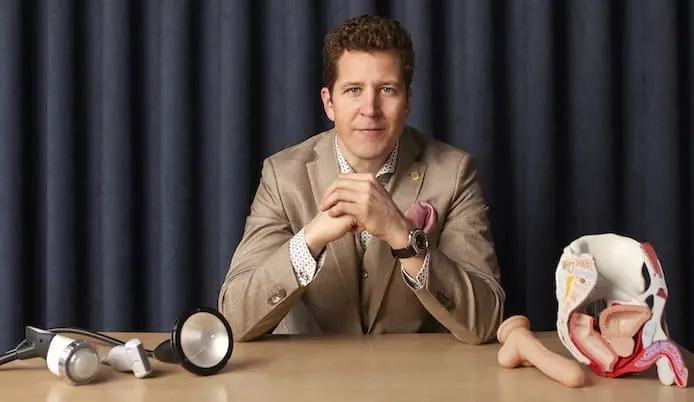
International speaker & expert in shockwave and EMTT treatment for erectile dysfunction, peyronies & CPPPS.
It’s perfectly normal to become concerned if you notice a lump, sore or persistent changes on the penis. Many men with erectile dysfunction, pelvic pain or skin changes go too long alone with the thought: “Is it penis cancer?”. I meet you without taboos, give you a professional overview and help you take the right steps quickly. In my experience, clarity and a plan bring peace of mind – whether it’s serious or not.
Penile cancer (penile cancer) is a relatively rare cancer in Denmark, which most commonly occurs in the skin and mucous membrane of the glans (head of the penis) or foreskin. The vast majority of cases are squamous cell carcinomas – a type of cancer that originates from the surface cells of the skin. Penile cancer is most commonly seen in men over the age of 50, but can occur earlier. It is not the same as prostate cancer; the two diseases have different symptoms, courses and treatments.
Human papillomavirus (HPV) plays a significant role in some cases. Chronic irritation, phimosis and smoking also increase the risk. Early detection makes a big difference because in many cases, treatment can be more gentle and organ-preserving when the lesion is small and has not spread.
I distinguish between precancerous lesions (superficial cell changes in the skin) and invasive penile cancer, where the cells grow deeper into the tissue. Precancerous lesions can resemble common skin conditions, which is why professional assessment is important – especially if something is not healing, changing shape or bleeding.
Penile cancer can manifest itself in several ways. React especially if you are experiencing:
– A wound that won’t heal or returns to the same place.
– A lump, thickening or “warty” change on the glans, shaft or foreskin.
– Reddish-brown or white spots, skin changes with rough surface or scaling.
– Discharge from under the foreskin, often with an unpleasant odor.
– Bleeding, burning, pain or itching that doesn’t go away.
– Foreskin that suddenly becomes tight (phimosis) so that it cannot be pulled back.
– Swollen or tender lymph nodes in the groin.
An important reality check: Erectile dysfunction and pelvic pain alone are rarely signs of penile cancer. They usually have other, treatable causes (e.g. blood vessels, nerves, pelvic floor or Peyronie’s disease). However, if you also have skin or mucosal changes on the penis, you should be taken seriously and examined.
A concrete piece of advice: Check the change in good light once a week and note the date, appearance and any pain. Take a discreet photo from the same angle. If a wound or lump does not improve in 2-4 weeks, or if there is bleeding, odor or rapid growth, prioritize an assessment.
Many changes on the penis are benign. Genital warts (HPV-related) are small, cauliflower-like growths. Balanitis is an inflammation/irritation that can cause redness and soreness. Peyronie’s disease causes a hard “string” or plaque under the skin, curvature with erection and sometimes pain – but the skin is usually intact with no sores. Penile cancer more often causes ulcers, firm nodules or lesions on the surface that do not heal. I’ll help you differentiate – and take the right next steps.
Other harmless variations that often cause concern are pearly papules (small, luminous bumps around the glans) and sebaceous buds/follicles, which can feel like small balls under the skin. They are not dangerous. The key is whether there are ulcers, persistent fluid/bleeding, rapid growth or hard, unyielding tissue change – then you need to be seen.
– HPV: Types 16 and 18 in particular increase the risk. HPV is transmitted through sexual contact, but the infection does not necessarily cause cancer. HPV vaccination protects and is also recommended for boys/men.
– Phimosis: Chronic moisture, irritation and difficult cleaning under a tight foreskin increases the risk.
– Chronic inflammation/irritation: Repeated episodes of balanitis or skin diseases such as lichen sclerosus can predispose.
– Smoking: Damages the immune system and healing of the skin and mucous membrane.
– Age and immune system: Increasing age and reduced immune function increase the risk.
Good intimate health is not about “perfect” hygiene, but about regular, gentle cleaning under the foreskin when it can be pulled back without pain and responding to ongoing changes.
If you are prone to irritation or skin disease in the intimate area, get it treated early. Simple habits like rinsing with lukewarm water in the shower, drying gently and avoiding perfumed products can prevent recurring inflammation.
My focus is to provide you with a thorough, respectful assessment and a concrete plan. The process with me can include:
– Interview: I ask about symptoms, duration, sexual history, smoking, skin diseases, medications and previous surgeries. I talk openly with you about concerns, sexuality and function – without taboos.
– Examination: I look for sores, lumps, color changes, thickening and assess foreskin mobility. I feel for lymph nodes in the groin and assess tenderness, size and mobility.
– Advanced ultrasound: I use high-frequency ultrasound to assess changes in penile tissue, vessels and any plaques (e.g. Peyronie’s). Ultrasound can provide useful information about the depth and extent of a change, but the diagnosis of penile cancer is made with a tissue sample.
If I suspect penile cancer, I advise you to contact your GP as soon as possible for a referral to the urology department. Here you will typically get a biopsy (tissue sample) from the lesion. Depending on the findings, imaging (e.g. MRI, ultrasound of the groin or CT) may be used to assess the extent and lymph nodes. The sooner you get there, the better.
I explain what is happening and what the purpose is. Soreness is taken seriously and the examination is done at your pace. You’ll get clear, written recommendations to take to your doctor.
I can help you with diagnosis, documentation (measurements/photos), ultrasound evaluation, and a clear plan for the next steps. If you have signs of a serious illness, my priority is to quickly refer you to your primary care physician or a urologist for further evaluation. If you have harmless but bothersome conditions such as Peyronie’s disease, vascular erectile dysfunction, or chronic pelvic pain, I can offer targeted, evidence-based treatment at the clinic.
Treatment depends on the stage (how deep the change is and whether it has spread). In general, the following applies:
– Precursors (carcinoma in situ): Can often be treated gently with cream (e.g. imiquimod or 5-FU), laser or superficial surgery. The goal is to preserve form and function.
– Localized cancer on the surface: Organ-preserving surgery (e.g. lesion excision, glans resurfacing) may be possible. Close follow-up is important.
– Deeper tumors: Here, partial or, in rare cases, total penectomy (removal of part or all of the penis) may be necessary to completely remove the cancer. Reconstructive options are available and can be discussed with the surgical team.
– Lymph nodes in the groin: Depending on the risk, sentinel node biopsy (sentinel lymph node) or lymph node surgery can be performed. Swollen lymph nodes may contain infection or cancer cells – this must be clarified.
– Radiation therapy: Can be used in selected cases as an alternative or complement to surgery, e.g. brachytherapy (internal radiation) for smaller tumors.
– Systemic treatment: For more extensive disease, chemotherapy (often cisplatin-based) or in some cases immunotherapy may be considered.
Prognosis is good with early detection and many can be treated in an organ-preserving manner. Therefore, early assessment is crucial.
It’s perfectly legitimate to be concerned about erection, desire, orgasm and body identity. After organ-preserving treatment, many men retain the ability to have sex, but there may be altered sensitivity or cosmetics. After major surgery, it takes time and support to find a new normal. This is something I work with calmly and systematically:
– Counseling on sexual rehabilitation, intimacy and expectation management.
– Training pelvic floor function, which can support erection and stamina.
– Managing pain and hypersensitivity in scars and tissues when it is safe to do so.
– Once you have the green light for cancer treatment, I can help with erectile dysfunction treatment, such as medical advice and proven treatment for vascular ED. I offer focused sound waves(shockwave therapy), EMTT and neuromodulation, among other treatments, tailored to the individual – always with your safety first.
I also include simple, concrete tools: correct use of lube, relaxation and breathing, sensate focus exercises to rebuild confidence in intimacy, and aids such as a vacuum pump if it makes sense. The goal is for you to experience intimacy, function and desire again – in a way that suits you and your situation.
Is penile cancer common? No, it is rare in Denmark. But rare is not the same as impossible – and long-term changes should always be investigated.
Is penile cancer contagious? Cancer itself is not contagious. HPV, which may play a role in its development, can be sexually transmitted. Condoms reduce the risk, but do not protect 100% against HPV.
Can a change “go away on its own”? Wounds or lumps that don’t heal in 2-4 weeks need attention. Don’t wait months “just in case”.
How do I differentiate between cancer and genital warts? Genital warts are often soft, cauliflower-like and can appear in clusters. Cancerous changes are often firmer, can ulcerate and bleed. Only a professional assessment – and if necessary a biopsy – can provide the answer.
Does penis cancer hurt? Not always. Some changes are painless at first. However, pain, burning or itching may be present – so visual changes are important to respond to.
Can I have sex if I have a suspicious change? Wait until you have been assessed. Sex can irritate the area and in rare cases make sores worse. If you have sores, bleeding or discharge, prioritize examination first.
Can erectile dysfunction be a sign of penile cancer? As a general rule, no. Erectile dysfunction is most often caused by blood vessels, nerves, hormones, psyche or Peyronie’s. But if you also have a skin/mucosal change, you should be examined.
What can I do to prevent it myself? HPV vaccination (if applicable), non-smoking, gentle hygiene under the foreskin and prompt treatment of persistent irritation or phimosis. Check your penis and groin regularly so you know your “normal picture”.
When is it an emergency? If you have a fast-growing sore/lump, obvious bleeding, strong-smelling discharge with fever or very tender, swollen lymph nodes in the groin, you should seek urgent medical attention.
Fortunately, most changes are due to other, treatable conditions. I work with on a daily basis:
– Peyronie’s disease: Diagnosed with clinical examination and ultrasound. Treatment course with focused sound waves, EMTT, targeted training and counseling.
– Erectile dysfunction: Advanced blood vessel and tissue assessment, followed by proven treatment and lifestyle advice.
– Chronic pelvic pain(CPPS): Holistic approach with neuromodulation, pelvic floor function, pain strategies and sleep/habits.
The point is: Don’t go it alone with this concern. With a thorough assessment, you’ll either get fast access to penile cancer treatment or a plan to solve your other problems.
Uncertainty wears you down. An early and respectful assessment creates peace of mind and saves you months of worry. At the clinic in Copenhagen, I meet you at eye level, without prejudice, and with a focus on your reality – work, relationships, sexuality and well-being. I have clients from all over Denmark, especially Copenhagen and Zealand, and I prioritize discretion and short waiting times.
Book an appointment if you:
– Have a sore, lump or persistent change on the penis.
– Experiencing discharge, odor, bleeding or new phimosis.
– Have erectile dysfunction or pelvic pain and want a thorough, professional assessment.
You’ll get a clear answer on what’s next – and support every step of the way.
– Initial consultation: I talk to you in a safe environment about your symptoms, concerns and goals. I examine you calmly and respectfully.
– Ultrasound and documentation: If needed, I’ll perform targeted ultrasound and document findings so you know the facts.
– Plan: Either safe clarification and treatment of harmless but bothersome problems – or clear guidance on how to talk to your own doctor about urological examination (e.g. biopsy or imaging) if penile cancer is suspected.
– Follow-up: I follow up so you feel supported. Once you have an overview of your situation, I work with you on what is most valuable to you – function, pain, sexuality and well-being.
Penile cancer is rare – but early response makes a big difference. If you have ulcers, lumps or persistent changes, get it assessed. I’ll give you a professional, down-to-earth overview and a concrete plan. And in most cases, I can help you directly with the challenges that plague you: erectile dysfunction, pain or non-cancerous changes. Get in touch and we’ll take the steps together, calmly and systematically.
If you are interested in hearing more about how I can help you, you are always welcome to contact me by phone 41 40 08 58 or email michael@msinsight.dk. I’ll get back to you quickly with a customized proposal so we can find the best way forward together.
I will get back to you within 12-24 hours.
Are you unsure about what’s causing your symptoms, or whether a specialized treatment program at our clinic in Copenhagen would be right for you? If so, you can start with a brief, confidential consultation. During this consultation, we’ll assess whether your symptoms align with the areas I specialize in at MS Insight and determine what the next appropriate step might be.
The initial consultation is not a full consultation, diagnosis, or treatment plan. It is intended for those who would like a thorough assessment of whether it makes sense to proceed with a more in-depth examination, an ultrasound scan, and a personalized plan at our clinic in Copenhagen.