

Average penis size is a topic more than most men care to admit – and I know how much it can affect confidence and peace of mind. In this article, you’ll get an honest overview of what the research says about length and girth, why comparisons rarely make sense, and how concerns about size are often linked to erection quality, pain or performance pressure. I’ll show you how to measure correctly, what’s actually normal, and why focusing on function and well-being gives you far more freedom than chasing centimeters. If you read on – and choose my treatment – you’ll gain knowledge, confidence and concrete solutions that strengthen your masculinity and quality of life.
The average penis size in adult men is approximately 13 cm when erect and 11-12 cm in circumference, but there is a lot of natural variation.

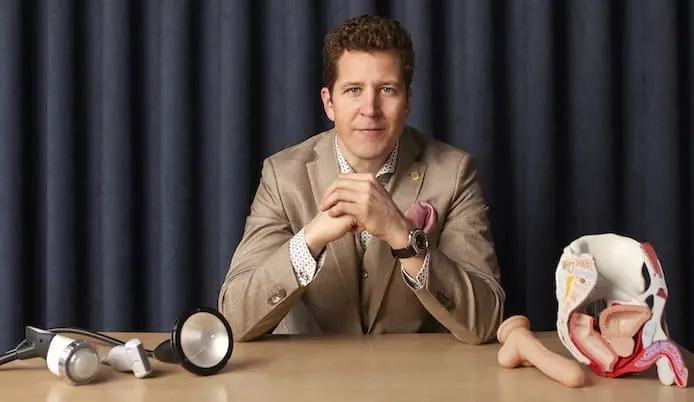
International speaker & expert in shockwave and EMTT treatment for erectile dysfunction, peyronies & CPPPS.
“Average penis size” often becomes a mirror for everything else: performance pressure, doubt, pain or an erection that doesn’t feel stable. I meet men of all ages who are perfectly normal but have doubts because they compare themselves to images, angles and stories that don’t reflect reality. My approach is simple: clarify what’s normal, understand what your body is telling you and focus on what gives you the most value – healthy tissue, good blood flow, well-functioning nerves and a balanced pelvic floor. When the body cooperates, the mind typically calms down and centimeters take up less space.
I meet many men who are preoccupied with size, often because of erectile dysfunction, pelvic pain or because their body feels different than it did before. When intimacy doesn’t work, centimeters suddenly become a focal point. My job is to dispel myths, explain what’s normal, and focus on what actually gives you a strong and safe sex life: healthy tissue, good blood flow, well-functioning nerves and a balanced pelvic floor. Averages are statistics – not a measure of your worth, your desire or your ability to be present.
The best data comes from larger measurement studies conducted by healthcare professionals. A robust review points to approximately:
These are averages – not a measure of what’s “right”. There is a lot of natural variation and lengths above and below these numbers are common. Stretched flaccid length often correlates well with erect length, while flaccid length alone says very little. Some measurements indicate length pressed to the pubic bone (BPEL), others without pressing (NBPEL). BPEL naturally gets longer because the fat pad is not counted. This is why comparisons across sources can fluctuate.
The erect circumference in many studies is around 11-12 cm on average. Again, the range is wide, and both smaller and larger circumferences are perfectly normal. Circumference is most accurately measured in the middle of the shaft when fully erect; close to the root the circumference can be slightly larger, and just below the glans slightly smaller. If you use a condom, the practical gain is often finding a fit that fits securely without pinching – not chasing specific centimeters.
The conclusion: “Average penis size” is a benchmark, not a judgment. Most men fall within a wide normal range.
If you need to measure at all (most people don’t), do it consistently and gently:
If you have any doubts, or if the measurement takes up too much of your thoughts, I’m happy to have a calm, concrete talk with you. In my experience, focusing on function and safety means more than numbers.
Micropenis in adults is defined as a stretched length more than 2.5 standard deviations below the mean. In practice, this typically equates to around 9 cm or less when measured straight. This is rare. If you think you are in this range, or if you have significant changes in size over a short period of time, a professional assessment is relevant. I can assess function, tissue and blood flow and advise you on what further investigations may be relevant to discuss with your GP (e.g. hormones). Sometimes a “small penis” is experienced even though the shaft is actually normal because skin or fat pad hides the root (often called “buried penis”) – it is handled differently than micropenis.
In the clinic, I use ultrasound scanning and functional examination to assess tissue, vessels and strain patterns as part of a holistic plan. If there are signs of systemic causes, I can advise on appropriate steps to take with your GP.
If you struggle with erection, pelvic pain or performance pressure, it’s function and well-being that I help you strengthen – not the pursuit of a specific number.
Worry can settle in the body. I see it often:
A combination of bodywork, gradual exposure to safe sexual situations, breathing and concrete strategies help you shift your focus from ‘goals’ to pleasure and connection. I work gently and in a structured way, so you get a realistic plan and experience progress in everyday life.
I work with men’s intimate health every day – with respect, professionalism and an eye for the whole you. My program can include:
My focus is always to make it simple, concrete and effective – without taboo and without unnecessary treatment.
No, it isn’t. Average is not a pass/fail threshold. There is a lot of normal variation. If your erection is working and you have no pain or significant changes, there is rarely medical cause for concern.
Flaccid length fluctuates greatly with temperature, stress and body build. Two men can have almost the same erect length but very different flaccid length. This is normal.
I do not work with surgical resizing or fillers. My focus is on function, healthy tissue and painlessness. If you are considering medical tests or other procedures, I can guide you on what you should discuss with your doctor.
No, it isn’t. Fertility is primarily about sperm quality, ejaculation and intercourse logistics – not centimeters. If you experience no ejaculation, pain or erectile dysfunction, I can address it specifically.
Some men experience less fullness with erection, new curvature or the impression of shortening. Causes can be:
This is something I can investigate and treat with a combination of ultrasound-based assessment, focused sound waves, EMTT, neuromodulation and exercise/relaxation.
Vacuum can temporarily increase fullness and is used medically for erection support and tissue maintenance. It does not provide lasting size change on its own. Penis rings can stabilize erection for a short time, but must be used correctly to be safe. I am happy to guide safe use as part of a plan.
For most people, presence, communication, stimulation and comfort are more important than centimeters. Technique, pace and being able to read your partner means more to pleasure than “average penis size”.
Low energy, decreased desire and fewer morning erections can have many causes – including sleep, stress and in some cases hormonal conditions. I can help you determine if there are any signs that make it relevant to talk to your GP about blood tests.
No, it isn’t. Porn is not a measure of normality. Camera, casting and angles distort reality. In the clinic, I work to shift the focus from comparison to contact, desire and function.
If thoughts of “average penis size” are on your mind, it’s often a sign that something else is calling for attention: erection quality, curvature, pelvic pain, nerve signs or performance pressure. I’ll help you get clarity – while respecting that it can be vulnerable to talk about. Together with you, I create a concrete plan that builds on:
I’m based in Copenhagen and have clients from all over Zealand and the rest of the country. You are welcome regardless of age, experience and starting point. It’s not the number on the ruler that matters – it’s that you get a body that cooperates, a sex life you can look forward to and peace of mind.
Get in touch today and let me help you from doubt to confidence.
If you are interested in hearing more about how I can help you, you are always welcome to contact me by phone 41 40 08 58 or email michael@msinsight.dk. I’ll get back to you quickly with a customized proposal so we can find the best way forward together.
I will get back to you within 12-24 hours.
Are you unsure about what’s causing your symptoms, or whether a specialized treatment program at our clinic in Copenhagen would be right for you? If so, you can start with a brief, confidential consultation. During this consultation, we’ll assess whether your symptoms align with the areas I specialize in at MS Insight and determine what the next appropriate step might be.
The initial consultation is not a full consultation, diagnosis, or treatment plan. It is intended for those who would like a thorough assessment of whether it makes sense to proceed with a more in-depth examination, an ultrasound scan, and a personalized plan at our clinic in Copenhagen.